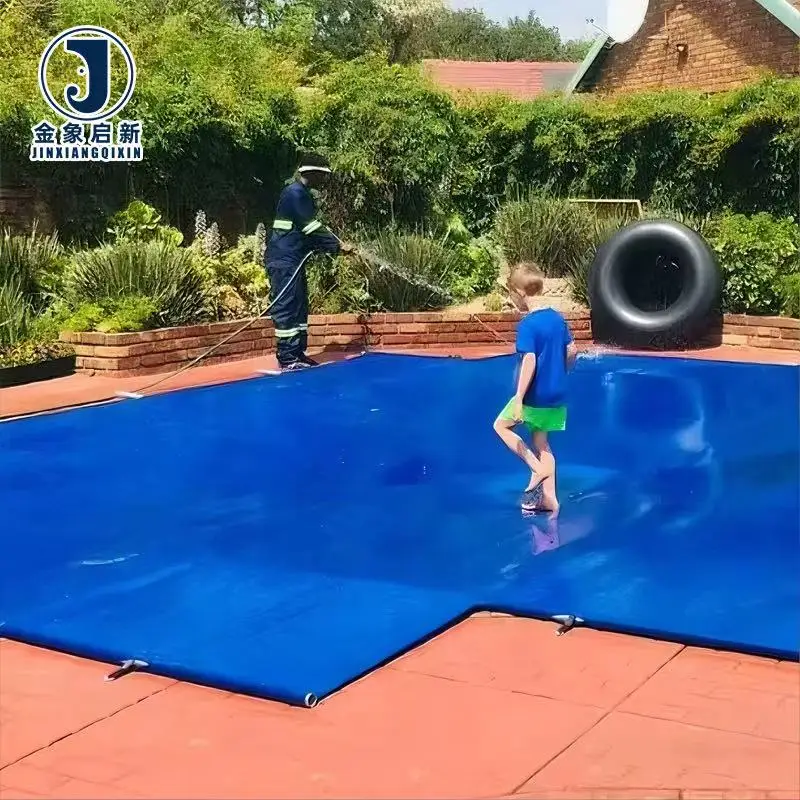
Laminated Coating Consistency — Verified GSM across every roll with pre-shipment inspection records, ensuring the PVC pool cover tarpaulin you specify is exactly what arrives at your facility.
Technical Specifications
| Parameter | Value |
|---|---|
| Product Type | PVC Tarpaulin Pool Cover |
| Material | PVC + High-strength polyester mesh fabric |
| Coating Method | Laminated technology & Hot-melt coating technology |
| Weight (GSM) | 350gsm / 420gsm / 500gsm / 550gsm / 600gsm / 750gsm |
| Thickness | 0.32mm / 0.35mm / 0.4mm / 0.45mm / 0.5mm / 0.65mm |
| Roll Size | 2m width 75m length / 2.1m width 50m length |
| Color | Blue / Red / Yellow / Light blue / Grey (Customized) |
| Key Features | Waterproof, sunproof, anti-mildew, cold crack resistance, outstanding tearing strength for welding, best color fastness |
| Special Treatments | Flame retardant, anti-static, anti-cold, anti-mildew, 3P (confirm grade required for your market) |
Application Suitability
| Application | Exposure & Requirement |
|---|---|
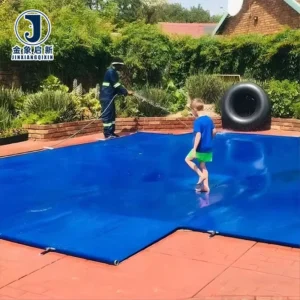
| Swimming pool covers | Continuous UV exposure, water evaporation control, debris exclusion, tension from ratchet or hook systems |
| Fish tank and aquaculture pond liners | Permanent water contact, biological growth resistance, puncture risk from substrate |
| Water containment structures | Outdoor weathering, thermal cycling, secure edge anchoring on irregular contours |
| Tent and awning adjacent structures | Wind load, UV degradation, colour matching with adjacent fabric panels |
Why "Sunproof" Needs a Test Report Before You Commit
A PVC pool cover tarpaulin claiming sun protection without documented UV test data leaves buyers exposed to premature colour shift and surface chalking. The term "sunproof" on a quotation does not guarantee that the material will retain its tensile properties or appearance after consecutive seasons of direct solar exposure.
Facility operators managing multiple pools or transport contractors covering water containment structures often discover inconsistency only after installation, when one section degrades noticeably faster than another from the same purchase order [NEED_CITE: tensile and tear test methods for coated fabrics per ISO 1421]. Requesting the specific UV treatment test basis before bulk commitment is the only reliable way to verify that the anti-UV claim matches the actual chemical formulation applied during coating.
How Transport and Fleet Operators Use Pool-Grade PVC Fabric
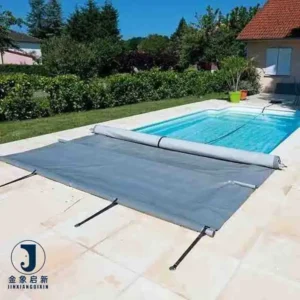
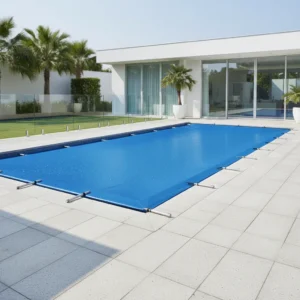
Transport and fleet operators sourcing covers for water containment trailers or mobile reservoir structures specify this PVC pool cover tarpaulin because the laminated construction on high-tenacity polyester mesh delivers the tear resistance needed at anchor points. When a cover is tensioned over a rectangular steel frame using aluminium bars and ratchets, the stress concentrates at the hem and eyelet line. The hot-melt coating process creates strong adhesion between the PVC layers and the base fabric, which prevents delamination at these critical flex zones during transit and repeated deployment.
Securing Covers to Irregular Pool and Structure Contours
Custom-shaped pools and non-standard containment structures require covers cut to exact dimensions rather than generic rectangles. This PVC pool cover tarpaulin is supplied either as inventory rolls for on-site fabrication or as pre-cut finished panels with hems reinforced for the specific tensioning hardware being used. A hook system suits irregular freeform contours where edge tension varies around the perimeter, while aluminium bar and ratchet tensioning works best on larger rectangular installations where uniform tension across the full span prevents water pooling on the cover surface [NEED_CITE: DIN 4102 fire classification for building materials].
Reading GSM in Context with Base Fabric Construction
The available weight range from 350gsm through 750gsm does not operate in isolation — each grade pairs with a specific base fabric denier and weave density that together determine tensile and tear performance. A 500gsm sheet built on a dense 1000-denier mesh will resist tear propagation differently than a 500gsm sheet on a lighter base. Laminated coating with hot-melt technology bonds the PVC to both sides of the polyester mesh simultaneously, producing higher peel strength than knife-over-edge methods at equivalent weight. This matters directly when the cover is heat-welded at seams, because the weld strength depends on the coating’s ability to re-flow and fuse without the base fabric delaminating under thermal pressure.
What Happens When Colour Drifts Between Rolls on the Same Site
Installing multiple covers side by side at a commercial pool complex or across a fleet of water transport trailers makes batch colour inconsistency immediately visible once panels are adjacent. A light blue cover from one roll placed next to a light blue cover from a different production batch can show a perceptible hue shift that triggers rejection at handover [NEED_CITE: ISO 9001 quality management system requirements for coated textile production]. This forces re-ordering of entire sections, delays project timelines and damages installer credibility with the end client. Verifying batch colour consistency through pre-shipment inspection records before dispatch prevents this outcome at the source rather than on site.
What Distinguishes This Supply Capability
Dedicated QA/QC inspection at every production stage means GSM is measured and recorded per roll, not averaged across a production run and assumed. The 10-person R&D team develops custom colour samples and cut-to-contour specifications within days, allowing buyers to approve material before committing to bulk. Three full production lines and 36 sets of professional equipment support volume orders with consistent delivery scheduling. Nearly three decades of focused experience in coated fabric manufacturing provides process control over coating weight, adhesion strength and colour formulation that translates directly into repeatable product across orders.
Documentation & Verification
- Material specification sheet stating GSM, base fabric denier, coating method and colour reference per roll
- Test reports for UV resistance and flame retardant grades where applicable to stated treatment
- Weight verification per roll against the quoted GSM documented before dispatch
- Pre-shipment inspection record with photographic evidence of roll condition and labelling
- Roll packing list with piece count, dimensions and gross weight for customs clearance
- Certificate of origin and ISO and CE certification documentation included with shipment
Fabrication, Handling & Storage
- Heat-weld seams at temperatures matched to the specific GSM grade to avoid delamination at the polyester mesh interface
- Reinforce hem lines with additional PVC strip layering before inserting eyelets to distribute anchor point loads
- Store rolls horizontally on pallets to prevent permanent creasing across the 2m or 2.1m width
- Unroll cold-stored fabric and allow it to reach ambient temperature before fabrication to avoid cracking at the fold line
- Use non-abrasive cleaners only to protect the surface coating finish and maintain colour fastness
- Lay flat or loosely re-roll finished covers for transport to prevent compression marks on the laminated surface
Requesting a Specification Match
Provide your pool or containment structure dimensions, the tensioning system in use, and the target market for the installation so that the correct GSM grade and treatment package can be recommended. Specify whether you require rolls for on-site fabrication or finished cut panels with hem reinforcement. Confirm the colour reference and whether multiple covers will be installed side by side, so batch consistency can be managed from production scheduling. Request a sample for approval before bulk order confirmation when custom colour or non-standard sizing is involved.
Frequently Asked Questions
Q: How is GSM verified on arrival to ensure the cover matches the quotation?
A: Each roll is weighed and measured during pre-shipment inspection, with the recorded GSM documented against the material specification sheet. This record accompanies the dispatch so you can cross-reference on arrival. If weight falls outside tolerance, the inspection flag is raised before the shipment leaves the facility.
Q: What is the difference between hook system and aluminium bar tensioning?
A: Hook systems suit irregular contours where edge tension must vary around the perimeter to follow the pool shape. Aluminium bar and ratchet tensioning suits larger rectangular installations where uniform tension across the full span is required. Specify your structure shape and dimensions so the correct hem reinforcement can be fabricated.
Q: How is batch colour consistency maintained across multiple covers?
A: Covers for the same site are scheduled within a single production run using the same coating formulation batch. Colour reference is verified during in-process QA checks, and pre-shipment inspection confirms visual consistency across all rolls before packing. This prevents the hue shift that becomes visible when panels are installed adjacent to each other.
Q: What UV treatment documentation is available for outdoor pool exposure?
A: Anti-UV treatment is available with test reports provided where applicable. Request the specific test basis for your market’s compliance requirements during the inquiry stage so that the correct formulation is applied and documented before production begins.
Q: Can the cover be cut to a custom non-rectangular pool shape?
A: Yes, custom contour cutting is available with hem reinforcement specified to match the tensioning hardware at each anchor point. Provide pool dimensions or a template drawing, and a sample will be developed within days for fitment approval before bulk production is scheduled.