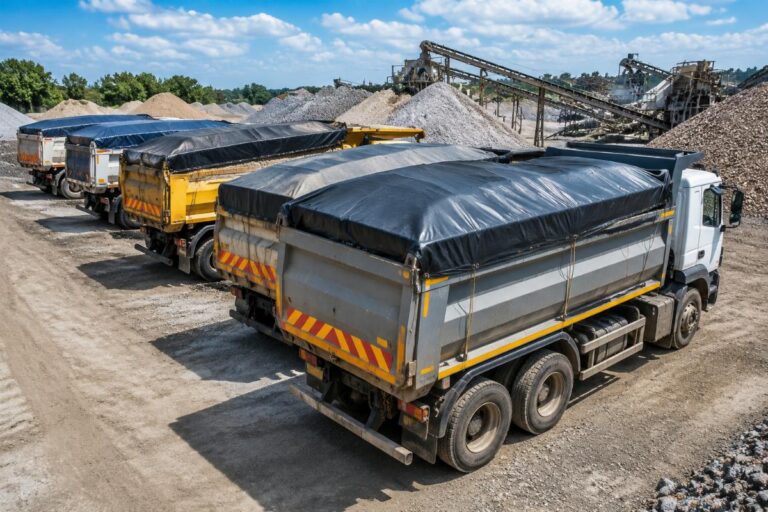
PVC Tarpaulin Supplier for Bangladesh: China Factory Direct
Higher gram weight does not automatically mean longer service life in tropical climates.
When sourcing a PVC tarpaulin supplier for Bangladesh, buyers must match UV stabilizer concentration, base fabric weave density, and coating adhesion to the local monsoon climate rather than simply specifying the highest GSM available. A factory-direct supplier from China who understands South Asian weather patterns can adjust these parameters at the production stage, preventing premature cracking, delamination, and mildew that plague off-the-shelf rolls.
I still remember a container that nearly got returned at Chittagong port. A Dhaka-based trader had ordered a full load of standard truck-cover fabric, and within weeks of the monsoon season, the material started splitting along fold lines. The complaint was about tear strength, but the real culprit was coating adhesion breaking down under continuous UV exposure and humidity cycling. We had quoted a conventional specification without asking enough about the end-use environment. Since then, every inquiry from South Asia gets a detailed conversation about terminal application and local climate before any spec sheet goes out. [NEED_CITE: tropical monsoon climate impact on polymer-coated textile degradation mechanisms]
Let me walk through the key decisions that separate a successful import from a costly lesson.
What Special Demands Does the Bangladesh Climate Place on PVC Tarpaulins?
The combination of high humidity, intense ultraviolet radiation, and prolonged monsoon rainfall demands custom anti-UV formulations and mildew-resistant coatings that go beyond standard export specifications.
Bangladesh sits in a subtropical monsoon zone where relative humidity regularly stays above eighty percent for months, and dry-season UV indices reach extreme levels. For any PVC tarpaulin supplier for Bangladesh, this means the material faces three simultaneous stressors: photodegradation from unfiltered sunlight, hydrolytic breakdown from constant moisture, and biological attack from mold spores thriving in warm, damp conditions.
| Environmental Stressor | Effect on Standard PVC Coating | Required Material Response |
|---|---|---|
| Prolonged UV exposure | Surface chalking, embrittlement | Controlled UV absorber dosage |
| High humidity cycling | Coating delamination from base fabric | Enhanced adhesion promotion |
| Monsoon rainfall | Water ingress at seam and fold zones | Robust weld-line integrity |
| Warm damp storage | Mildew growth on fabric surface | Biocide integration in topcoat |
[NEED_CITE: ISO 4892 accelerated weathering test methodology for coated fabrics]
A buyer from Khulna once told me his previous supplier’s tarpaulins turned chalky and stiff within a single dry season. The material had been produced for a temperate-market client and simply repurposed for his order. The UV stabilizer package was adequate for European sunlight hours but completely insufficient for South Asian exposure. When we reformulated with a higher concentration of hindered amine light stabilizers and adjusted the titanium dioxide ratio in the topcoat, the same base fabric lasted substantially longer under identical conditions.
The takeaway is straightforward: a PVC tarpaulin supplier for Bangladesh who does not ask about your specific city and application is not a supplier worth working with.
How Do You Match GSM and Coating Process to the Actual End Use?
Truck covers, aquaculture liners, and construction site protection each require a different combination of base fabric density, coating weight, and lamination approach — and no single specification covers all three.
This is where the “higher GSM equals better quality” assumption causes the most damage. The real performance drivers are the polyester yarn denier and weave count in the base fabric, plus whether the coating is applied through a knife-over-roll process or a calendering line. Knife coating allows precise control of coating thickness on each side and produces superior adhesion, while calendering is faster and cheaper but leaves the coating more vulnerable to peeling under stress.
| Application | Base Fabric Density | Coating Process | Anti-UV Requirement | Flame Retardancy |
|---|---|---|---|---|
| Truck cover tarpaulin | High-density plain weave | Knife-over-roll | Controlled UV absorber dosage | Optional per transport route |
| Aquaculture pond liner | Reinforced scrim structure | Knife-over-roll double-side | Substantially extended UV endurance | Not required |
| Construction site cover | Medium-density weave | Calendering or knife | Standard UV package | Certified flame-retardant grade |
[NEED_CITE: knife-over-roll versus calendering coating adhesion comparison for flexible fabrics]
Consider a shrimp farm operator in Cox’s Bazar who needed pond liners resistant to saltwater and constant sun exposure. His previous liner had cracked within a couple of seasons. The issue was not the gram weight — it was the absence of a proper UV stabilizer package and a single-side coating that allowed moisture to penetrate the uncoated side and degrade the scrim from within. Switching to a double-side knife-coated liner with reinforced scrim solved the problem completely, even though the total GSM increase was modest.
On the construction side, a project supplier in Dhaka needed flame-retardant covers for welding zones. The critical spec was not waterproofing but achieving a recognized fire-resistance classification while maintaining enough flexibility to be draped over scaffolding. We adjusted the coating formulation with a halogen-free retardant system and kept the fabric pliable enough for manual handling.
What Advantages Does a China Factory-Direct PVC Tarpaulin Supplier for Bangladesh Offer Over Trading Companies?
Direct factory sourcing unlocks parameter customization, flexible minimum order quantities, and complete export documentation — advantages that trading intermediaries structurally cannot match.
When you buy through a trading company, the specification sheet is usually fixed. They order what the factory produces in bulk and resell it with a margin. If your market needs a non-standard width, a specific color match, or a modified UV package, the trader has to negotiate with the factory on your behalf — and the factory may not accommodate a small deviation for a single container.
Working directly with a manufacturer in Shandong changes the equation. Production lines can be adjusted for custom roll widths to reduce on-site waste, coating formulations can be tweaked for regional climate conditions, and color matching can be done against physical Pantone references rather than digital approximations. The factory also controls the full documentation chain: bill of lading, certificate of origin, test reports from recognized laboratories, and any pre-shipment inspection certificates required by Bangladesh customs.
[NEED_CITE: Bangladesh import documentation requirements for textile and coated fabric products]
A recurring issue I see with trader-sourced shipments is inconsistent roll-to-roll quality. One roll in a container may come from a different production batch with slightly different coating viscosity, leading to visible color variation or uneven thickness. A factory running a dedicated production run for your order eliminates this variability entirely.
Another practical advantage is MOQ flexibility. A new buyer testing the market may need only a partial container of mixed specifications. A factory can consolidate different GSM grades and colors into one shipment, while a trader typically requires full-batch purchases. For an established PVC tarpaulin supplier for Bangladesh with repeat orders, the factory can also hold semi-finished base fabric in stock and coat to order, reducing lead times for restocking.
Which Technical Parameters and Test Certifications Must Be Confirmed Before Placing an Order?
Tear strength, UV weathering hours, flame-retardant classification, and coating adhesion test results are non-negotiable — and every claim must be backed by a verifiable third-party report.
Too many buyers accept the supplier’s in-house test data at face value. I have seen specification sheets listing impressive numbers that bore no resemblance to the material actually shipped. The only reliable safeguard is requiring test reports from internationally recognized laboratories, with report numbers that can be independently verified.
Here is the minimum documentation checklist for any serious order:
- Tear strength test — conducted per the relevant ISO standard, reporting both warp and weft directions. The base fabric weave density matters more than total GSM here. [NEED_CITE: ISO tear strength testing standard for coated industrial fabrics]
- UV accelerated weathering — the report should state the test standard used, total exposure hours, and the evaluation criteria for color retention and mechanical property retention.
- Flame retardancy — if your application requires it, confirm the specific classification standard and whether the rating applies to the coated fabric as a whole, not just the base textile.
- Coating adhesion — peel strength testing reveals whether the coating will separate from the scrim under real-world flexing and temperature cycling.
- Waterproofness — hydrostatic pressure testing confirms the coating is continuous and pinhole-free.
[NEED_CITE: third-party laboratory certification types accepted in Bangladesh import market]
A buyer in Chattogram once showed me a test report from his previous supplier that listed UV resistance in vague terms without specifying the test method or exposure duration. When we ran the same material through an accredited lab, the results told a very different story. The lesson was expensive but clear: if a PVC tarpaulin supplier for Bangladesh cannot produce verifiable test reports for every claim, walk away.
Conclusion
Sourcing PVC tarpaulin from China for the Bangladesh market requires climate-matched specifications, not just competitive pricing.
A reliable PVC tarpaulin supplier for Bangladesh must understand the interplay of UV intensity, humidity, and monsoon rainfall, and translate that understanding into measurable material parameters. Factory-direct sourcing from an experienced Shandong manufacturer ensures those parameters are built into the product from the coating line, not patched on after the fact. Verify every technical claim with independent test reports, and the material will perform in the field the way it performs in the lab.