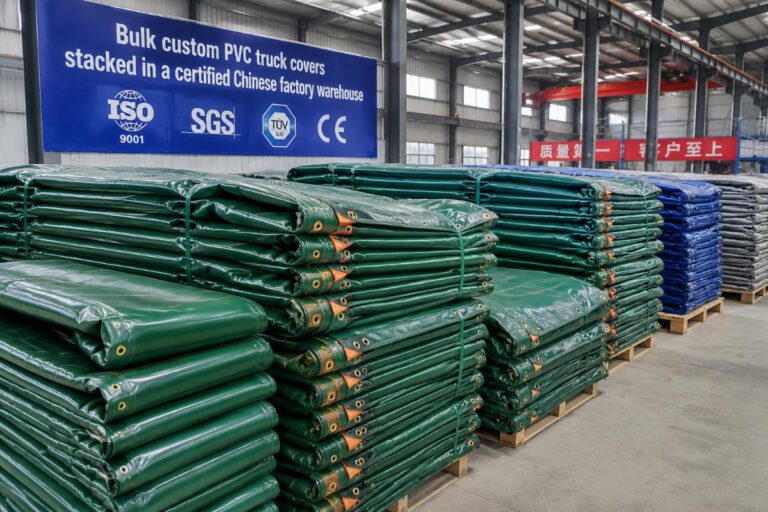
Wholesale PVC Tarpaulin for Chile Agricultural Distributors
Higher GSM does not guarantee survival in the Atacama Desert.
For agricultural distributors sourcing wholesale PVC tarpaulin for Chile, the critical specification is not fabric weight but UV stabilization level. Standard 440gsm tarps with Level 4 UV resistance will fail within two seasons in northern Chile due to extreme solar radiation. To prevent premature cracking and warranty claims, distributors must specify Level 6+ anti-UV masterbatch and double-sided coating structures, regardless of the base GSM.
Walking through the exhibition halls in Hanover, I often see buyers fixated on thickness gauges, ignoring the chemical composition that actually determines lifespan. A Chilean agricultural distributor once showed me a sample from a previous supplier. It was a heavy 440gsm sheet, yet it crumbled in his hands like dry parchment. The failure occurred in the edge regions of the Atacama, where solar intensity is among the highest globally. The root cause was not mechanical wear but photo-degradation. The manufacturer had used standard stabilizers suitable for European climates, not the specialized formulation required for high-altitude South American agriculture. This mismatch between material science and local environmental stress is the most common pitfall in this sector. [NEED_CITE: correlation between latitude/altitude and UV degradation rates in polymer materials]
Understanding this distinction transforms how you evaluate PVC Tarpaulin Wholesale Chile Agriculture opportunities. It shifts the conversation from price-per-square-meter to cost-per-season. When you align your specifications with the specific microclimates of Chile, you reduce after-sales friction and build long-term trust with farm cooperatives.
Why Do Standard PVC Tarps Fail in Chile’s Agricultural Zones?
The assumption that waterproofing equals durability is dangerous in high-radiation zones. Chile presents a unique challenge because its agricultural regions span extreme climatic variations, from the hyper-arid north to the rainy south. Standard global PVC formulations are often designed for moderate UV exposure. When these materials are deployed in northern Chile, the polymer chains break down rapidly.
The primary enemy is ultraviolet radiation, which attacks the plasticizers and stabilizers in the PVC matrix. Without adequate protection, the material loses flexibility, leading to micro-cracks that expand under wind load. [NEED_CITE: mechanisms of polymer degradation under xenon arc testing] Many suppliers claim their products are "UV resistant," but this term is unregulated. A basic additive might offer six months of protection, while a high-grade masterbatch can extend life to five years or more.
In the northern desert farms, the combination of intense sun and dry air accelerates this process. I have seen cases where standard tarps became brittle enough to shatter upon folding after just one harvest season. This is not a manufacturing defect in the traditional sense; it is a specification error. The material was built for a different environment. For distributors, recognizing this means moving beyond generic product catalogs. You need to verify the specific UV stabilization level. If a supplier cannot provide data on their anti-UV masterbatch grade, the risk of failure is high.
When sourcing PVC Tarpaulin Wholesale Chile Agriculture solutions, ask for the specific UV resistance rating. Look for certifications that reference extended xenon arc testing hours. This data point is more valuable than the fabric weight when predicting longevity in the north.
Key Specifications for Agricultural Durability: Beyond GSM
Weight is a measure of material quantity, not quality. A heavier tarp can still fail if the coating adhesion is poor or the UV stabilizers are insufficient. To select the right product, you must evaluate three core parameters: UV stabilization level, coating structure, and tensile strength.
| Specification Factor | Standard Global Offer | Recommended for Chile North | Recommended for Chile Central/South |
|---|---|---|---|
| UV Stabilization Level | Basic (Level 3-4) | High (Level 6+) | Moderate to High (Level 5-6) |
| Coating Structure | Single-side or weak bond | Double-sided, high adhesion | Double-sided with anti-mildew |
| Tensile Strength Focus | General purpose | High tear resistance | Balanced strength and flexibility |
| Additives | None or basic | Advanced anti-oxidants | Anti-mildew and anti-fungal |
[NEED_CITE: industry standards for PVC coating adhesion strength testing]
The table above illustrates why a one-size-fits-all approach fails. In the north, the UV level is the non-negotiable factor. In the central valley, where silage storage is common, the mechanical stress from wind and handling requires high tear resistance. Here, a 650-800gsm range with robust tensile properties is ideal. In the south, moisture is the main threat. Anti-mildew additives become essential to prevent fungal growth on the tarp surface, which can degrade the material and contaminate stored goods.
A common mistake is assuming single-side coating is sufficient. In reality, double-sided coating prevents delamination. When the outer layer degrades slightly, the inner layer remains protected, extending the service life significantly. This structural integrity is crucial for PVC Tarpaulin Wholesale Chile Agriculture buyers who need reliable performance over multiple seasons.
By focusing on these technical details, you move away from commodity trading and into value-added distribution. You are not just selling a cover; you are selling a solution tailored to the local environment.
Selecting the Right Tarp for Your Crop: Silage vs. Grain vs. Pond Liners
Different agricultural applications impose different stresses on the material. Understanding these nuances helps you recommend the correct product to your clients.
Silage covers face high mechanical stress. They are dragged over rough ground, exposed to sharp stubble, and subjected to constant tension from wind. For this application, prioritize tear resistance and puncture proofing. A heavier fabric in the 800gsm range with reinforced eyelets is often necessary. The coating must remain flexible in cooler temperatures to prevent cracking during winter storage.
Grain storage tarps, on the other hand, require breathability control and moisture barrier integrity. While waterproofing is key, the material must also resist abrasion from the grain itself if used for lining. Here, a smooth, double-sided coating helps prevent grain damage and ensures easy cleaning. Anti-static properties can also be beneficial to reduce dust accumulation.
Pond liners serve a completely different function. They must be impermeable and resistant to biological growth. Food-safe certification is often required if the water is used for irrigation or livestock. In this case, the focus shifts to chemical stability and resistance to algae and roots. A specialized geomembrane or heavy-duty PVC liner with anti-root additives is the standard choice.
Matching the product to the application reduces waste and improves efficiency. When you discuss PVC Tarpaulin Wholesale Chile Agriculture options with clients, ask about their specific use case. This simple question demonstrates expertise and helps avoid mismatched sales.
How to Verify Supplier Quality Before Bulk Ordering
Verification is the final step in mitigating risk. Do not rely solely on datasheets provided by the manufacturer. Request independent test reports, particularly for UV resistance and coating adhesion. Xenon arc test results should correlate with real-world exposure years. [NEED_CITE: conversion factors between xenon arc testing hours and real-world outdoor exposure]
Ask for physical samples of the coating adhesion. Perform a simple peel test. If the coating separates easily from the mesh, the bond is weak. This weakness will lead to delamination under stress, especially in windy conditions. Check the consistency of the weave. Irregularities can create weak points that fail under tension.
Verify the supplier’s ability to customize. Can they adjust the UV masterbatch level? Can they add specific anti-mildew agents? Flexibility in production indicates a manufacturer with technical control over their process, rather than one simply assembling generic components.
For distributors looking to test new specifications, working with a manufacturer that offers flexible minimum order quantities allows for low-risk trials. This approach enables you to validate performance in the field before committing to large volumes. It is a prudent strategy for entering new segments or introducing upgraded products to your client base.
Conclusion
Durability in Chile’s agricultural sector is defined by chemical stability, not just physical thickness.
Standard PVC tarps fail in high-UV zones because they lack adequate stabilization. By prioritizing UV levels, double-sided coatings, and application-specific features, distributors can offer superior solutions. This technical alignment reduces warranty claims and builds lasting partnerships with farmers. Sourcing PVC Tarpaulin Wholesale Chile Agriculture products with these criteria ensures long-term reliability and customer satisfaction.