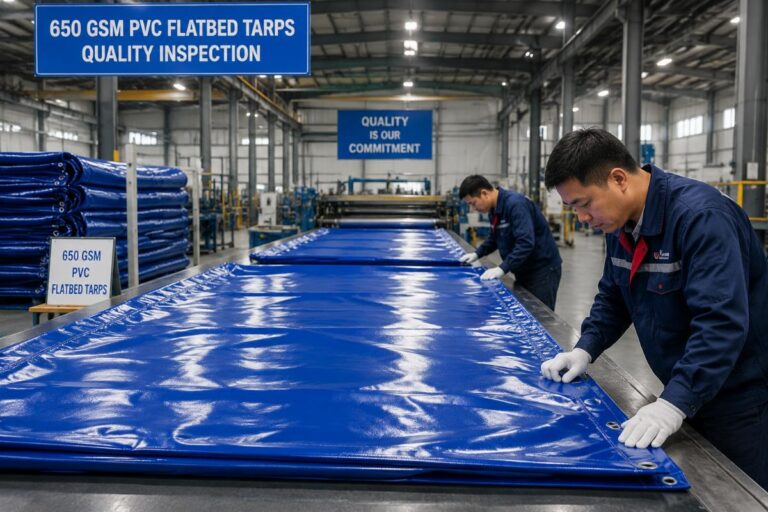
Buy Truck Cover Wholesale Supplier China Factory Direct
Higher gram weight does not automatically mean longer service life—the coating formula and base fabric density determine anti-aging performance far more than raw thickness.
When sourcing from a truck cover wholesale supplier in China, the real decision is not about the lowest price per square meter. It is about verifying the anti-UV additive package, the heat-welding parameters, and the seam construction method to ensure the cover survives extreme heat, heavy abrasion, and prolonged rainfall without premature failure.
I still remember standing at Qingdao Port years ago, watching a full container of PE truck covers get rejected. The shipment was bound for West Africa, and within a few months under the Lagos sun, the stitched edges had turned brittle and cracked open. The entire order came back. That failure was not caused by low gram weight—the fabric itself was thick enough. The problem was the absence of proper UV stabilizers and the reliance on pure stitching without heat-sealed seams. Since then, I have visited transport fleets in Dubai, checked tarpaulin performance at mining sites in Central Asia, and walked through production lines in Shandong to understand what actually separates a cover that lasts from one that falls apart. The pattern is always the same: coating chemistry and joining工艺 matter far more than the spec sheet suggests. [NEED_CITE: relationship between UV stabilizer concentration and polymer degradation rate in polyethylene films]
Let me walk you through how to evaluate a truck cover wholesale supplier in China based on what actually determines field performance.
PVC vs PE: Which Truck Cover Material Fits Your Market?
The choice between PVC-coated polyester and PE laminated fabric depends on your cargo type, climate zone, and expected replacement cycle—not on which material is more expensive.
PVC truck covers use a polyester scrim coated with polyvinyl chloride on both sides. The result is a fabric with high tensile strength, excellent tear resistance, and strong resistance to chemicals and abrasion. PE truck covers are made from woven polyethylene strips laminated with LDPE film on both sides. They are lighter, more flexible, and significantly cheaper per square meter.
| Parameter | PVC-Coated Polyester | PE Laminated Fabric |
|---|---|---|
| Base Fabric | Polyester scrim | Woven PE tape |
| Coating / Lamination | PVC paste coating on both sides | LDPE lamination on both sides |
| Tensile Strength | High | Moderate |
| Tear Resistance | Robust | Noticeably lower under sustained load |
| Abrasion Resistance | Resistant | Vulnerable to repeated friction |
| UV Stability (with additives) | Substantially extended | Noticeably reduced without proper stabilizers |
| Weight Range | 440–1000 gsm | 60–300 gsm typical |
| Cost per Square Meter | Higher | Lower |
| Typical Service Life | Extended | Shorter, especially in high-UV zones |
[NEED_CITE: comparative weathering performance of PVC-coated polyester versus PE laminated fabrics under accelerated UV testing per ISO 4892]
A distributor in the Middle East once ordered both PVC and PE covers for a砂石运输 fleet operating out of Dubai. The PE covers were chosen for cost reasons. Within months, the constant abrasion from sand and gravel during loading and unloading caused the PE surface to wear through at stress points. The PVC covers, by contrast, showed minimal surface damage after the same period. The tear strength retention of the PVC fabric remained substantially higher. [NEED_CITE: abrasion resistance testing methods for coated industrial fabrics per ISO 5975]
In West Africa, a transport company running routes between Lagos and inland cities found that standard PE covers without UV additives became brittle and faded within a short dry season cycle. When they switched to PE covers with controlled UV stabilizer incorporation, the service life extended noticeably—even though the gram weight remained the same.
Conclusion: If your market involves heavy cargo, frequent loading, or extreme UV exposure, PVC is the reliable choice. If the covers are for light-duty, short-term, or seasonal use, PE can work—but only if the supplier incorporates proper UV stabilization. A trustworthy truck cover wholesale supplier should be able to explain the difference clearly and offer both options with transparent specifications.
How to Verify Anti-UV Performance from a China Supplier?
Do not accept a generic “anti-UV” label. Ask for the specific additive type, the incorporation method, and a third-party lab report confirming weathering test results.
Anti-UV performance in both PVC and PE tarpaulins depends on the type and dosage of UV stabilizers added during production. For PE covers, this typically involves UV masterbatch—concentrated pellets containing hindered amine light stabilizers (HALS) or benzotriazole-type absorbers—mixed into the extrusion process. For PVC covers, liquid UV absorbers are blended into the plastisol coating.
The problem is that many suppliers claim “anti-UV” without specifying what was actually added or at what ratio. Some use minimal stabilizer content just enough to pass a basic visual inspection, but insufficient for long-term exposure in equatorial or desert climates.
Here is what you should request from any truck cover wholesale supplier:
- Additive specification sheet: The exact type of UV stabilizer used (e.g., HALS, benzotriazole, benzophenone) and whether it is incorporated into the coating, the base fabric, or both.
- Dosage confirmation: The percentage of UV masterbatch or liquid stabilizer in the total formulation. Even a small variation in dosage can lead to a significant difference in service life.
- Third-party weathering test report: Accelerated weathering data per ISO 4892-2 or ASTM G154, showing retention of tensile strength and color change after a defined number of hours. [NEED_CITE: standard accelerated weathering test protocols for flexible polymeric sheeting]
- Real-world reference: Ask which markets the product has been shipped to and whether the supplier can provide feedback from buyers in high-UV regions such as the Middle East, West Africa, or Southeast Asia.
A buyer from Latin America once received a shipment of PE covers labeled “anti-UV” from a supplier. The covers looked fine on arrival. But after one rainy season followed by intense sun exposure, the fabric lost flexibility and began cracking along fold lines. Lab analysis later showed the UV stabilizer content was well below what was needed for tropical conditions. The supplier had used the cheapest masterbatch available and had no independent test data to back up the claim.
Conclusion: A reliable truck cover wholesale supplier will provide verifiable data on UV protection—not just a marketing label. At Jinxiang, for example, the anti-UV coating formula is developed with controlled stabilizer incorporation, and weathering test reports are available for buyer review. This level of transparency separates serious manufacturers from trading companies that simply resell generic stock.
Stitching vs Heat Welding: The Real Cause of Leaks and Tears
The needle holes created by stitching are the primary entry points for water infiltration and UV degradation. Heat welding eliminates this vulnerability entirely.
This is the single most misunderstood aspect of truck cover manufacturing. Many buyers assume that denser stitching means a stronger, more durable cover. The reality is the opposite: every stitch punctures the fabric, creating a microscopic channel through which water can penetrate and UV radiation can attack the base fabric directly.
In a sewing machine operation, the needle passes through the fabric at every stitch point. Even with high-quality thread and tight stitch density, these perforations remain. Over time, UV exposure degrades the thread and the surrounding fabric. Water seeps through the needle holes, especially under the pressure of wind-driven rain. The result is leakage, seam failure, and ultimately, fabric tearing along the stitch line.
Heat welding, by contrast, fuses two layers of coated fabric together using controlled temperature and pressure. No needle holes are created. The weld seam is continuous, waterproof, and maintains the same UV resistance as the rest of the fabric. The key parameters are welding temperature, pressure, and dwell time—each must be precisely controlled to ensure a strong bond without damaging the coating.
| Seam Method | Water Penetration Risk | UV Vulnerability | Long-Term Durability |
|---|---|---|---|
| Pure Stitching | Vulnerable | Vulnerable | Noticeably reduced |
| Stitching + Tape Cover | Standard | Standard | Moderate |
| Heat Welding | Resistant | Resistant | Substantially extended |
| Heat Welding + Reinforced Stitching | Resistant | Resistant | Robust |
[NEED_CITE: seam strength testing methods for heat-welded versus sewn joints in coated industrial fabrics per ISO 1427]
A fleet operator in South America experienced persistent leakage problems with their truck covers during the rainy season. The covers were stitched throughout. After switching to heat-welded seams for all critical joints—corners, edges, and overlap panels—the leakage rate dropped to near zero. The covers also showed significantly less seam degradation after prolonged sun exposure.
At Jinxiang’s production facility, heat welding is the standard method for all high-stress and waterproof seams. The welding temperature and speed are calibrated to the specific coating formulation to ensure optimal bond strength. This is not a process that can be done correctly with generic equipment—it requires experience with the specific PVC or PE compound being used.
Conclusion: If your truck cover wholesale supplier relies entirely on stitching without heat welding for critical seams, you are accepting a higher risk of leaks and premature seam failure. For any application involving heavy rain, high winds, or intense sun, heat welding is non-negotiable.
Red Flags When Sourcing Truck Covers from China
The lowest quoted price per square meter often hides compromises in coating formulation, base fabric quality, and quality control that will cost far more in returns and reputation damage.
The Chinese tarpaulin industry is vast, with hundreds of manufacturers and trading companies offering truck covers at every price point. This makes it essential to know what warning signs to watch for when evaluating a truck cover wholesale supplier.
Red Flag 1: Price significantly below market range. If a supplier’s quote is substantially lower than competitors for the same gram weight and material type, the savings almost always come from somewhere. Common corners cut include using recycled or lower-grade base fabric, reducing coating thickness below specification, or skipping UV stabilizers entirely. [NEED_CITE: common quality failure modes in low-cost PVC and PE tarpaulin production]
Red Flag 2: Vague or missing quality certifications. A serious manufacturer will have test reports for tensile strength, tear strength, waterproofing, and fire retardancy from recognized laboratories. If a supplier cannot provide these or offers only self-issued certificates, treat the specifications with skepticism.
Red Flag 3: No clear warranty or replacement policy. If the supplier avoids committing to any performance guarantee or replacement terms for defective goods, it signals a lack of confidence in their own product quality.
Red Flag 4: Inability to customize. A capable factory should be able to adjust gram weight, width, color, and finishing details to your specifications. If the supplier only offers fixed stock sizes and refuses customization, they are likely a trading company rather than a manufacturer.
Red Flag 5: Poor communication on technical details. If the supplier cannot explain the difference between their PVC and PE options, cannot describe their UV stabilization process, or does not understand the difference between stitching and heat welding, they lack the technical depth to support your business.
A distributor in Southeast Asia once sourced truck covers from a supplier offering prices well below the market average. The first shipment arrived on time and looked acceptable. But within weeks, buyers in the local market began returning covers because the coating was peeling off the base fabric. Lab testing revealed that the coating adhesion was far below acceptable levels—the manufacturer had skipped a critical priming step to save cost. The distributor faced significant losses in freight, returns, and damaged customer relationships.
Conclusion: Sourcing from a truck cover wholesale supplier in China can deliver excellent value, but only if you verify the supplier’s manufacturing capability, quality control processes, and willingness to stand behind their product. The cheapest option is rarely the most economical in the long run.
Conclusion
Buying truck covers from China is a technical sourcing decision, not just a price comparison. The coating formula, UV stabilization method, and seam construction determine whether your covers survive real-world conditions or fail within months. Verify every claim with test data, insist on heat welding for critical seams, and treat suspiciously low prices as a warning sign. A qualified truck cover wholesale supplier will welcome your technical questions and provide transparent documentation to support their product quality.