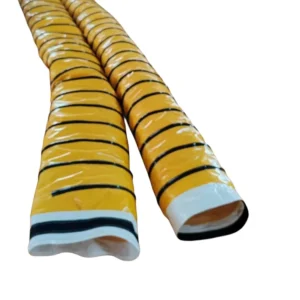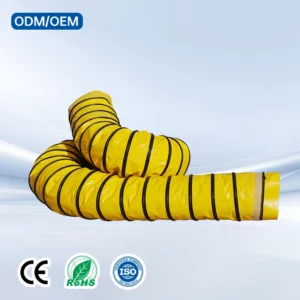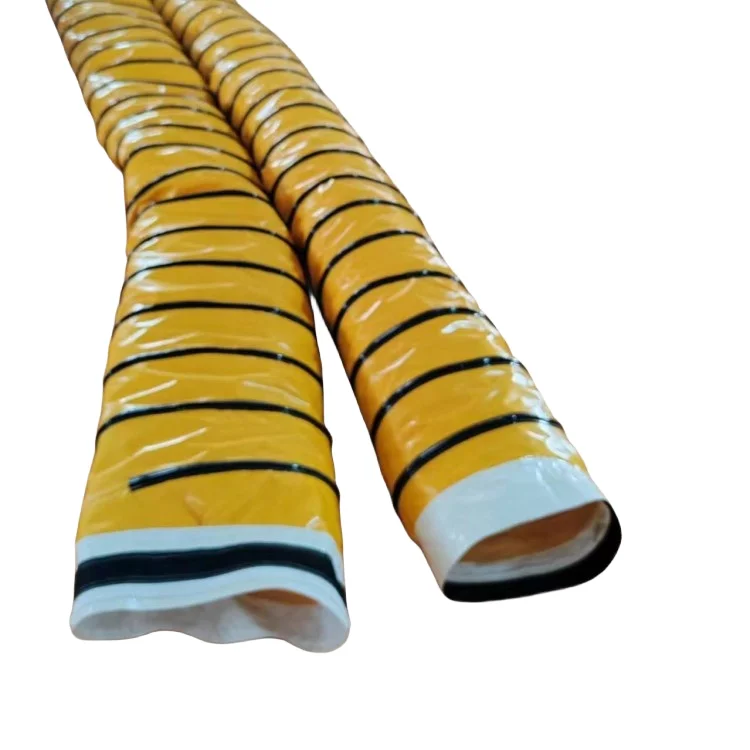
Deep Coating Process Control — we maintain strict adhesion and coating weight consistency across every meter of aviation duct fabric, verified at each production stage before assembly.
Technical Specifications
| Parameter | Value |
|---|---|
| Product Type | Aircraft PCA Air Duct |
| Inner Diameter | 12 Inch |
| Coating Material | PVC coated cloth with fabric-reinforced layer |
| Insulation Layer | Built-in aluminum foil bubble film |
| Temperature Range | -30°C to 150°C |
| Outer Layer Color | Yellow-black alternating (high visibility) |
| Connection Method | Zipper and Velcro |
| Key Features | Mildew resistance, water resistance, high tensile strength, foldable for storage |
| Flame Retardant | Available in flame retardant grades — confirm the grade required for your airport authority |
| Anti-Static | Available upon request — verify surface resistance against your apron safety protocol |
| Logo Customization MOQ | 100 units |
| Standards | ISO, CE |
Application Suitability
| Application | Exposure & Requirement |
|---|---|
| Airport apron PCA unit to aircraft cabin connection | Constant outdoor UV exposure, jet blast debris, fuel and de-icing fluid contact, rapid temperature cycling |
| Aviation maintenance temporary cabin climate control | Repeated coupling and decoupling, drag across concrete apron surfaces, tight turnaround schedules |
| Fixed-base operator fleet turnaround air supply | Prolonged sun exposure between service cycles, high-visibility safety compliance on busy ground operations |
Why Certification Gaps on the Apron Cost More Than the Duct Itself
An aviation PCA air duct without verifiable fire-retardant and anti-static documentation is a compliance liability, not a cost saving.
Ground support equipment on airport aprons operates under strict safety oversight. When a duct is deployed without the flame retardant grade or anti-static certification the site demands, the entire ground operation can be halted during an audit. We have seen operators face unexpected downtime because the duct supplier provided a generic certificate that did not match the specific airport authority requirement [NEED_CITE: IATA Airport Handling Manual ground equipment safety standards]. The Aircraft PCA Air Duct aftermarket supplier you choose must provide traceable test reports, not just a claim on the quotation.
Thermal Integrity Across the Full Operating Envelope
The built-in aluminum foil bubble film insulation layer is engineered to maintain thermal performance from -30°C to 150°C, which covers the extremes encountered on aprons ranging from arctic winter deployments to midday summer operations in desert climates. This insulation barrier prevents condensation buildup inside the duct when transmitting pre-conditioned cold air, a common failure point in single-layer ducts where moisture accumulates and promotes mildew growth. As an Aircraft PCA Air Duct aftermarket supplier, we construct each section with the insulation bonded between the inner liner and the PVC coated outer shell to prevent delamination under repeated flex cycles.
Quick-Connect Joints Built for Turnaround Pressure
Every minute an aircraft sits on the apron without conditioned air is a minute the operator pays for in passenger dissatisfaction and potential schedule delay. The zipper and Velcro modular connection system allows ground crews to couple and decouple duct sections rapidly without tools, reducing the physical effort and time required during tight turnaround windows. The high-visibility yellow-black alternating outer coloring serves a dual purpose: it marks the duct path clearly for vehicle operators navigating the apron, and it provides an immediate visual reference for crew members inspecting connection integrity before each use [NEED_CITE: airport apron ground marking and equipment visibility standards].
How Temperature Range and Insulation Layer Interact on the Apron
The -30°C to 150°C rating reflects the boundary conditions where the PVC coated fabric retains flexibility without becoming brittle at the low end, and where the coating does not soften or degrade at the high end. The aluminum foil bubble film layer works in conjunction with this range by reflecting radiant heat gain from direct sun exposure, which can raise the surface temperature of a dark-colored duct significantly above ambient. Without this reflective barrier, the PCA unit must work harder to deliver air at the target cabin temperature, increasing energy consumption on ground support equipment. The fabric-reinforced PVC layer provides the structural backbone that prevents the duct from collapsing under negative pressure or expanding unevenly under positive pressure, maintaining consistent airflow diameter throughout the connected length.
The Hidden Cost of Unverified Duct Specifications
When a duct arrives on the apron without the fire-retardant grade the airport authority requires, the operator faces a choice: ground the equipment and source a compliant replacement under time pressure, or deploy it and accept the compliance risk. Both paths carry costs that far exceed the price differential between a documented and an undocumented duct. Similarly, when the anti-static surface resistance is not verified before deployment, the duct can accumulate static charge during high-velocity airflow, creating a discharge hazard near fuel operations. We have observed situations where batch-to-batch color inconsistency on the outer layer forced an operator to replace an entire set of ducts because the mismatched sections were visually unacceptable during ramp inspections [NEED_CITE: airport ground equipment visual compliance requirements].
What We Bring to Every Duct We Build
Our 10-person R&D team handles material selection and custom sizing for duct configurations that match specific PCA unit models and aircraft interface geometries. Three full production lines with 36 sets of professional equipment support volume orders without compromising the individual inspection each duct section receives. Nearly 30 years of focused coated fabric experience means our process control over coating weight and adhesion is embedded in production, not added as a final check. Dedicated QA/QC runs at every production stage, with 100% pre-shipment inspection covering dimensional accuracy, connection joint integrity, and insulation layer continuity. Custom samples are developed within days, allowing you to verify fit and performance before committing to a production run.
Documentation & Verification
- Material specification sheet confirming PVC coating weight, base fabric denier, and aluminum foil insulation composition
- Fire-retardant test report matched to the specific grade required by your airport authority
- Anti-static surface resistance verification where mandated by apron safety protocols
- Pre-shipment inspection record covering 12-inch diameter check and zipper/Velcro joint integrity
- ISO and CE certificates supporting export documentation for international ground support equipment procurement
Fabrication, Handling & Storage
- Heat-weld all longitudinal seams using temperature settings matched to the PVC coated cloth thickness to prevent delamination at flex points
- Store folded sections in dry conditions away from direct UV to preserve the aluminum foil bubble film insulation bonding integrity
- Inspect zipper and Velcro joints after each deployment cycle for fabric fraying or hook degradation under apron abrasion
- Avoid dragging the yellow-black outer layer across unpaved surfaces to prevent coating scuff that reduces high-visibility contrast
- Clean with mild detergent only — solvents can degrade the PVC coating and compromise mildew resistance treatment
What to Include in Your Inquiry
Provide the specific PCA unit model and aircraft types you service so we can confirm the 12-inch inner diameter matches your equipment interface, or recommend an alternative size if needed. Share the fire-retardant grade and anti-static requirements mandated by your operating airport or aviation authority so we can align our test documentation before production. Indicate whether you need custom lengths, branded outer layers, or specific end-fitting configurations, along with your estimated annual volume, so we can structure the most efficient production run for your fleet.
Frequently Asked Questions
Q: What fire-retardant grade does this PCA duct carry, and does it meet airport ground equipment standards?
A: The duct is available in flame retardant grades, but the specific grade must be confirmed against your airport authority or local aviation ground equipment standard. Request the test report matched to your required classification before placing a bulk order, as different airports reference different standards such as NFPA, DIN, or local civil aviation regulations.
Q: How is the -30°C to 150°C temperature range verified?
A: This range reflects the operating boundaries where the PVC coated fabric and aluminum foil bubble film insulation maintain functional integrity. A third-party test report documenting performance across this range is available upon request. We recommend reviewing the report against your specific apron climate conditions before finalizing your specification.
Q: Can the duct length and end fitting configuration be customized to match our PCA unit model?
A: Yes. Custom lengths and end fitting configurations can be developed to match your specific PCA unit outlet and aircraft belly receptacle geometry. Provide the equipment model details and connection interface dimensions, and our R&D team will prepare a sample for fit verification before production commitment.
Q: What is the expected service interval for zipper and Velcro joints under daily apron use?
A: Service intervals depend on deployment frequency, surface abrasion conditions, and UV exposure intensity at your operating location. We recommend scheduled inspection of zipper teeth alignment and Velcro hook engagement after each use cycle. Replacement joint kits are available to extend duct service life without replacing the entire section.
Q: How do you ensure batch-to-batch color consistency on the yellow-black high-visibility outer layer?
A: Color consistency is controlled through standardized coating formulation and in-process visual inspection against reference standards at each production stage. Pre-shipment inspection includes a side-by-side comparison of rolls within the same order. Specify your color tolerance requirements at inquiry stage so we can align our QC checkpoints accordingly.