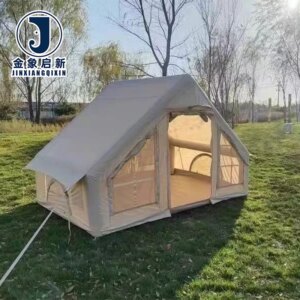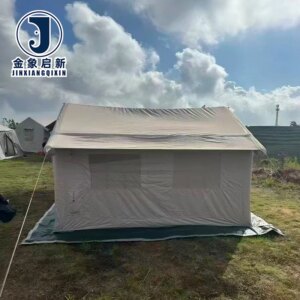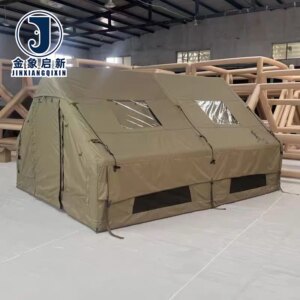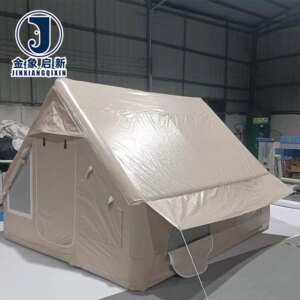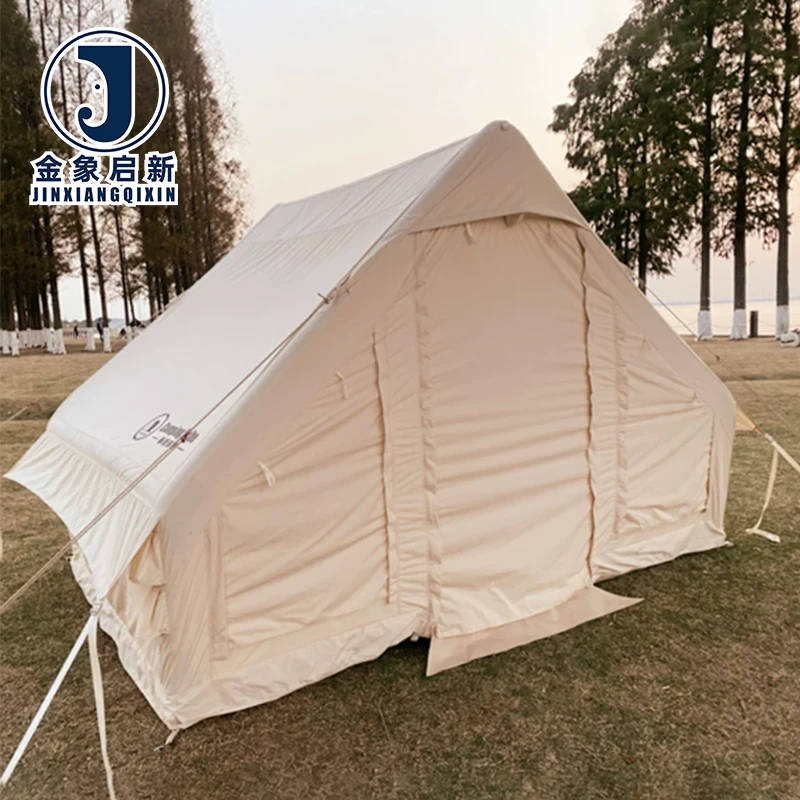
Precision Heat-Sealed Seams — Every inflatable chamber on this tent undergoes a 24-hour pressure retention test before leaving the line, catching weld defects that generic suppliers miss until the product reaches the field.
Technical Specifications
| Parameter | Value |
|---|---|
| Product Type | Inflatable Tent |
| Core Material | UV Water-resistant PVC Fabric |
| Waterproof Rating | Water column ≥ 5000mm |
| UV Protection | UPF 50+ (test basis not stated) |
| Tear Resistance | ≥ 300N per ISO 13934.2 |
| Structure | Single layer inflatable |
| Design | Extended type with separate sleeping and living areas |
| Capacity | 4-Person |
| Color | Khaki |
| Fabric Thickness Range | 0.3mm–0.8mm |
| Dimensional Accuracy | ±2cm for custom orders |
| Season Rating | 4-Season |
| Certifications | ISO 9001, ISO 14001, ISO 45001, CE |
Application Suitability
| Application | Exposure & Requirement |
|---|---|
| Construction site temporary shelters | Wind-driven rain, sustained UV exposure, repeated inflate-deflate cycles, ground abrasion |
| Emergency response field operations | Rapid deployment, all-weather resistance, modular reconfiguration, transport vibration |
| Commercial rental fleet units | High-frequency handling, variable site conditions, cross-user wear, long-term UV degradation |
| Outdoor gear manufacturing components | Integration with inflatable frame systems, material compatibility, batch-to-batch consistency |
| Agricultural storage field covers | Crop moisture exposure, UV intensity over growing seasons, puncture from equipment contact |
Why Seam Integrity Matters More Than Fabric Weight for Inflatable Shelters
A tent that holds air at the factory but loses pressure in the field is almost always a seam problem, not a fabric problem.
When buyers evaluate inflatable tent fabric, the conversation tends to start and end with material thickness or GSM. Yet field failures on inflatable structures trace back to heat-sealed joints that separate under wind load or transport vibration. The PVC-coated fabric itself may perform adequately, but the welded seam — where two panels meet under internal air pressure — represents the structural weak point [NEED_CITE: tensile and tear test methods for coated fabrics per ISO 1421]. For commercial fleets deploying inflatable camping tents for truck and transport operations or remote site shelters, a seam failure means the entire unit must be pulled from service, regardless of how well the base fabric resists UV or water.
Heat-Sealed Joints Engineered for Internal Pressure Loads
Inflatable structures place continuous outward force on every welded seam. This Inflatable Camping Tent for truck and transport applications uses heat-sealed PVC construction tested to ISO 13934.2, with tear resistance exceeding 300N at the seam line. Unlike stitched construction where thread holes create perforation points, heat sealing fuses the coating layers directly, producing a joint that matches the parent material in flexibility and air retention.
Weather Exposure Across Four Seasons in the Field
A 4-season inflatable tent faces conditions that shift rapidly — driving rain on one side, direct UV on the other, and temperature swings that expand and contract the PVC membrane. The water column rating of ≥ 5000mm addresses sustained rainfall, while the UPF 50+ UV-resistant PVC coating (available with test documentation upon request) reduces surface degradation from prolonged sunlight. For commercial buyers evaluating Inflatable Tent Fabric for commercial application, these ratings define the service window before material replacement becomes necessary.
Reading the Specification Sheet Beyond Thickness
Fabric thickness between 0.3mm and 0.8mm tells only part of the story. The base fabric denier and weave density determine how tears propagate once initiated — a tightly woven polyester scrim arrests tear spread far more effectively than a loosely woven alternative of the same thickness. Coating adhesion matters equally: if the PVC layer delaminates from the base fabric under flexing, the waterproof barrier fails even though neither layer is individually damaged. The single-layer inflatable design here relies on the bond between coating and substrate remaining intact through repeated pressurisation and folding cycles.
The Cost of Under-Specifying Inflatable Shelter Fabric
Buyers who select material based on price-per-metre alone frequently encounter problems that emerge only after deployment. Inflatable structures require airtight integrity that places different demands on PVC fabric compared to flat tarpaulins — internal pressure constantly tests the coating-substrate bond and every welded seam [NEED_CITE: DIN 4102 fire classification for building materials]. When UV treatment is claimed without supporting test data, colour fading and surface embrittlement appear within the first season, forcing rental operators to retire units prematurely. Dimensional inaccuracy above the ±2cm threshold compounds the problem: panels that do not align correctly create stress concentrations at seams, accelerating failure under wind load.
Sourcing Confidence for Commercial Inflatable Tent Procurement
Nearly 30 years of coated fabric production informs how coating weight and substrate adhesion are controlled through each production run. Three full production lines and 36 sets of professional equipment provide capacity to fulfil bulk orders for commercial rental fleets without extending lead times. A 10-person R&D team handles custom thickness selection between 0.3mm and 0.8mm, pattern development, and structural sample creation. Dedicated QA/QC staff operate across 8 critical inspection points, including 24-hour pressure retention tests on every inflatable unit before dispatch.
Documentation & Verification
- Fabric performance test report covering tear resistance per ISO 13934.2 for each batch
- Waterproof rating verification confirming water column ≥ 5000mm on sampled panels
- UV treatment documentation with test basis supporting UPF 50+ claim
- ISO 9001, ISO 14001, ISO 45001, and CE certificates included with shipment documentation
- Pre-shipment inspection record with 8-point quality checklist completed per unit
Fabrication, Handling & Storage
- Heat-seal temperature must match the PVC coating grade selected — confirm parameters before welding inflatable chamber seams
- Store rolled tent fabric on its core in dry conditions; flat-folding the 0.3mm–0.8mm PVC material creates permanent crease lines at flex points
- Clean the UV-resistant PVC surface with pH-neutral detergent only; solvent-based cleaners degrade the coating adhesion layer
- Repair field punctures with PVC-compatible adhesive patches matched to the single-layer inflatable construction thickness
- Maintain minimum 15cm seam overlap when welding panels for custom-size inflatable shelters to distribute internal pressure loads
Requesting a Sample or Production Quote
Provide your target deployment environment — climate zone, expected UV exposure duration, and frequency of inflate-deflate cycles. Specify the fabric thickness within the 0.3mm–0.8mm range and confirm whether custom dimensions or standard 4-person sizing meets your requirement. If the inflatable camping tent is destined for a market with specific compliance requirements, note those standards at the inquiry stage so that test documentation is prepared alongside production.
Frequently Asked Questions
Q: What customization options are available for dimensions, fabric thickness, and printing?
A: Fabric thickness is adjustable between 0.3mm and 0.8mm to match durability requirements. Custom dimensions are produced with dimensional accuracy within ±2cm. OEM and ODM services include sample customization and pattern printing, with the 10-person R&D team developing prototypes within days for approval before mass production begins.
Q: How is seam strength and airtightness verified before shipment?
A: Every unit undergoes a 24-hour pressure retention test as part of the 8-point inspection process. Heat-sealed seams are verified against the ISO 13934.2 standard for tear resistance exceeding 300N. Dedicated QA and QC staff inspect coating adhesion at weld lines and confirm airtight integrity across all inflatable chambers before packaging.
Q: What UV-resistance test basis supports the UPF 50+ claim for outdoor longevity?
A: The PVC fabric carries a UPF 50+ UV treatment rating. Test basis documentation is available upon request to support compliance audits and buyer verification. Commercial buyers sourcing Inflatable Tent Fabric for commercial application should request the specific test report to confirm suitability for their target market’s exposure conditions.
Q: What certifications and documentation accompany each batch for compliance audits?
A: Each shipment includes ISO 9001, ISO 14001, ISO 45001, and CE documentation alongside a comprehensive quality inspection report. The report covers fabric performance data, seam strength records, and airtightness verification results. Material specification sheets stating coating details and colour reference are also provided for batch traceability.
Q: What is the sample approval and production lead time process for custom orders?
A: Pre-production samples are developed within 7–10 days for material and structural verification. Once the sample is approved, mass production proceeds with in-process quality checks across all 3 production lines. Buyers are advised to confirm thickness, dimensions, and compliance requirements at the sample stage to avoid adjustments during production.