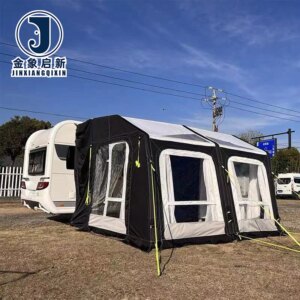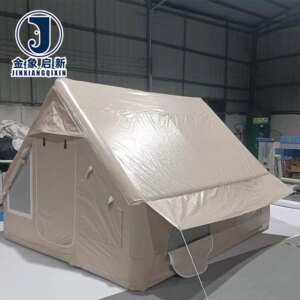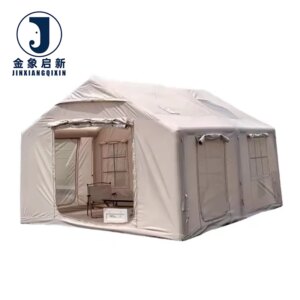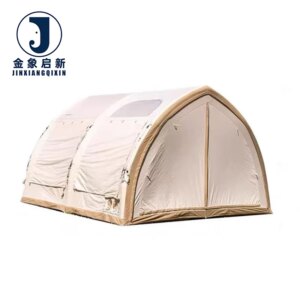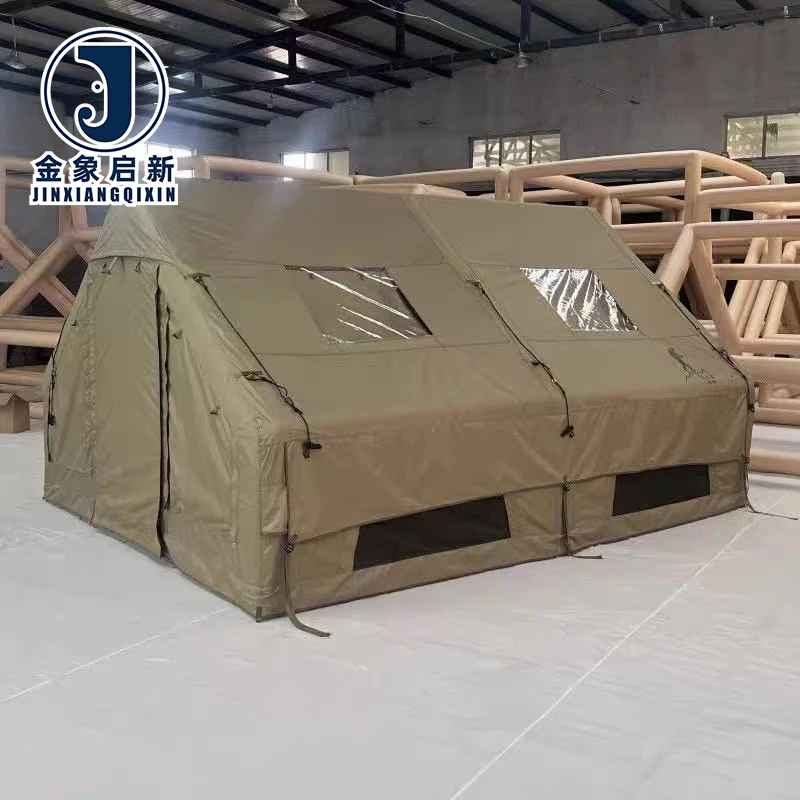
Full-process QA at every production stage — each roll of PVC inflatable tent fabric undergoes 100% pre-shipment inspection with traceable batch records, eliminating the material variation that causes warranty claims in commercial outdoor gear lines.
Technical Specifications
| Parameter | Value |
|---|---|
| Product Type | Inflatable Tent |
| Core Material | PVC Tarpaulin |
| Key Performance | Waterproof, UV-resistant (test basis not stated), Tear-resistant (standard not stated) |
| Capacity | 4-6 Person |
| Opening Mechanism | Quick Automatic Opening |
| Product Forms | Inflatable structure |
| Customization | OEM & ODM, sample customization, pattern printing available |
| Production Lines | 3 full production lines |
| Processing Equipment | 36 sets of professional equipment |
| R&D Support | 10 technicians |
| Certifications | ISO9001, ISO14001, ISO45001, CE |
Application Suitability
| Application | Exposure & Requirement |
|---|---|
| Commercial camping equipment manufacturing | Repeated inflation cycles, flexing at seam joints, transport abrasion during distribution |
| Outdoor activity group accommodation | Prolonged sun exposure, rain and wind loading, frequent setup and takedown by non-specialist crews |
| Industrial event and festival supply | High foot traffic around base, UV degradation over multi-day events, rapid deployment requirement |
| Camping equipment wholesale product lines | Batch consistency across seasonal orders, shelf-ready branding, end-user warranty support |
Why Inflatable Tent Fabric Consistency Matters More Than Quoted GSM Alone
Stated GSM on the quotation does not guarantee the coating weight and adhesion your inflatable tent production line actually receives.
Inflatable structures depend on uniform air-holding performance across every panel. When coating weight drifts between batches, some panels stretch more than others under internal pressure, creating uneven stress distribution that shows up as premature seam separation or valve-area failure. Commercial outdoor gear manufacturers absorb the cost of these field failures through warranty replacements and brand damage. The Inflatable Tent Fabric for Truck and Transport market is particularly sensitive to this because fleet operators expect tent structures to deploy identically every time [NEED_CITE: tensile and tear test methods for coated fabrics per ISO 1421].
Coating Adhesion and Inflatable Structural Integrity
The defining requirement for any Inflatable Tent for Commercial Outdoor Gear is that the coating stays bonded to the base fabric through repeated inflation and deflation cycles. Each cycle flexes the PVC layer against the woven substrate, and any weakness in adhesion propagates as delamination at fold lines and valve cut-outs. Our 36 sets of processing equipment allow precise control over coating temperature and pressure during lamination, which directly governs the peel strength between layers. This control is what separates material that survives hundreds of deployment cycles from material that begins separating after one season.
Panel Seam Behaviour Under Internal Pressure
Inflatable tent panels carry constant internal pressure, meaning every welded seam operates under sustained load rather than the intermittent stress seen in conventional tents. The Inflatable Tent Fabric for Truck and Transport application requires seams that match or exceed the base fabric strength. Heat-welded joints on PVC tarpaulin depend on compatible coating chemistry and correct welding temperature windows. Our R&D team of 10 technicians develops welding parameter recommendations matched to the specific material grade, so fabricators avoid the common failure mode where seams part before the fabric itself reaches its tear limit [NEED_CITE: weld strength testing protocols for coated technical textiles].
Understanding What the Specifications Actually Mean for Your Production
Waterproof performance in PVC tarpaulin comes from the continuous coating layer that fully encapsulates the base fabric, leaving no exposed fibre paths for moisture ingress. Tear resistance is governed not by coating thickness alone but by the base fabric denier and weave density — a heavier coating on a loosely woven substrate will crack rather than resist tearing under load. UV resistance is available as a formulation option; confirm the test standard required for your target market before specifying. Quick automatic opening mechanisms place concentrated stress around valve and inflation point reinforcements, so the base fabric density in these zones must be sufficient to resist local deformation through repeated pressurisation cycles.
What Happens When the Wrong Material Grade Reaches Production
Colour variation between rolls in the same order becomes visible once tent panels are welded side by side on the assembly floor, forcing manufacturers to sort and match panels manually or scrap mismatched sections entirely. Inflatable structures are especially vulnerable because even slight differences in coating stiffness between rolls cause panels to inflate at different rates, producing a visibly asymmetric finished product. UV or waterproof treatment claimed on paper but unsupported by a test report surfaces only when end-users file warranty claims after one season of exposure. These failures trace back to material selection decisions made at the sourcing stage [NEED_CITE: DIN 4102 fire classification for building materials].
Why Commercial Outdoor Gear Manufacturers Source This Material Here
Nearly 30 years of focused coated fabric production means the coating weight and adhesion parameters for inflatable structures are controlled through accumulated process knowledge, not trial and error. Three full production lines and 36 sets of professional equipment support the volume requirements of commercial tent manufacturing without sacrificing batch-to-batch consistency. The 10-person R&D team handles material selection, pattern printing specifications, and sample development specific to inflatable applications, delivering customised samples within days. Dedicated QA and QC staff inspect every production stage with 100% pre-shipment verification, so the Inflatable Tent for Commercial Outdoor Gear you receive matches the approved sample. ISO9001, ISO14001, ISO45001, and CE certifications provide the compliance documentation your target market demands.
Documentation & Verification
- Material specification sheet stating base fabric, coating type, and colour reference per roll
- UV and waterproof test reports provided where applicable to the specified grade
- ISO and CE certificates supporting market compliance requirements
- Pre-shipment inspection record with batch traceability via order number
- Roll packing list and certificate of origin for customs clearance
Fabrication, Handling & Storage
- Heat-weld seams at temperatures matched to the PVC coating grade to avoid delamination
- Reinforce valve cut-out zones where internal pressure concentrates stress on the base fabric
- Store rolls upright on end cores to prevent permanent creasing in the coating layer
- Allow cold-stored rolls to reach ambient temperature before unrolling for cutting
- Use PVC-compatible cleaners only to protect the coating surface from chemical degradation
- Plan panel nesting layouts to minimise off-cuts and reduce welded seam count per tent
What We Need to Prepare Your Quotation
Provide the intended deployment environment and expected frequency of inflation cycles so we can recommend the appropriate coating weight and base fabric construction. Confirm any fire-retardant or UV-resistance test standards required by your destination market, along with preferred roll widths and annual volume. Let us know whether you need finished panels with pattern printing or raw roll stock for your own fabrication line, and whether pre-production samples are required for your approval process before mass production.
Frequently Asked Questions
Q: How is batch-to-batch material consistency ensured for inflatable tent fabric across large orders?
A: Every production run follows controlled coating parameters monitored across our three production lines. Dedicated QA staff conduct in-process checks on coating weight and adhesion, with 100% pre-shipment inspection on every roll. Each batch ships with a quality inspection report linked to your order number, giving you full traceability from raw material through to delivered product.
Q: What customization options are available for inflatable tent material?
A: Our 10-person R&D team supports OEM and ODM requirements including custom pattern printing, colour matching, and sizing to your panel dimensions. We develop pre-production samples for your evaluation and adjustment before committing to mass production. Available options cover surface finish, base fabric selection, and treatment formulations matched to your market requirements.
Q: How are waterproof and UV-resistant performance claims validated?
A: Waterproof performance is inherent to the continuous PVC coating construction that fully encapsulates the base fabric. UV-resistant formulation is available as a treatment option; the specific test standard and documentation provided depend on the grade selected. We recommend confirming the test requirements for your destination market during the specification stage so the appropriate grade and supporting test report are supplied.
Q: What is the sample development process before mass production?
A: Submit your material requirements including intended application, performance expectations, and any custom printing or sizing needs. Our R&D team produces customised samples within days for your evaluation. Once you approve the sample specifications, we lock the production parameters and proceed to mass manufacturing with full in-process quality control throughout.
Q: What quality documentation ships with each order for market compliance?
A: Each shipment includes a material specification sheet, pre-shipment inspection record, roll packing list, and certificate of origin. ISO9001, ISO14001, ISO45001, and CE certificates are provided to support compliance in your target market. Additional test reports for specific treatments are included where applicable to the material grade ordered.