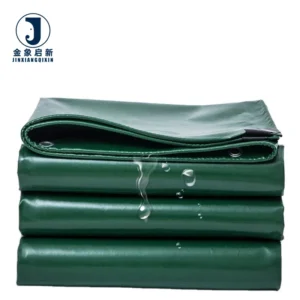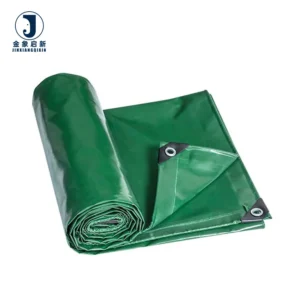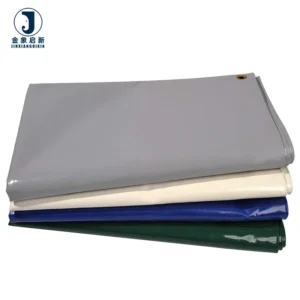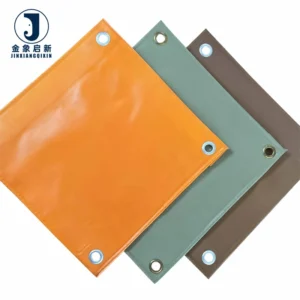
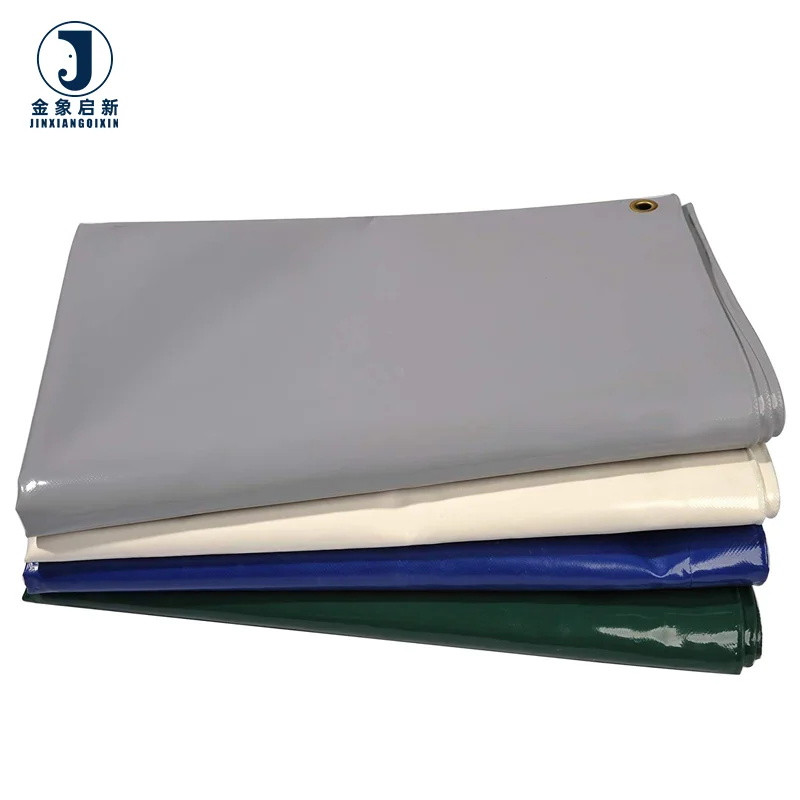
Coated Fabric Process Control — nearly three decades focused on PVC coating weight and adhesion, with dedicated QA at every stage ensuring the roll you receive matches the specification you approved.
Technical Specifications
| Parameter | Value |
|---|---|
| Product Type | PVC Coated Tarpaulin |
| Coating Material | PVC on Polyester Base Fabric |
| Base Fabric Denier Options | 500D×840D, 500D×1000D, 1000D×1000D, 1000D×1300D, 1300D×1300D, 1000D×2000D |
| Weight Options | 350 GSM, 400 GSM, 420 GSM, 500 GSM, 600 GSM, 650 GSM, 750 GSM, 900 GSM |
| Total Thickness Range | 0.29 mm – 0.65 mm |
| Density (warp × weft / cm) | 30×19, 20×20, 30×15 |
| Tensile Strength Warp | 1650 N – 3900 N (test basis not stated in source) |
| Tensile Strength Weft | 1600 N – 3500 N (test basis not stated in source) |
| Temperature Range | Brittle ≤ -50 to -60 °C; Softening ≥ 80 °C; Melting point 212 °C |
| Edge Finish | High-temperature heat-sealed seamless edge wrapping with 5 mm unspliced rope |
| Eyelets | 3 cm enlarged aluminum alloy buttonhole |
| Corner Treatment | Reinforced corners on all sides |
| Key Features | Water resistant, waterproof, flame retardant (grade not stated — confirm for your market), anti-UV (test basis not stated) |
| Colour | Gray |
| Package Options | Roll packing, bale packing, carton |
| Standards | ISO, CE (specific standard numbers not stated) |
Application Suitability
| Application | Exposure & Requirement |
|---|---|
| Flatbed and curtain-side trailer covers | Continuous road vibration, wind flap, tie-down abrasion at hem and eyelet zones, UV and weather exposure |
| Low-bed trailer machinery covers | Heavy point loads from equipment edges, multi-directional pull during transit, flex cycling at contact points |
| Truck top and side covers for fleet operators | Daily deployment and retraction, friction against load edges, sustained highway-speed wind pressure |
| Pergola and terrace rain covers | Permanent outdoor mounting, seasonal thermal cycling, standing water pooling on horizontal spans |
| Outdoor equipment and groundsheet covers | Direct ground contact, puncture risk from debris, prolonged moisture exposure |
Why Truck Cover Buyers See Weld Failure Before Fabric Failure
Heat-sealed seams must carry the same cyclic load as the base fabric — and most do not.
Fleet operators routinely report that the first point of failure on a PVC coated tarpaulin for truck and trailer cover applications is not the field of the material but the welded edge. Road vibration and repeated tie-down tension concentrate stress at the hem, where a poorly controlled heat-seal creates a brittle boundary between coating and substrate. The cover may show no damage across its surface while the seam peels apart under load. [NEED_CITE: tensile and tear test methods for coated fabrics per ISO 1421]
Covering a Moving Load Demands More Than a Generic Cut
Truck and trailer operators know that a cover cut to standard dimensions will flap, billow, and abrade against the load it is supposed to protect. Our PVC coated tarpaulin for truck and trailer cover applications is cut to your specific vehicle model — flatbed width, curtain-side track length, or low-bed deck profile — so the fabric sits tight under tie-downs without excess material creating drag or wear points.
Reinforced Load-Bearing Points Where It Matters Most
The 3 cm aluminum alloy eyelets and 5 mm unspliced rope hem distribute tie-down tension evenly across the perimeter. Reinforced corners on all sides address the multi-directional pull that occurs when a load shifts during braking or cornering. The high-temperature heat-sealed edge wrapping bonds the PVC coating to the polyester base at the hem with high adhesion, eliminating the glue cracking and loose-edge failures that generic covers develop within months of highway use. [NEED_CITE: DIN 4102 fire classification for building materials]
Reading the Specification Sheet Beyond GSM Alone
Weight per square metre is the most quoted number in coated fabric procurement, but it tells only part of the story. Two rolls at 650 GSM can perform very differently depending on how that weight is distributed between the polyester base and the PVC coating. A heavier base fabric denier such as 1000D×1300D with a lower coating weight will resist tear propagation better than a lighter base loaded with filler-heavy coating to reach the same GSM. The density figures — 30×19 or 20×20 warp and weft per centimetre — indicate how tightly the yarns are woven, which directly influences how far a puncture or cut will spread before stopping. Buyers specifying PVC coated tarpaulin for truck and trailer cover use should request both the base fabric denier and the coating weight breakdown, not just the total GSM.
The Hidden Cost of Specifying on Price Per Square Metre
When procurement decisions rest on the lowest quoted GSM, the material that arrives is often lighter than agreed — sometimes by a margin invisible to the eye but significant under load. A cover that was quoted at 650 GSM but delivered at 580 GSM will reach its tensile limit sooner at the flex points where the trailer load moves most. Flame retardant grades claimed without a supporting test report create a different risk: the cover passes visual inspection but fails a site fire-safety audit, forcing replacement at the contractor’s expense. Colour variation across rolls in a single fleet order becomes visible only after installation, when adjacent panels show different shades under daylight. Each of these failures traces back to a specification that lacked verification checkpoints. [NEED_CITE: pre-shipment GSM verification practices in coated fabric supply]
Why Transport Equipment Builders Source Here
Three full production lines and 36 sets of professional equipment support bulk orders with reliable on-time delivery — critical when a trailer production schedule depends on cover availability. A 10-person R&D team handles pattern development for specific truck and trailer models, moving from drawing to sample within days rather than weeks. Dedicated QA/QC runs at every production stage with 100% inspection before dispatch, catching GSM deviation, colour drift, and weld adhesion issues before the roll ships. Deep process control over coating weight and adhesion, built over nearly 30 years of focused PVC coated fabric production, means the material behaves predictably during fabrication and in service.
Documentation & Verification
- Material specification sheet stating exact GSM, base fabric denier, and coating type for each roll
- Flame retardant test report supplied where applicable — confirm the grade your market requires before ordering
- Pre-shipment inspection record verifying weight and dimensions against the original quotation
- Roll packing list with individual roll weights and dimensions for receiving inspection
- ISO and CE certificates provided with shipment documentation
- Certificate of origin and customs support documentation included
Fabrication, Handling & Storage
- Heat-seal temperature and dwell time must match the PVC coating thickness — test on an offcut from the same roll before full production
- The 5 mm unspliced rope hem requires even feed tension during sewing to prevent puckering at the edge wrap
- Store rolls upright on end-caps in a shaded, ventilated area to prevent flat-spot creasing on the coating surface
- Allow cold-stored rolls to reach ambient temperature before unrolling to avoid brittle cracking at low temperatures
- Clean with mild detergent and soft brush — solvent-based cleaners may degrade the PVC coating surface over time
- Field repairs to punctures use PVC-compatible adhesive patches applied to a clean, dry surface
Request a Specification Match for Your Fleet
Tell us the truck or trailer make, model, and year so we can develop a pattern-fit cover rather than a generic cut. Specify the operating environment — highway transit, off-road construction sites, or long-term outdoor parking — and any fire-safety codes your destination market enforces. Provide your target GSM range, colour requirement, and annual volume so we can confirm lead time and batch consistency controls for your order.
Frequently Asked Questions
Q: How is GSM verified before my PVC coated tarpaulin shipment leaves the factory?
A: Every roll undergoes pre-shipment inspection where sample cuts are weighed and measured against the GSM stated on your quotation. The inspection record travels with your documentation so you can cross-check on arrival. If your application requires a specific weight, confirm the exact GSM grade during the specification stage so production is set to that target from the start.
Q: Which flame retardant grade does my transport market require?
A: Fire-safety requirements vary by country and application — road transport, mining, and construction each reference different standards. We supply flame retardant grades with supporting test reports where applicable, but you must confirm which classification your local authority or site operator demands before we produce. Provide the standard reference at inquiry stage to avoid compliance gaps.
Q: How do I get a cover that fits my exact trailer model?
A: Send us the trailer manufacturer, model designation, and production year along with any track or rail dimensions for curtain-side systems. Our R&D team develops a cut pattern matched to those dimensions, produces a sample for your approval, and then cuts production units to the same pattern — eliminating the flapping and material waste that generic sizes cause.
Q: How do you control colour consistency across a fleet-sized order?
A: All rolls in a single order are produced from the same coating batch with in-process colour checks at the line. We run side-by-side comparison against the approved sample before packing. For repeat orders, we retain the colour reference from your first batch to match subsequent production runs and keep your fleet visually uniform.
Q: What is the expected behaviour of heat-sealed seams under road vibration?
A: The high-temperature heat-sealed edge wrapping bonds PVC coating to polyester base at high adhesion, designed to flex with the fabric rather than crack independently. Actual seam longevity depends on tie-down tension, load profile, and road conditions. We recommend specifying reinforced corner patches and the 5 mm rope hem for routes with sustained vibration exposure.