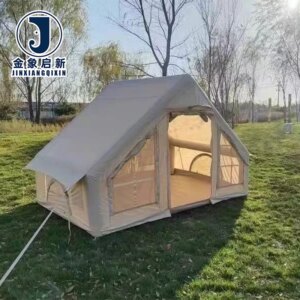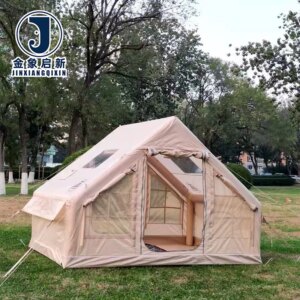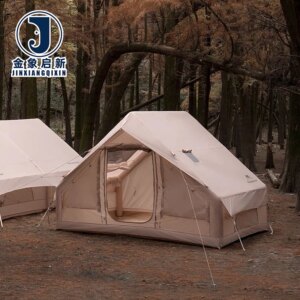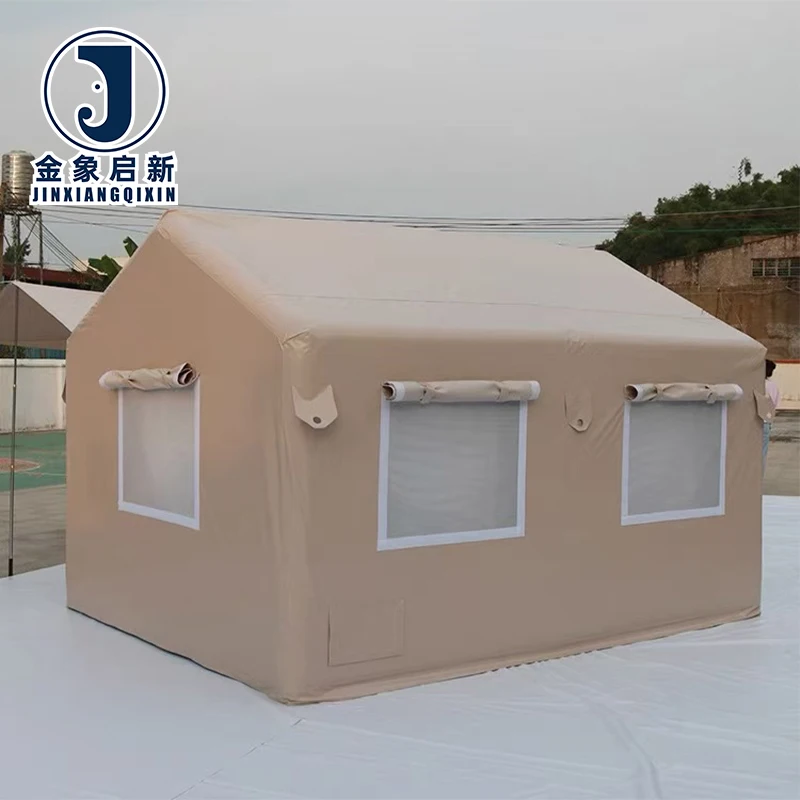
Three Production Lines for Bulk Fabric Output — our facility runs three full coating lines with 36 processing units to deliver custom inflatable shelter fabric with consistent batch quality and reliable lead times.
Technical Specifications
| Parameter | Value |
|---|---|
| Product Type | Inflatable Tent |
| Core Material | PVC tarpaulin |
| Product Forms | Inflatable structure |
| Construction | Single layer |
| Capacity | 3-4 Person |
| Season Rating | Four-Season |
| Opening Mechanism | Quick automatic opening |
| Key Features | Waterproof, tear-resistant |
| UV Resistance | Available in UV-treated grades — confirm the grade required for your market |
| Fire Retardancy | Available in flame retardant grades — confirm the grade required for your market |
| Anti-Static | Available in anti-static grades — confirm the standard required for your market |
| Certifications | ISO9001, ISO14001, ISO45001, CE |
| Customization | OEM & ODM (sample customization, pattern printing, material selection, product design) |
| R&D Support | 10 technicians |
Application Suitability
| Application | Exposure & Requirement |
|---|---|
| Temporary site offices | Constant weather exposure, daily inflation cycles, foot traffic abrasion at entry points |
| Equipment storage shelters | UV and moisture exposure, dust ingress prevention, wind load resistance |
| Mobile field operations | Rapid deployment, repeated packing and unfolding, transport vibration and compression |
| Construction site camps | Heavy rain, wind loading, fire safety compliance for occupied structures |
| Outdoor event management | Public safety standards, branding and colour consistency across multiple units |
| Industrial project bases | Extended outdoor deployment, temperature fluctuation, chemical and dust exposure |
Why Generic Tent Fabric Fails at the Seams in Field Conditions
Seam failure on inflatable shelters traces back to fabric that was never engineered for repeated inflation stress.
Inflatable structures place cyclical load on every welded joint each time they are pressurised and depressurised. Standard tarpaulin fabric, specified only by a headline weight, often shows adequate tensile strength on a flat pull test yet splits along the heat-welded seam after a few weeks of field use. The base fabric weave and coating adhesion both need to match the inflation cycle profile, not just a static load figure. [NEED_CITE: tensile and tear test methods for coated fabrics per ISO 1421]
Patterned Sizing Eliminates Field Rework on Shelter Installation
Transport fleet operators and construction teams frequently receive shelter covers cut to generic dimensions that require on-site trimming and re-seaming. Our Inflatable Tent Fabric for Transport and Field Shelter is produced against exact structural templates, so each panel arrives dimensionally matched to the intended inflatable frame. This approach removes the most common source of field delay and protects seam integrity by avoiding secondary cuts.
Reinforcement Strategy at Inflation Stress Points
The junctions where air beams connect to the ground sheet endure concentrated stress during pressurisation. Our R&D team specifies reinforcement layout based on the structural design of each inflatable unit rather than applying a standard hem treatment across all panels. Tie-down points and base perimeter edges receive additional coating passes and hem folding matched to the anchoring method used on site, reducing the risk of tear initiation at these high-load zones. [NEED_CITE: DIN 4102 fire classification for building materials]
Reading Beyond the GSM Figure on Inflatable Shelter Fabric
Specifying inflatable tent fabric by weight alone creates a false sense of security. The tensile and tear performance of a PVC-coated fabric depends on the denier of the base yarn and the weave density as much as the total coated weight. A lighter fabric woven from high-tenacity yarn can outperform a heavier fabric made with coarse, low-density yarn when subjected to the repeated flexing that inflatable beam structures demand. Coating method also matters: knife-over-roll coating produces stronger adhesion between the PVC layer and the base fabric than lamination, which directly affects how well heat-welded seams hold under inflation pressure. For single-layer inflatable structures deployed across four seasons, the low-temperature flexibility of the coating compound determines whether the fabric remains pliable or becomes brittle during winter deployments.
The Hidden Cost of Underspecified Inflatable Shelter Fabric
When the fabric weight stated on the quotation does not match the material received, inflatable shelters fail in the field rather than at the inspection desk. The coating may be thinner than agreed, reducing both waterproof integrity and seam weld strength. Fire-retardant treatment claimed without a matching test report can lead to failed site safety audits and work stoppages. Colour variation between production batches becomes visible when multiple shelter units are installed side by side at an event or project base, forcing costly replacement. [NEED_CITE: fire safety compliance requirements for temporary site structures]
What Sets This Inflatable Tent Fabric Supply Chain Apart
Three full production lines running within a 9,180 m² facility give us the capacity to supply both roll stock and finished inflatable shelter panels without outsourcing critical coating stages. Our 10-person R&D team handles material selection, structural pattern development, and sample production in-house, which shortens the feedback loop between design adjustment and physical sample delivery. Every production run passes through dedicated QA checkpoints at the coating, curing, and finishing stages, with 100% pre-shipment inspection covering dimensional accuracy against structural templates and seam strength verification. OEM and ODM customisation extends to pattern printing, custom sizing, and material grade selection, all managed under ISO9001, ISO14001, ISO45001, and CE certified processes.
Documentation & Verification
- Material specification sheet stating base fabric denier, weave density, coating type, and treatment details for each roll
- Fire-retardant and anti-static test reports matched to production batch number where applicable
- Pre-shipment inspection record confirming panel dimensions against inflatable structure templates
- Weight verification per roll against the stated specification before dispatch
- Certificate of origin and customs documentation for cross-border shipment
Fabrication, Handling & Storage
- Heat-weld PVC tarpaulin panels using temperature and dwell time settings matched to the single-layer coating weight
- Reinforce hem folds at anchoring points with additional PVC strip welding to distribute tie-down loads
- Store rolled Inflatable Tent fabric upright in shaded, ventilated areas to prevent permanent creasing and coating adhesion loss
- Avoid deploying four-season rated inflatable shelters in sustained sub-zero conditions without confirming low-temperature flexibility grade
- Clean coated surfaces with neutral pH detergents to preserve the waterproof coating layer and any applied treatment finish
- Plan panel cutting layout to minimise offcuts and reduce the number of field-welded seams on large inflatable structures
Specify Your Inflatable Shelter Requirements
Tell us the structural dimensions, inflation pressure range, and deployment climate so we can recommend the correct base fabric and coating combination. Share any fire safety or anti-static compliance standards your site requires, along with colour or branding specifications. Confirm whether you need finished panels cut to pattern or roll stock for your own fabrication line, and whether sample approval is required before bulk production.
Frequently Asked Questions
Q: How is the inflatable tent fabric sized to fit specific shelter structures?
A: We produce panels against exact dimensional templates provided by the structural designer or developed jointly with our R&D team. Each panel is cut and welded to match the inflatable frame geometry, eliminating on-site modification. Template accuracy is verified during pre-shipment inspection against the agreed structural drawings.
Q: What fire-retardant and anti-static certifications are available for site compliance?
A: Fire-retardant and anti-static treatments are available across our Inflatable Tent Fabric for Transport and Field Shelter range, with grade and standard confirmed per order. We supply matching test reports tied to the production batch so site auditors can verify compliance against local safety regulations.
Q: How is batch-to-batch colour and material consistency controlled?
A: Each production run follows a controlled coating recipe with in-process QA checks at the mixing, coating, and curing stages. Colour reference standards are established at the sample approval phase, and pre-shipment inspection compares every roll against that reference to flag any visible deviation before dispatch.
Q: What is the sample development process for custom inflatable shelter dimensions?
A: Our R&D team develops material samples and structural panel prototypes within days of receiving your specifications. You review the sample for dimensional accuracy, coating feel, and seam performance before authorising bulk production, ensuring the final output matches your field deployment requirements.
Q: What documentation accompanies each shipment?
A: Every dispatch includes a material specification sheet, pre-shipment inspection record, roll packing list, and certificate of origin. Where fire-retardant or anti-static treatment is specified, the corresponding test report is included and cross-referenced to the production batch number for traceability.