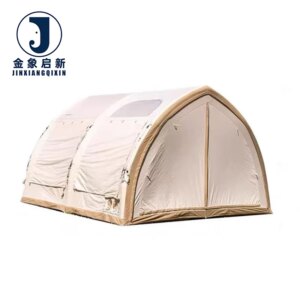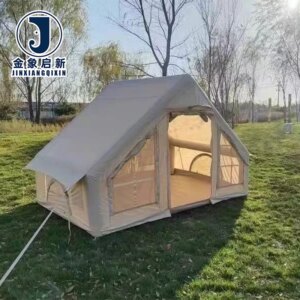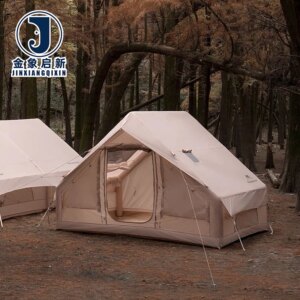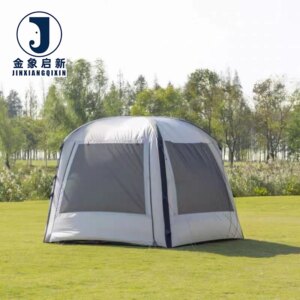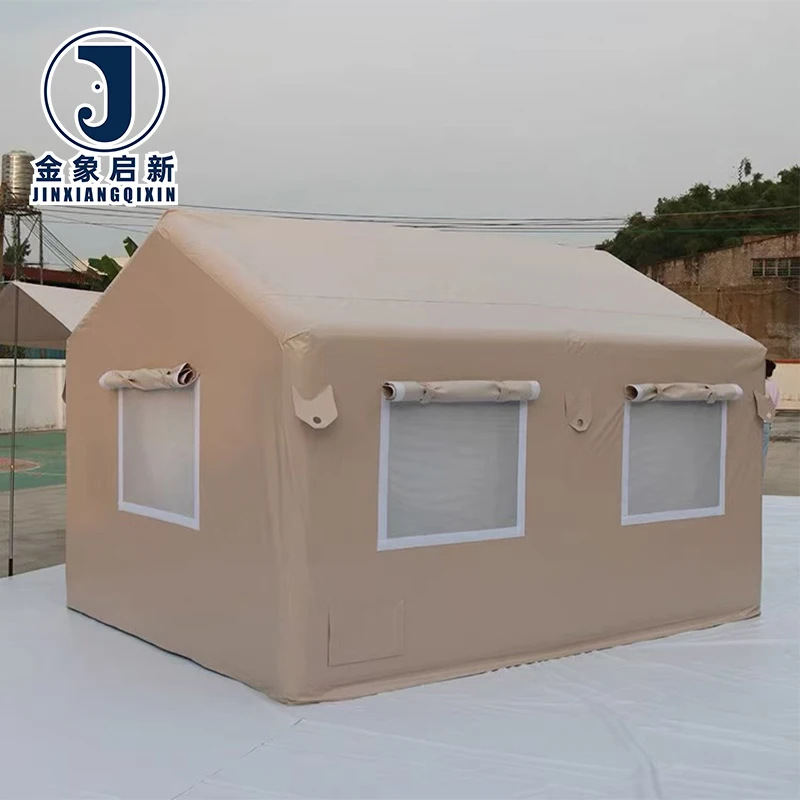
Process-Controlled Coating — Every roll undergoes dedicated QA/QC inspection with 100% pre-shipment verification, ensuring batch consistency across your inflatable tent fabric order.
Technical Specifications
| Parameter | Value |
|---|---|
| Product Type | Inflatable Tent |
| Capacity | 6-8 person |
| Opening Mechanism | Quick automatic opening |
| Design | Four-season |
| Construction | Single layer |
| Type | Extended |
| Core Material | PVC |
| Customization Service | OEM & ODM supported |
| Flame Retardant Grade | (grade not stated in source) — confirm the grade required for your market |
| UV Treatment | (test basis not stated in source) — available in UV-treated grades, request test report |
| Anti-Static | (standard not stated in source) — available on request, verify against site requirements |
| Certifications | ISO 9001, ISO 14001, ISO 45001, CE |
Application Suitability
| Application | Exposure & Requirement |
|---|---|
| Emergency command centers at industrial accident sites | Rapid deployment under time pressure, exposure to precipitation, wind loading on inflated structure, need for certified flame-retardant material in regulated zones |
| Temporary site offices during infrastructure development | Daily inflation-deflation cycles, abrasion from ground contact and equipment movement, prolonged UV and weather exposure |
| Mobile workspace solutions for remote engineering projects | Transport over rough terrain, storage in compressed conditions, temperature extremes during deployment |
| Temporary storage facilities for disaster response equipment | Load-bearing stress on roof panels, moisture ingress prevention, extended outdoor standing in variable conditions |
Why Inflatable Tent Fabric Fails at the Seam Before the Fabric Does
When a PVC inflatable tent fails, the rupture almost always traces back to a welded seam under inflation stress — not the body fabric itself. The coating adhesion and base fabric compatibility determine whether your structure holds pressure through repeated cycles or develops leaks within weeks of deployment.
Inflatable structures concentrate mechanical stress at every junction where panels meet. I have reviewed failure samples where the PVC coating peeled away from the base fabric precisely at the heat-welded line, leaving the structural threads exposed to moisture and UV degradation [NEED_CITE: weld seam peel strength testing per ISO 2411 for coated fabrics]. The fabric panel beside the seam remained intact, but the tent lost pressure and collapsed. Specifying a PVC inflatable tent manufacturer custom capable of controlling coating weight and adhesion across every production stage eliminates this failure mode. Without that process control, you are gambling on a structure that must perform under emergency conditions.
Covering a Moving Emergency Response Operation
An inflatable tent deployed for emergency command or disaster staging faces conditions that static structures never encounter. The fabric must endure transport in folded or compressed state, rapid inflation under field conditions, and sustained internal pressure while crews operate inside. For a PVC inflatable tent manufacturer custom producing structures for these scenarios, the coating formulation and base fabric selection must account for the repeated flexing that occurs during deployment, use, and takedown.
The quick automatic opening mechanism specified for this 6-8 person unit depends on consistent air retention across the entire structure. Any coating inconsistency — a thin spot in one panel, a variation in plasticiser distribution — creates a pressure differential that slows deployment or causes uneven inflation. When your team arrives at an industrial incident site, minutes matter. The fabric must perform identically every time the structure is raised, whether in arid heat or freezing rain.
Fabric Performance Across Four-Season Deployment Windows
Four-season capability in an inflatable tent demands that the PVC coating remains flexible at low temperatures without becoming tacky at high ambient heat. The single-layer construction reduces weight for transport to remote sites but places all weather resistance responsibility on one material system [NEED_CITE: low-temperature flexibility testing for PVC coated fabrics per ISO 4616]. The extended type designation provides functional space for equipment staging and coordination work, but that additional surface area also means more material exposed to wind loading and solar radiation.
For industrial emergency response programs, procurement teams must verify that the PVC compound used maintains its mechanical properties across the full temperature range the structure will encounter. A coating that becomes brittle in sub-zero conditions risks cracking during inflation, while an overly soft compound in high heat reduces dimensional stability and allows panels to sag under their own weight.
How Core Material Choices Determine Field Performance
The PVC core material in this inflatable tent provides the waterproof barrier and structural rigidity needed to maintain shape under internal pressure. Unlike woven fabrics that rely on tension from poles or frames, inflatable structures derive their form entirely from air pressure pushing against the coated material. This means the tensile strength of the base fabric and the adhesion of the coating to that fabric work together to resist the outward force.
The 6-8 person capacity creates a specific internal volume that dictates wall curvature and panel geometry. Smaller structures concentrate stress at tighter radii, while larger spans experience greater total force across each panel. The single-layer construction keeps packed weight manageable for rapid transport but requires the material to serve simultaneously as the air barrier, the weather shield, and the structural skin. Understanding how these demands interact prevents specification errors that only become visible during actual deployment.
What Unverified Material Claims Cost You in the Field
Procurement specifications that list "flame retardant" or "UV resistant" without citing a test standard or grade create a false sense of security. I have encountered projects where inflatable structures ordered for regulated industrial sites arrived without the fire classification documentation the facility safety plan required, forcing the entire order to be rejected at delivery [NEED_CITE: fire safety classification standards for temporary structures]. The delay in sourcing compliant replacement material meant emergency preparedness coverage gaps that no procurement team wants to explain to safety auditors.
Similarly, UV treatment claims unsupported by accelerated weathering test data leave you guessing about actual service life in outdoor deployment. Colour shift and surface chalking may not matter for a weekend camping tent, but for emergency response equipment that must remain service-ready across seasons of storage and deployment cycles, material degradation directly affects operational reliability.
Production Capability Applied to Your Inflatable Fabric Order
Three full production lines and 36 sets of professional processing equipment support consistent output across your inflatable tent fabric volume, whether you require sample quantities or container-load commitments.
The 10-technician R&D team handles material selection, sizing adjustments, and sample development specific to inflatable structure demands, returning samples within days rather than weeks.
Dedicated QA and QC staff inspect every production stage, with 100% pre-shipment inspection ensuring that the material reaching your facility matches the specification agreed at order placement.
OEM and ODM customization pathways allow branding, sizing, and construction modifications while maintaining the process control that keeps coating weight and adhesion consistent across every roll or finished unit.
ISO 9001, ISO 14001, and ISO 45001 certification frameworks govern production, environmental, and occupational health processes, providing documented traceability for compliance-sensitive procurement.
Documentation & Verification
- Material specification sheet stating core material, coating parameters, and colour reference matched to your inflatable tent order
- Flame retardant test report cited to specific grade and standard, issued per batch where applicable
- UV treatment test data available upon request, matched to production batch for traceability
- Pre-shipment inspection record with QA/QC sign-off covering coating adhesion and dimensional verification
- ISO 9001, ISO 14001, ISO 45001, and CE certificates available for compliance documentation packages
- Certificate of origin and customs support documentation for cross-border shipment processing
Fabrication, Handling & Storage
- Heat welding parameters must match the specific PVC coating formulation — request recommended temperature and dwell time settings for this material
- Inflatable structures concentrate stress at seam junctions — reinforce all welded joints per manufacturer-recommended overlap widths
- Store rolled or folded fabric in dry conditions away from direct sunlight to prevent premature UV exposure before deployment
- Allow cold-stored inflatable fabric to reach ambient temperature before inflation to prevent coating stiffness and cracking at fold lines
- Clean PVC surfaces with mild detergent only — abrasive or solvent-based cleaners degrade coating plasticisers and reduce flexibility
- Repair field damage with compatible PVC adhesive patches — verify chemical compatibility with the base coating system before application
Specifying Your Inflatable Tent Fabric Requirement
To move from inquiry to sample development, provide your intended deployment scenarios, the climatic conditions the structure will face, and any fire safety or regulatory classifications required in your target market. Specify whether you need fabric by the roll for your own fabrication or finished inflatable tent units, along with sizing, colour, and any branding requirements. Confirm annual volume estimates so production scheduling can be aligned to your procurement cycle.
Frequently Asked Questions
Q: How do I verify the flame-retardant grade matches my market’s fire safety requirements?
A: Provide the specific standard your jurisdiction requires, such as a national building code classification or industrial safety regulation. We match available flame-retardant grades to your cited standard and supply test reports per batch. If your market requirement is not yet defined, we can outline the grade options and their corresponding test methods to support your compliance planning.
Q: What UV exposure testing supports the expected outdoor service life of this inflatable structure?
A: UV treatment options are available with test data from accelerated weathering protocols. Request the test report matched to the specific grade you specify. Actual field exposure depends on your geographic location, deployment duration per cycle, and storage conditions between uses. We recommend discussing your typical deployment patterns so we can recommend the appropriate UV treatment level.
Q: What customisation options exist for sizing, branding, and construction modifications?
A: OEM and ODM pathways support custom dimensions, panel geometry, and branding elements for inflatable tent structures. The 10-technician R&D team develops samples incorporating your sizing and visual requirements, typically returning prototypes within days. Confirm your inflation system interface, access point placement, and any structural modifications needed before sample development begins.
Q: What lead times apply to custom-colour or custom-width inflatable tent fabric orders?
A: Lead times depend on whether your order requires stock material or a custom production run, the complexity of colour matching, and order volume relative to production scheduling. Standard specifications ship faster than custom formulations. Confirm your required specifications and target delivery window at inquiry stage so we can provide an accurate timeline aligned with your project schedule.
Q: How reliable are welded seams under repeated inflation and deflation stress?
A: Welded seam integrity depends on coating adhesion to the base fabric and the heat-welding parameters used during fabrication. Our production process controls coating weight and adhesion to support consistent weld performance. For your own fabrication, request recommended welding parameters for this specific material to ensure seam strength matches the panel fabric through repeated pressure cycles.