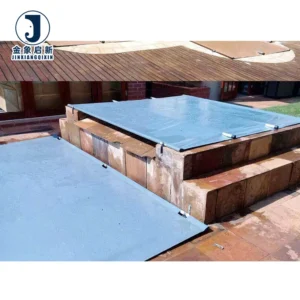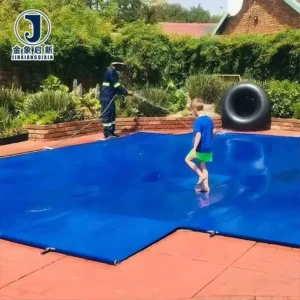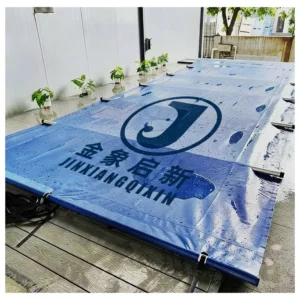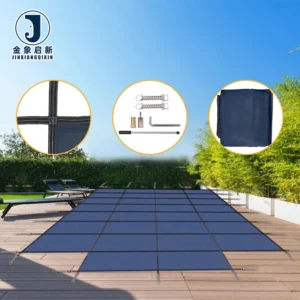
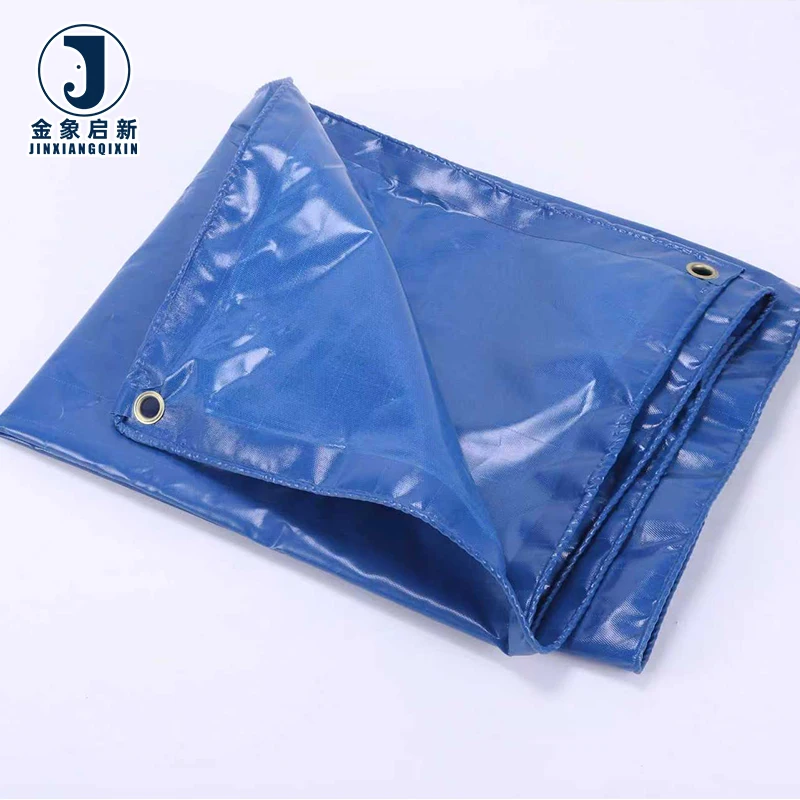
Custom-Sized Protection — Every pool cover is cut to the exact dimensions of your pool deck layout with reinforced anchor points, eliminating the loose fabric and water pooling caused by generic-size covers.
Technical Specifications
| Parameter | Value |
|---|---|
| Product Type | PVC Tarpaulin Swimming Pool Cover |
| Material | Knife Coated PVC Fabric |
| Weight (GSM) | 50 gr/m² ~ 220 gr/m² (specify grade per application) |
| Total Thickness | 0.2–0.4 mm / 8 mil–16 mil / Custom |
| Colours Available | Blue, Blue/Orange, Green, Grey, Black, Clear, Grey/Green, Orange, or custom |
| UV Treatment | Available — confirm test basis required for your market |
| Hardware Options | Brass Anchor, Triangular Hook, Ratchet System, Aluminium Poles |
| Attachment | Self-sinking stainless steel connections at six points |
| Operation Compatibility | Manual or motorized winders |
| Certification | ISO 9001, ISO 14001, ISO 45001, CE |
| OEM / ODM | Supported |
Application Suitability
| Application | Exposure & Requirement |
|---|---|
| Residential solid pool cover | Continuous UV, rain and debris loading; deck-mounted anchor and ratchet tensioning |
| Commercial pool safety cover | High foot-traffic risk, frequent deployment and removal, chemical splash from pool treatment |
| Seasonal pool winterisation | Standing water, snow load, prolonged moisture contact and mildew risk |
| Transport fleet load cover | Road abrasion, wind flex, weather exposure during transit and yard storage |
Why Generic-Size Pool Covers Fail at the Anchor Points
Covers cut to a standard rectangle rarely match the actual pool deck geometry, and the misfit shows first at the brass anchors and ratchet tie-downs.
When a PVC pool cover tarpaulin aftermarket supplier ships a cover that is even slightly off-dimension, the excess fabric pools water in the centre while the corners pull tight. The tension concentrates at the anchor holes, and after a season of UV exposure and repeated wind loading the material begins to tear radiating outward from each fastener. Fleet operators covering open trailers face the same failure pattern — a cover that does not match the trailer bed length leaves slack zones that flap and abrade against the load edges [NEED_CITE: tensile and tear test methods for coated fabrics per ISO 1421]. Specifying the exact pool or trailer dimensions before production removes this failure mode entirely.
Deck-Mounted Hardware and Load Distribution
A finished PVC pool cover relies on the interaction between the fabric edge and the deck hardware. The brass anchors distribute pull-out force across a wider area of the pool surround, while the triangular hooks engage the ratchet system to apply even tension along each side. Aluminium support poles span the centre of wider pools to prevent water from collecting on the cover surface during heavy rain. Selecting the correct GSM and thickness ensures the fabric can carry this tension without stretching beyond recovery over multiple seasons.
Fabrication Details That Protect the Flex Zone
The perimeter of a pool cover flexes every time the ratchet is tightened or released. Reinforced hems with doubled fabric layers at the hem line absorb that cyclic stress and prevent the PVC coating from cracking at the fold. Where the cover attaches to the self-sinking stainless steel connections at six points, the local load is substantially higher than across the field of the fabric. Welded seams in these zones must be inspected for full adhesion before dispatch — a seam that fails before the fabric does is almost always a process-control issue rather than a material issue [NEED_CITE: hot-air welding parameters for PVC coated fabrics].
Reading the Specification Sheet Beyond GSM
GSM tells you the total weight per square metre of the finished PVC pool Cover Material, but it does not separate the contribution of the base fabric from the coating. Two covers can share the same GSM yet differ significantly in tear resistance if one uses a heavier base yarn and thinner coating while the other relies on a thick coating over a lighter weave. Knife coated PVC fabric generally achieves stronger adhesion between coating and base fabric than lamination methods, which translates into better resistance to delamination at welded seams and cut edges. Thickness values between 0.2 mm and 0.4 mm cover the range from lightweight seasonal covers to heavier grades suited to year-round installation. Colour selection affects heat absorption — darker shades such as Black or Grey absorb more solar energy, which can accelerate plasticiser migration in high-temperature climates.
The Hidden Cost of Wrong Specification Choices
Ordering a cover based on price per kilogram without verifying the actual GSM on arrival is a common source of dispute. Material that arrives lighter than the quoted grade will stretch and tear earlier, often within the first winter cycle. Similarly, accepting a UV treatment claim without requesting the underlying test report leaves the buyer exposed when the coating surface chalks or becomes brittle after one season of direct sunlight. Batch colour variation between rolls in the same order becomes visible once panels are installed side by side on a large commercial pool, forcing a complete replacement rather than a panel swap [NEED_CITE: colour consistency measurement methods for coated textiles]. Welded seams that separate at the flex points under ratchet tension are typically the result of incorrect temperature or dwell time during fabrication, not a defect in the PVC itself.
Why Buyers Source Pool Cover Fabric Through This Facility
Three full production lines and 36 sets of professional equipment support bulk roll output while maintaining coating-weight consistency across every batch. A 10-person R&D team develops custom-sized samples within days, allowing buyers to verify fit and hardware compatibility before committing to a full production run. Dedicated quality control inspects every roll at each production stage, with a 100 percent pre-shipment check that catches GSM drift, colour shift, and weld adhesion issues before they leave the factory. The facility holds ISO 9001, ISO 14001, ISO 45001 and CE certification, providing a documented compliance trail for commercial and municipal pool projects. Custom width, length, colour and hardware combinations are available without the extended lead times and high minimums that constrain buyers working with standard catalogue products.
Documentation & Verification
- Material specification sheet stating exact GSM, base fabric construction and coating type for each roll
- Colour reference and consistency check recorded during pre-shipment inspection
- UV treatment test report available on request — confirm the standard required for your market
- Roll packing list with individual roll weight and dimension for receiving verification
- Certificate of origin and customs documentation included with every export shipment
- Pre-shipment inspection record covering weld seam integrity and hardware kit completeness
Fabrication, Handling & Storage
- Hot-air weld temperature and speed must match the 0.2–0.4 mm thickness range to ensure full coating fusion at seams
- Brass anchor holes should be reinforced with additional PVC patches to distribute point load and prevent tear propagation
- Store rolls upright on hard paper tubes in a shaded area to avoid compression marks on the knife coated surface
- Allow folded covers to acclimate to ambient temperature before unfolding in cold weather to prevent coating crack
- Clean with mild detergent and soft brush — avoid solvent-based cleaners that attack the PVC plasticiser system
- Cut panels using a sharp blade on a flat surface to achieve clean edges that weld without fraying
Requesting a Quotation That Matches Your Project
Provide the exact pool or trailer dimensions, including any non-rectangular geometry, so the cover can be cut to fit rather than adapted on site. State the GSM range, colour and hardware configuration you require, along with the UV or fire-retardant standard your local regulations demand. If you are covering multiple pools or trailers, share the unit count and whether you need finished covers with hardware or roll stock for your own fabrication line. Sample development is available before production to confirm colour, weight and fit.
Frequently Asked Questions
Q: How is the GSM of the pool cover verified before shipment and on arrival?
A: Every roll is weighed and measured during the pre-shipment inspection, and the result is recorded against the quoted GSM on the inspection report. Buyers can repeat the measurement on arrival by cutting a known-area sample and weighing it on a calibrated scale. Any discrepancy outside the agreed tolerance is addressed before the goods are accepted.
Q: What test basis supports the UV-resistance claim for the PVC pool cover material?
A: UV treatment is available for this PVC Pool Cover Material, but the specific test standard varies by market requirement. Buyers should specify the exposure standard their project demands — such as a Xenon-arc weathering cycle — so the correct test report can be issued. Confirm the required standard at the quotation stage.
Q: Can the pool cover be cut to a non-standard pool shape?
A: Yes. The cover is cut to the exact dimensions and geometry you provide, including freeform, kidney and L-shaped pools. Supplying a dimensioned drawing or template ensures the anchor and ratchet hardware align with the deck layout without on-site modification.
Q: How are welded seams reinforced at anchor and flex points?
A: High-stress zones around brass anchors and ratchet attachments receive additional PVC patches welded over the primary seam. The extra layer distributes the point load and prevents tear initiation. Each reinforced zone is inspected during the pre-shipment check for full adhesion.
Q: What hardware options are supplied with the finished pool cover?
A: The standard hardware kit includes brass anchors, triangular hooks, a ratchet tensioning system and aluminium support poles. Self-sinking stainless steel connections are fitted at six attachment points. All metal components are selected for corrosion resistance in chlorinated and saltwater pool environments.