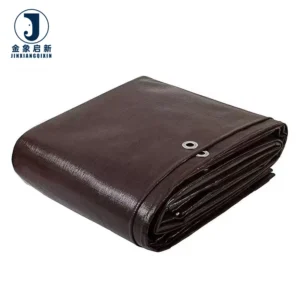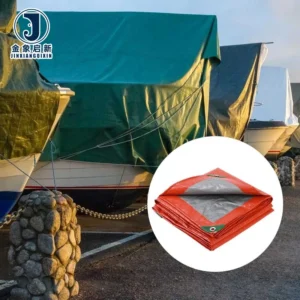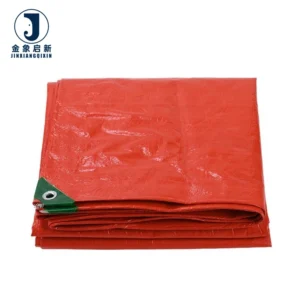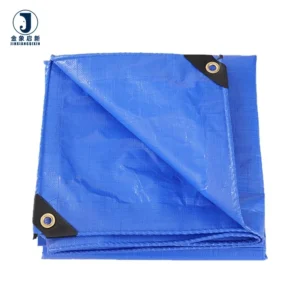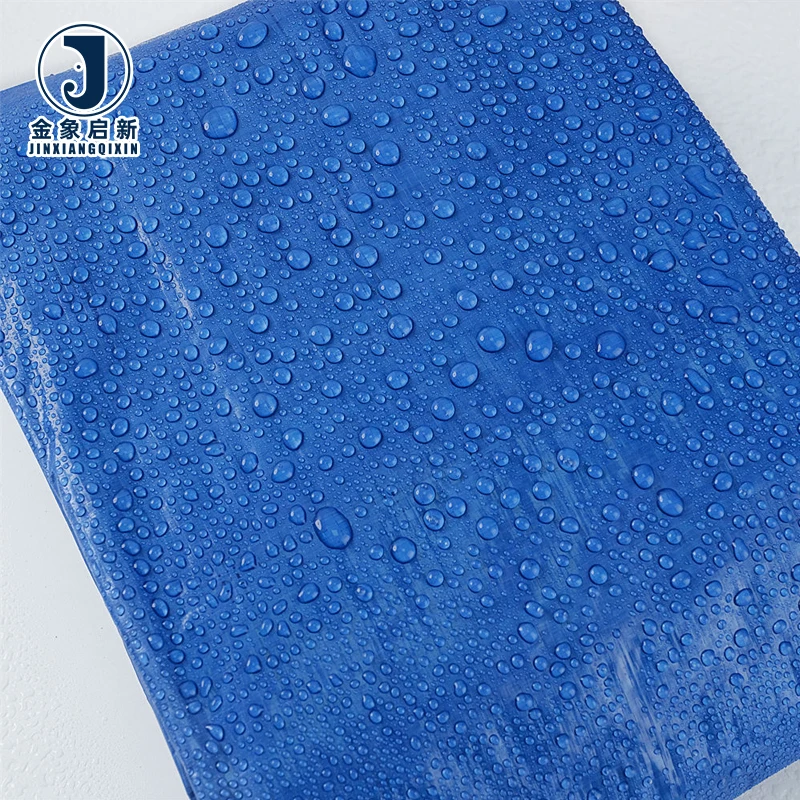
Process-Controlled Coating Lines — Jinxiang operates three full production lines and 36 sets of equipment, enabling bulk PE tarpaulin output with roll-to-roll consistency that fleet operators rely on when covers must match across an entire transport fleet.
Technical Specifications
| Parameter | Value |
|---|---|
| Product Type | PE Tarpaulin |
| Material | Polyethylene |
| Lightweight Grade Weight | 80–110 g/m² |
| Medium Grade Weight | 120–150 g/m² |
| Heavy-duty Grade Weight | 160–240 g/m² |
| Lightweight Grade Thickness | 0.18–0.22 mm |
| Medium Grade Thickness | 0.22–0.28 mm |
| Heavy-duty Grade Thickness | 0.30–0.35 mm |
| Lightweight Grade Knitting Density | 8×8 |
| Medium Grade Knitting Density | 10×10 |
| Heavy-duty Grade Knitting Density | 12×12 |
| Lightweight Grade Tensile Strength | Meridian 300–500 / Latitude 250–450 N/5cm |
| Medium Grade Tensile Strength | Meridian 500–800 / Latitude 400–700 N/5cm |
| Heavy-duty Grade Tensile Strength | Meridian 900–1200 / Latitude 700–1000 N/5cm |
| Water Resistance | Double waterproof surfaces, reinforced corners |
| UV Treatment | Available — confirm UV grade required for your market (test basis not stated) |
| Anti-Mildew | Mildew proof and anti-aging (test basis not stated) |
| Size | Custom size |
| Color | Custom color |
| Center to Center Spacing | 39.4 inches |
| Certification | ISO, CE |
Application Suitability
| Application | Exposure & Requirement |
|---|---|
| Truck and trailer load covers | Constant road vibration, wind flutter at high speed, UV from prolonged sun exposure, tie-down strap abrasion at corners |
| Side curtain fabric for transport trailers | Repeated flexing at roll-up points, contact with metal guide rails, rain ingress during transit |
| Fleet replacement covers for specific vehicle models | Accurate dimensional fit to avoid cargo exposure, reinforced hems matching existing tie-down configurations |
| Agricultural stockpile and equipment covers | Extended outdoor weathering, moisture contact, mildew risk in humid storage conditions |
Why Generic-Size PE Tarpaulin Covers Fail on the Road
A cover cut to a generic size never fits a specific trailer model, and the gaps it leaves are where cargo damage starts.
When a fleet operator orders PE tarpaulin for truck and transport use, the expectation is that the cover drops onto the trailer and seats against the rails without adjustment. In practice, generic dimensions leave slack at the corners, which flaps under highway speeds and accelerates abrasion at the hem. Worse, the tie-down eyelets do not align with the trailer’s anchor points, forcing operators to improvise with extra straps that concentrate load on unreinforced fabric. The result is a cover that tears at the flex points long before the material itself has reached the end of its service life [NEED_CITE: tensile and tear test methods for coated fabrics per ISO 1421].
Model-Specific Fitment Eliminates On-Site Rework
Fleet operators and transport equipment builders need covers that arrive ready to install. Our PE Tarpaulin for Truck and Transport is cut to the exact vehicle dimensions you supply, whether that is a standard flatbed, a refrigerated trailer, or a specialized low-loader. The pattern accounts for the drape allowance at the sides and the drop at the rear, so the cover seats without pulling or bunching. Corner reinforcements are positioned where your tie-down hardware actually connects, not where a generic template assumes it should be.
Reinforcement at the Points That Fail First
On any truck cover, the hem and the eyelet zone carry the highest concentrated load every time a strap is tensioned. We reinforce these areas with additional layers of base fabric and heat-sealed patches that distribute the strap load across a wider section of the PE tarpaulin sheet. This approach addresses the failure mode where seams separate before the body fabric shows wear — a common complaint from operators who replace covers season after season [NEED_CITE: DIN 4102 fire classification for building materials]. The reinforced corners and double waterproof surfaces work together to keep the tie-down zone intact through repeated tensioning cycles.
Reading the Weight Grades Against Actual Load Conditions
The three weight grades — lightweight at 80–110 g/m², medium at 120–150 g/m², and heavy-duty at 160–240 g/m² — are not arbitrary tiers. Each grade pairs a specific knitting density with a corresponding coating weight and base fabric construction. The lightweight 8×8 weave suits temporary covers and short-haul loads where the primary need is rain protection and minimal handling weight. The medium 10×10 grade adds tensile capacity in both warp and weft directions for operators running regular intercity routes with daily strap tensioning. The heavy-duty 12×12 construction, with meridian tensile strength reaching 900–1200 N/5cm, is specified for long-haul fleets and oversized loads where wind load and road vibration impose sustained stress on the fabric. Choosing the correct grade means matching the knitting density and tensile profile to the exposure severity, not simply selecting the heaviest option available.
The Hidden Cost of Underspecifying a Truck Cover
When a PE tarpaulin cover arrives lighter in GSM than the quotation stated, the problem rarely shows up on day one. The fabric performs adequately during the first few weeks, and the operator assumes the specification was met. Then, as the coating layer wears through at the flex points — typically where the cover bends over a sharp trailer edge — the base fabric is exposed and moisture penetrates the weave. A cover specified at the medium grade but delivered at lightweight density will show this pattern of premature failure consistently across the fleet. The cost is not just the replacement cover; it includes the cargo claims, the downtime while the vehicle sits uncovered, and the loss of confidence in the supply chain [NEED_CITE: coating weight and adhesion test standards for laminated fabrics].
Why Source PE Tarpaulin for Truck and Transport Here
Our three full production lines run dedicated coating processes with in-line weight monitoring, so the GSM on your quotation is the GSM on the roll that arrives at your dock. The 10-person R&D team develops patterns from your vehicle templates, producing sample covers within days rather than weeks, allowing you to verify fitment before authorizing a fleet-scale order. Every production run passes through a dedicated QA/QC checkpoint where tensile values, coating adhesion, and dimensional accuracy are checked against your specification sheet. Pre-shipment inspection covers 100% of the order, not a statistical sample, and the inspection record travels with the documentation package. Custom widths, colors, and eyelet configurations are handled on the same lines as standard production, so lead times remain consistent whether you are ordering a single trailer cover or a container load.
Documentation & Verification
- Material specification sheet stating base fabric denier, coating weight, and color reference for each roll
- GSM verification record per roll measured against the quoted weight before dispatch
- Pre-shipment inspection report covering dimensional accuracy, seam integrity, and color consistency
- UV and anti-mildew test documentation supplied where applicable to the grade ordered
- Roll packing list with individual roll identification matching the inspection record
- Certificate of origin and customs documentation for cross-border shipment
Fabrication, Handling & Storage
- Heat-seal temperature must be calibrated to the specific PE grade thickness (0.18–0.35 mm range) to avoid delamination at the weld
- Eyelet installation at 39.4-inch centers should use reinforced washer plates to distribute strap load across the knitting density
- Store rolls horizontally on pallets in a covered area to prevent permanent creasing of the double waterproof surfaces
- Avoid dragging heavy-duty 160–240 g/m² covers across abrasive surfaces during installation to protect the coated finish
- Clean with mild detergent and low-pressure water; solvents may degrade the PE coating layer
- Repair minor tears with PE-compatible adhesive patches applied to a clean, dry surface
What We Need to Quote Accurately
To provide a specification and lead time for your PE tarpaulin requirement, share the trailer model or dimensional drawing, the weight grade suited to your route conditions, and the eyelet spacing your tie-down system requires. If your fleet runs under specific regulatory conditions for UV or fire performance, let us know the standard your market demands so we can confirm whether the available grades meet it. For fleet-wide orders, indicate whether you need identical covers across multiple vehicle models or a mixed-specification container load.
Frequently Asked Questions
Q: How is the GSM verified on arrival against the quotation?
A: Every roll is weighed and measured during our pre-shipment inspection, and the recorded GSM is documented on the inspection report that ships with your order. If the received material does not match the quoted specification, the inspection record provides the basis for an immediate resolution.
Q: Can PE tarpaulin covers be cut to fit specific truck and trailer models?
A: Yes. We cut covers to the exact dimensions of your vehicle model, including drape allowance and rear drop. You supply the trailer drawing or model reference, and our R&D team produces a sample for fitment approval before production begins.
Q: What eyelet spacing and hem reinforcement options are available?
A: Standard center-to-center spacing is 39.4 inches, and we adjust this to match your tie-down anchor points. Reinforced corner patches and double-layer hem construction are applied based on the strap load your fleet’s securing system imposes on the cover.
Q: How does UV treatment perform under extended road exposure?
A: UV treatment is available across all weight grades. The specific UV grade and its test documentation should be confirmed against the exposure conditions in your market. We provide test reports where applicable rather than unverified claims on the data sheet.
Q: What is the typical lead time for custom-size PE tarpaulin covers?
A: Lead time depends on the quantity, the number of distinct vehicle models, and any custom color requirements. Sample development is completed within days. Share your order scope and we will confirm the production schedule with your quotation.