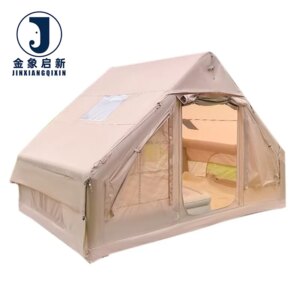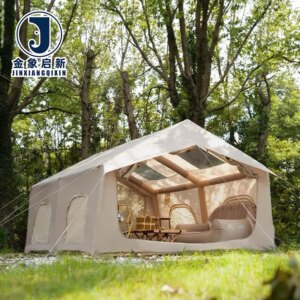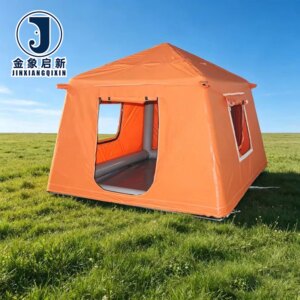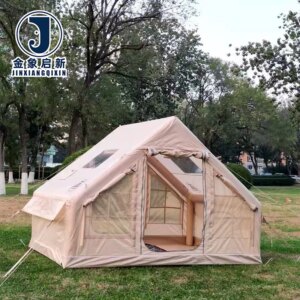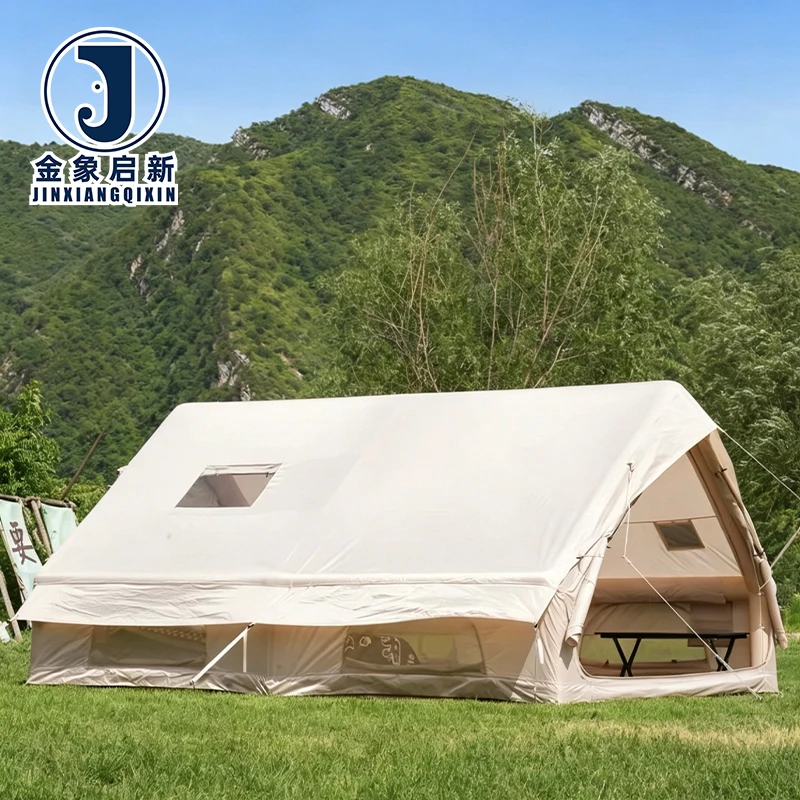
Factory-direct QA at every stage — a dedicated 7-point inspection protocol from raw PVC resin to final inflation test, ensuring every roll of inflatable tent fabric meets the stated specification before dispatch.
Technical Specifications
| Parameter | Value |
|---|---|
| Product Type | Inflatable Tent Fabric |
| Core Material | PVC Tarpaulin (knife-coated fabric) |
| Construction | Single Layer Air Tent, 2-3 Person Capacity |
| Opening Mechanism | Quick Automatic Opening |
| Season Rating | Four-Season |
| Waterproof Performance | Hydrostatic head rated (test report supplied per batch) |
| UV Resistance | QUV tested, 2000-hour simulation |
| Tear Resistance | ASTM D751 tested |
| Airtightness Verification | 20kPa pressure test |
| Customization Scope | OEM & ODM — size, pattern printing, color matching, hardware |
| Sample Lead Time | 7-10 days |
| Production Lead Time | 15-20 days (orders under 500 units) |
| Certifications | ISO9001, ISO14001, ISO45001, CE |
Application Suitability
| Application | Exposure & Requirement |
|---|---|
| Construction site temporary housing | Continuous weather exposure, repeated inflation/deflation, abrasion from ground contact |
| Expedition base camps | Extreme temperature swings, high wind loads, UV intensity at altitude |
| Commercial outdoor equipment rental | High-frequency setup and breakdown cycles, user handling wear, transport abrasion |
| Industrial event temporary structures | Crowd proximity, short-term weather protection, rapid deployment requirement |
| Outdoor gear brand OEM integration | Batch-to-batch consistency for product line uniformity, brand color accuracy |
Why Coated Fabric Consistency Matters More Than the Spec Sheet Promises
A spec sheet tells you what the PVC inflatable tent manufacturer custom material should be — production QA is what it actually arrives as.
When outdoor gear brands source inflatable tent fabric in volume, the gap between quoted performance and delivered reality is where returns originate. A batch that inflates perfectly in the sample run can show micro-leaks at the weld seams during mass production if coating adhesion varies between rolls. We have traced seam failures in inflatable tent applications back to coating weight deviations as small as a few grams per square metre across the width of a single roll [NEED_CITE: adhesion variance in knife-coated PVC tarpaulin per ISO 2411].
Airtightness Starts at the Coating Line
Every PVC Inflatable Tent manufacturer custom order depends on the base fabric holding pressure under repeated flex cycles. The knife-coating process used for this PVC tarpaulin bonds the polymer layer directly into the weave of the base fabric, rather than laminating a film on top. This mechanical bond is what prevents delamination when the tent walls flex under wind load or when the structure is inflated and deflated hundreds of times across a rental season.
Pressure Testing That Mirrors Field Conditions
The 20kPa airtightness test applied to each production batch is not a laboratory formality — it replicates the internal pressure an inflatable camping tent must sustain when fully deployed. At this pressure level, any inconsistency in seam welding or coating coverage becomes immediately visible. This testing discipline is what separates a PVC Inflatable Tent manufacturer custom supplier that ships verified product from one that relies on the buyer to discover defects on arrival [NEED_CITE: pneumatic pressure testing methods for inflatable structures].
Reading the Specs: What the Numbers Actually Control
The relationship between base fabric construction and coating weight determines how an inflatable tent behaves under stress. The denier of the yarn and the density of the weave control tear propagation — a higher thread count base fabric stops a puncture from becoming a split seam. The PVC coating weight governs abrasion resistance and waterproofing, but adding weight without proportional base fabric strength simply makes the material heavier without making it tougher. The knife-coating method specified here ensures the PVC penetrates the weave rather than sitting on the surface, which is critical for weld strength during fabrication. UV testing to the 2000-hour QUV simulation standard indicates how the formulation resists degradation under sustained solar exposure, though real-world service life depends on installation orientation and climate zone.
The Hidden Cost of Specifying on Price Alone
When procurement decisions reduce PVC inflatable tent material to a cost-per-unit comparison, the failures surface later — at the campsite, on the construction site, or in the rental depot. Coating that is thinner than the agreed specification may pass a visual check but will show accelerated wear at high-stress flex points after a single season. Weld seams that hold during factory testing can separate in the field if the coating adhesion was marginal from the start. Color variation between production runs forces brands into costly re-dyeing or inventory segregation when tents from different batches are deployed side by side [NEED_CITE: batch-to-batch colour consistency standards in coated textiles].
What This Production Line Delivers Differently
Nearly 30 years of coated fabric focus means the coating weight and adhesion parameters for inflatable tent PVC are dialled in from experience, not trial and error. The 10-technician R&D team handles the pattern printing and color matching that outdoor brands need for identity consistency across product lines. Three full production lines and 36 sets of processing equipment give the capacity to fulfill container-volume orders within the 15-20 day window for sub-500 unit runs. Dedicated QA at every stage — raw material tensile and thickness check, coating adhesion verification, 20kPa airtightness, seam integrity, hardware cycle testing, UV aging simulation, and dimensional accuracy — means defects are caught before they ship rather than discovered on your receiving dock.
Documentation & Verification
- Material specification sheet stating PVC coating type, base fabric denier, and color reference per order
- Batch-specific test report covering hydrostatic pressure, ASTM D751 tear strength, and QUV aging data
- Airtightness certificate per production lot documenting 20kPa pressure hold results
- Pre-shipment inspection record with full-process QA traceability from coating to packing
- ISO9001, ISO14001, ISO45001, and CE certificates for import compliance documentation
Fabrication, Handling & Storage
- Heat-weld parameters must match the knife-coated PVC formulation — test weld on scrap before production runs
- Store rolls flat or suspended to prevent permanent creasing in the PVC coating layer
- Avoid folding inflatable tent panels at sharp angles during packing to protect seam integrity
- Use PVC-compatible adhesives only for field repairs — solvent-based products may attack the coating
- Allow cold-stored material to reach ambient temperature before unrolling to prevent coating micro-cracking
- Pattern-printed panels should be cut with registration marks to maintain brand graphic alignment
Specifying Your Inflatable Tent Order
To generate an accurate quotation and sample, provide the deployed dimensions, intended use environment, and any wind or snow load requirements your market imposes. Specify target colors by Pantone or RAL reference, and confirm whether pattern printing is required for brand panels. Indicate the volume range and delivery schedule so production can be allocated across the available lines. If your market requires specific fire classification for temporary structures, state the standard so the correct PVC formulation is selected.
Frequently Asked Questions
Q: What elements of the inflatable tent can be customized?
A: Size, panel layout, pattern printing, color matching by Pantone or RAL reference, and hardware selection are all adjustable under OEM and ODM arrangements. The 10-technician R&D team develops a pre-production sample within 7-10 days for your engineering validation before mass production begins.
Q: Are the certifications sufficient for European and North American import?
A: The production facility holds ISO9001, ISO14001, ISO45001, and CE certification, with full documentation packages prepared for customs clearance. If your destination market requires additional fire classification or chemical compliance testing, confirm the specific standard at inquiry stage.
Q: Can I evaluate a custom sample before committing to bulk production?
A: Yes. Sample development takes 7-10 days and includes the exact PVC formulation, color, and printing specifications planned for your order. This allows physical testing of airtightness, seam strength, and inflation behavior before the production run is scheduled.
Q: How is batch-to-batch performance consistency controlled?
A: A 7-point inspection protocol covers raw material tensile and thickness, coating adhesion, 20kPa airtightness, seam integrity, hardware cycle durability, 2000-hour QUV aging simulation, and dimensional accuracy. Every batch ships with a traceable inspection record documenting all checkpoints.
Q: What is the typical lead time for a custom inflatable tent order?
A: Orders under 500 units typically move through mass production in 15-20 days after sample approval. Larger volumes or orders requiring custom color formulation and pattern printing may require additional time, confirmed at the quotation stage based on current line allocation.