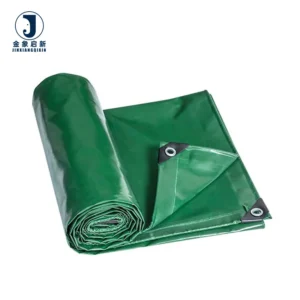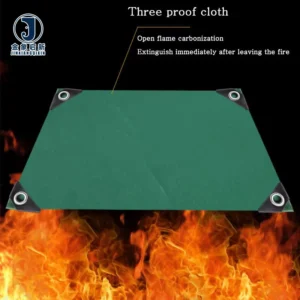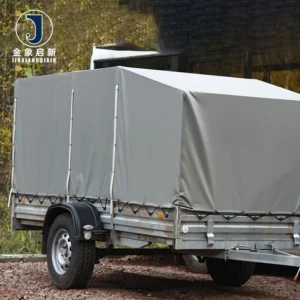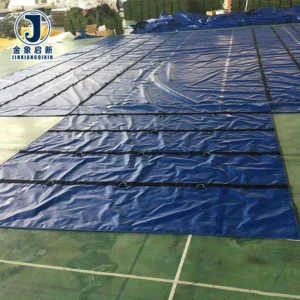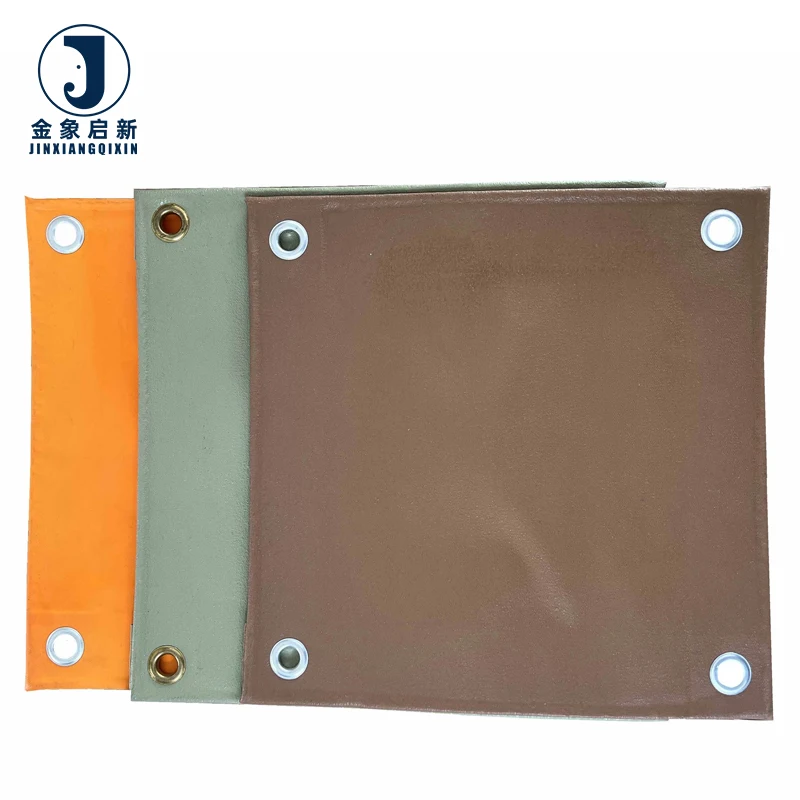
Exact Pattern Fitment — Covers are cut from verified trailer dimensions and tie-down layouts, not generic size charts, preventing slack and flex-point abrasion on the road.
Technical Specifications
| Parameter | Value |
|---|---|
| Product Type | PVC Coated Tarpaulin |
| Weather Resistance | 1–3 years outdoor life assurance |
| Flame Retardant Treatment | Available (grade not stated in source) |
| Anti-Static Treatment | Available (test basis not stated in source) |
| Anti-Cold Treatment | Available |
| Anti-Mildew Treatment | Available |
| Waterproof | Yes |
| Key Features | Flame retardant, anti-static, anti-cold, anti-mildew treatment options; high-strength base fabric to resist installation damage |
Application Suitability
| Application | Exposure & Requirement |
|---|---|
| Flatbed trailer load covering | Wind uplift, road debris impact, tie-down tension at flex points |
| Curtain-side trailer fabric | Continuous lateral flexing, abrasion against load edges, UV exposure |
| Construction equipment covers | Static outdoor storage, rain ingress, dust and chemical splash |
| Cold-chain transport covers | Sub-zero ambient temperatures, condensation cycling, mildew risk |
| Hazardous cargo covers | Fire safety compliance, static discharge prevention in dry climates |
Why Generic-Size Covers Cost Fleets More Than Custom-Cut PVC Tarpaulin
A cover that does not match the trailer model creates slack zones where wind-driven flapping destroys seams long before the fabric itself fails.
Fleet operators who order off-the-shelf sizes often discover that the cover shifts during transit, concentrating stress at points the original pattern never accounted for. The welded seams at high-flex zones — where the load moves most under braking and cornering — split first. In one review of returned covers, seam failure appeared on units that had not yet reached the midpoint of their expected service life [NEED_CITE: field failure analysis for PVC coated tarpaulin transport covers]. A PVC Coated Tarpaulin for Truck Cover cut to the exact trailer model eliminates this slack, distributing tension evenly across the fabric surface and the tie-down hardware.
Matching the Cover to the Trailer Model and Tie-Down Layout
Every trailer model has a distinct tie-down rail position, corner radius and side curtain track profile. When a PVC Coated Tarpaulin for Truck Cover is cut without referencing these specifics, the eyelets land between rails instead of on them, and the hem drapes into the wheel arch where road spray saturates the stitching. We request the trailer model code, measured dimensions and the tie-down spacing before any cutting begins, so the cover sits flush under tension without pulling away from the load edge.
Reinforcing the Zones Where Load Movement Concentrates Stress
The highest abrasion on any transport cover occurs where the load shifts against the fabric during braking, cornering and uneven road surfaces. Welded seams at these flex points must carry cyclic loading that a standard straight weld cannot sustain. Reinforcement patches and double-weld passes at the corners and along the tie-down hem line keep the seam integrity ahead of the fabric’s own fatigue limit. [NEED_CITE: cyclic flex testing methods for welded PVC coated fabric seams] This approach is critical for long-haul fleets whose trailers experience thousands of load-shift cycles per journey.
Reading the Specifications That Actually Govern Cover Performance
The base fabric denier and weave density determine how the material resists tear propagation once a puncture or cut initiates. A high-denier yarn in a ripstop weave limits tear spread far more effectively than a plain weave of the same weight. Coating weight and method — whether knife-over-roll, laminating or calendering — govern the bond between the PVC layer and the base fabric, directly affecting peel strength and heat-weld behaviour. Knife-coated fabrics typically show higher peel strength, which translates to welds that hold under repeated flexing. Surface finish, glossy or matte, influences dirt adhesion and the practicality of on-site cleaning; matte surfaces hide scuff marks but may require different welding temperature settings. Treatment options for flame retardancy, anti-static behaviour and cold flexibility each add specific chemical formulations to the coating compound, and the required grade depends on the cargo classification and the regulatory market the fleet operates in [NEED_CITE: flame retardant classification systems for transport cover fabrics].
The Hidden Cost of Specifying the Wrong Cover Grade
When a fleet selects a cover based solely on a low GSM figure, the material may be too light to withstand the abrasion at tie-down points, leading to early replacement. Covers ordered without the correct flame retardant grade can fail a site safety inspection, halting operations until compliant fabric arrives. Batch colour variation between rolls in the same order becomes visible once the covers are installed side by side on adjacent trailers, forcing a full re-order. Welded seams that are set to incorrect temperature parameters will delaminate before the fabric itself shows wear, because the coating compound did not fully fuse at the joint [NEED_CITE: thermal welding parameters for PVC coated tarpaulin seam integrity]. These failures all trace back to a specification that did not match the actual operating environment.
Why Transport Operators Source Covers From This Facility
Three full production lines and 36 sets of professional equipment support bulk cover orders with consistent on-time delivery, even during peak fleet replacement cycles. A 10-person R&D team develops sample covers from your trailer drawings within days, allowing you to verify fit before committing to a production run. Dedicated quality control inspects every cover before dispatch, checking seam welds, eyelet pull-out resistance and hem integrity against the agreed specification. Custom widths, colours and pattern printing are available without prohibitive minimums, so mixed fleets with several trailer models can standardise their cover inventory in a single order [NEED_CITE: PVC coated tarpaulin custom production capability and quality inspection records].
Documentation & Verification
- Material specification sheet listing base fabric denier, coating weight and all applied treatments for the cover
- Test report for flame retardant or anti-static treatment, matched to the grade requested at inquiry
- Pre-shipment inspection record confirming cover dimensions against the specified trailer model drawing
- Roll packing list showing colour batch references for consistency verification on multi-cover orders
- Certificate of origin and customs documentation to support cross-border fleet procurement
Fabrication, Handling & Storage
- Heat-weld seams at temperatures matched to the specific coating compound to achieve full fusion at flex zones
- Reinforce eyelet positions with PVC patches to distribute tie-down load across the high-strength base fabric
- Store rolls or folded covers on flat pallets away from direct sunlight to prevent crease-set and UV degradation
- Unfold anti-cold treated covers gently in sub-zero conditions to avoid cracking the coating surface
- Clean with mild detergent only; abrasive solvents will strip the anti-mildew formulation from the coating layer
- Repair minor cuts with compatible PVC adhesive patches, matching the coating weight of the original cover
Preparing Your Cover Inquiry for Accurate Quotation
Send the exact trailer model code, measured length, width and height, and the tie-down rail spacing so the pattern can be drafted before pricing. Specify whether flame retardant or anti-static certification is required and which standard your operating market mandates. Indicate the quantity per trailer model and whether you need finished covers with eyelets and hems, or roll stock for your own fabrication line.
Frequently Asked Questions
Q: How are cover dimensions matched to specific truck and trailer models?
A: We request the trailer model code and measured dimensions including tie-down rail positions. A cover pattern is drafted from these figures, and a sample is produced for fit verification before bulk cutting begins. This prevents the slack and misaligned eyelets that occur with generic-size covers.
Q: What test report comes with a flame retardant or anti-static cover?
A: A test report matching the grade requested at inquiry is supplied with the shipment. Because required grades vary by market and cargo class, we confirm the specific standard — such as a national fire classification — during the specification stage before production starts.
Q: Can I match colour across multiple covers in one order?
A: Yes. All covers in a single order are produced from the same coating batch, and roll-to-roll colour consistency is checked during pre-shipment inspection. Batch references are recorded on the packing list so you can verify consistency when the covers are installed side by side.
Q: What happens if a welded seam fails in service?
A: Seam failure typically traces to incorrect welding temperature or insufficient reinforcement at flex zones. Our pre-shipment inspection covers weld integrity testing. If a seam issue arises, we review the inspection record and the cover’s operating conditions to determine the corrective action.
Q: How are custom sizes and tie-down layouts communicated?
A: You provide the trailer model code or a dimensioned sketch showing tie-down spacing and corner profiles. Our R&D team drafts the cover pattern and returns a drawing for your approval before cutting, ensuring the final product aligns with your fleet’s hardware configuration.