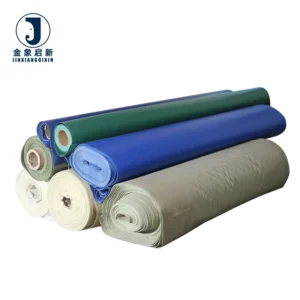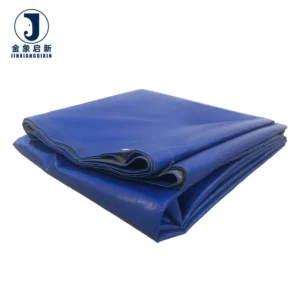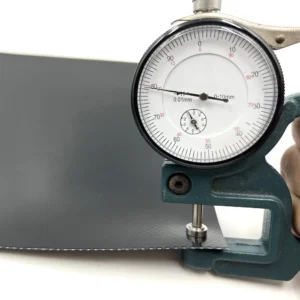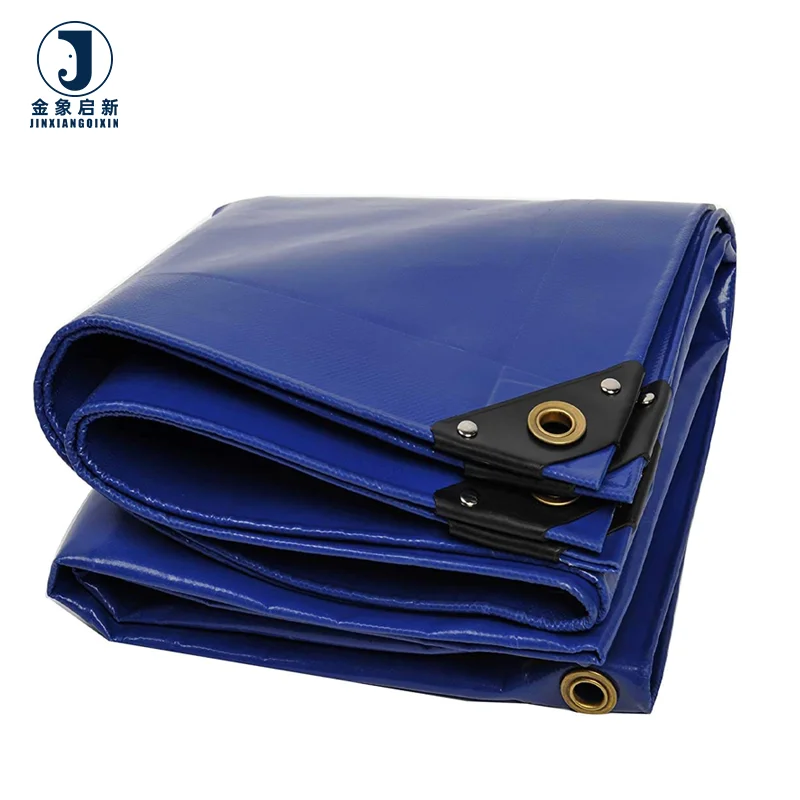
Deep Coating Process Control — every roll of PVC coated tarpaulin undergoes stage-by-stage QA verification of coating weight and adhesion, ensuring the fabric that arrives matches the material specification sheet.
Technical Specifications
| Parameter | Value |
|---|---|
| Product Type | PVC Coated Tarpaulin Roll |
| Coating Material | PVC coated polyester fabric |
| Weight Range | 50gr/m² ~ 220gr/m² (confirm grade for your application) |
| Total Thickness | 0.2–0.4mm / 8 mil–16 mil |
| Mesh Count Options | 6×6, 6×7, 7×7, 7×8, 8×8, 9×9, 8×10, 10×10, 12×12, 14×14, 14×16 |
| Available Widths | 6ft, 8ft, 10ft, 12ft / 2m, 4m, 6m |
| Roll Length | 100 yards, 100 meters, or custom |
| Color Options | Blue, Blue/Orange, Green, Grey, Black, Clear, Grey/Green, Orange, or custom |
| Hem Reinforcement | All four edges reinforced with PP rope in hem |
| Eyelet Options | Galvanized eyelets every 3ft or 1 meter interval |
| Corner Reinforcement | Reinforced plastic corners (finished tarpaulin only) |
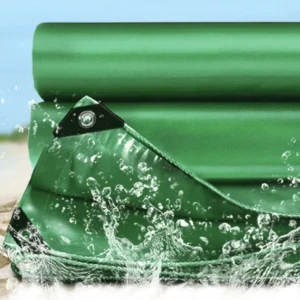
| Waterproof | Yes |
| Anti-UV Treatment | Available — confirm test basis required for your market |
| Anti-Static | Claimed — grade not stated, verify certification needed |
| Anti-Mildew | Mildew proof treated |
| Printing | Custom branding accepted |
| Certification | ISO, CE |
Application Suitability
| Application | Exposure & Requirement |
|---|---|
| Truck side curtain panels | Constant flexing at load points, road abrasion, UV and weather exposure, tie-down stress at eyelets |
| Flatbed and container load covers | Wind flap, water ingress, vibration-induced abrasion, secure fastening under highway speeds |
| Poultry and livestock coop curtains | Ammonia exposure, frequent wash-down, light and ventilation control, mildew risk in humid enclosures |
| Construction scaffolding wraps | Scaffold tie contact, wind load, debris impact, UV exposure over multi-month site use |
| Agricultural crop and equipment covers | Prolonged outdoor weather, stacking load pressure, mildew and moisture accumulation |
| Garden and backyard furniture covers | Seasonal UV, rain pooling, fold creasing during storage |
What "Custom-Sized" Really Means When Covers Fail at the Flex Points
Generic-size truck covers that do not match your trailer model cause costly rework and early seam failure.
I have seen fleet operators receive covers cut to a standard rectangle that left excess fabric flapping at the rear bolster and too little overlap at the cab end. The flapping section abrades against the load on every trip, while the short section pulls away from the eyelets in crosswind. Both problems trace back to ordering a cover that was sized to a catalogue dimension rather than to the actual trailer deck length, bolster spacing, and curtain rail height. When sourcing PVC coated tarpaulin roll for truck and transport applications, the roll width and the fabrication pattern matter just as much as the fabric weight. [NEED_CITE: dimensional fitment tolerances for side curtain and flatbed covers per fleet operator specifications]
Matching Roll Dimensions to Trailer Panel Geometry
A side curtain panel cut from a 4-meter-wide roll will require a mid-panel weld if the trailer height exceeds that dimension, and every weld is a potential flex-failure line. Selecting PVC coated tarpaulin roll stock in widths up to 6 meters allows full-height curtain panels without horizontal joins, removing the most common failure point on curtain-side trailers. Roll length options of 100 meters or custom cuts reduce waste when fabricating multiple panels from a single batch.
Reinforcement Where the Load Flexes Most
The edges and eyelet rows of a truck cover endure cyclic loading every time the vehicle hits a bump or encounters crosswind. PP rope hems distribute tie-down tension across the full edge rather than concentrating it at individual eyelets. Galvanized eyelets spaced at 3ft or 1-meter intervals provide secure anchor points for ratchet straps and bungee cords. Reinforced plastic corners add extra ply at the points where diagonal tension peaks during cornering and braking. [NEED_CITE: tie-down load distribution and eyelet spacing requirements for transport covers]
Reading GSM and Mesh Density Together
A 220gr/m² fabric with a 6×6 mesh count will behave very differently from a 220gr/m² fabric with a 14×16 mesh count. The higher mesh density means more yarn per square inch in the base fabric, which directly increases tear propagation resistance — the ability of the fabric to stop a cut from growing under load. Coating weight alone does not determine field performance; the base fabric construction carries the structural load while the PVC coating provides waterproofing and environmental protection. Selecting the right combination of GSM and mesh count for your trailer type and cargo profile prevents both over-specification and premature failure.
The choice of roll width also affects fabrication yield. Ordering a width that matches your panel dimension within a few centimeters reduces off-cuts and eliminates the need for weld joins that weaken at flex points. For operations fabricating covers across a mixed fleet, standardizing on one or two roll widths simplifies inventory and cutting patterns.
The Cost of Specifying by GSM Alone
When a buyer selects fabric based only on a quoted GSM figure, several risks emerge. A roll that arrives lighter than stated may pass a visual inspection but fail under tie-down tension during the first highway run. A fabric with correct weight but low mesh density can tear at the eyelet row when a strap is tensioned in wind. Anti-UV or anti-static treatment claimed without a supporting test report leaves the fleet exposed to compliance gaps and accelerated degradation in sunny or fuel-vapor-rich environments. Batch colour variation between rolls in the same order becomes visible once two panels are installed side by side on the same trailer, forcing a costly reorder. [NEED_CITE: tensile and tear test methods for coated fabrics per ISO 1421]
Why Fleet Fabricators Source This Roll Stock Here
Deep process control over coating weight and adhesion comes from nearly 30 years focused on coated fabric production, with QA verification at every stage from base fabric inspection through final roll winding. Three full production lines and 36 sets of professional equipment support bulk roll orders with reliable on-time dispatch, so your fabrication schedule is not held up by late material. A dedicated 10-person R&D team develops custom width, colour, and print samples within days, enabling you to match a fleet’s exact branding and dimensional requirements. Every roll receives 100 percent pre-shipment inspection with documented GSM verification, eliminating the surprise of underweight material arriving at your workshop. Full documentation packages — including material specification sheets, test reports, and certificates of origin — travel with every dispatch, satisfying fleet compliance and customs requirements.
Documentation & Verification
- Material specification sheet stating base fabric denier, coating method, mesh count, and confirmed GSM per roll
- Pre-shipment inspection record verifying coating weight matches the quoted grade before dispatch
- Test reports for anti-UV and anti-static treatment where grade has been confirmed for your market
- Roll packing list with individual roll identification for batch traceability
- Certificate of origin and customs documentation supporting international shipment clearance
- ISO and CE certificates confirming management system and product safety compliance
Fabrication, Handling & Storage
- Heat-weld seams at temperatures matched to the PVC coating thickness range of 0.2–0.4mm to prevent delamination at flex points
- Space galvanized eyelets at 1-meter intervals along PP rope hems to distribute tie-down tension evenly across the edge
- Store rolls upright on hard paper tubes to prevent flat-spot creasing that shows through the finished curtain panel
- Allow cold-stored rolls to reach ambient temperature before unrolling to avoid coating crack in low-temperature handling
- Use mild detergent for cleaning; avoid solvent-based products that attack the PVC coating surface and mildew-proof treatment
- Plan cutting layouts to align panel seams away from high-flex zones on the trailer side curtain
Preparing Your Roll Specification for Quotation
To receive an accurate quotation for PVC coated tarpaulin roll for truck and transport covers, share your trailer model dimensions or panel cutting pattern, the target GSM and mesh density you require, and any colour or branding specifications. If your fleet operates under a specific anti-static or fire-safety standard, state the grade so we can confirm treatment and test documentation. Let us know whether you need roll stock only or finished panels with eyelets and hem reinforcement applied.
Frequently Asked Questions
Q: How do I verify the GSM when the rolls arrive at my workshop?
A: Every roll ships with a pre-shipment inspection record confirming measured GSM against the quoted grade. On arrival, you can cross-check by cutting a measured square from the roll end and weighing it on a calibrated scale. Our material specification sheet states the base fabric denier and coating weight separately, so you can distinguish between coating shortfall and base fabric substitution.
Q: Can you produce custom widths and lengths for my trailer panel dimensions?
A: Custom roll widths up to 6 meters and lengths beyond the standard 100 meters are available. Our R&D team develops a sample within days for approval before bulk production runs. This allows you to match roll width to your exact curtain panel height, eliminating mid-panel weld joins that become failure points under road flex.
Q: What eyelet and hem finishing options are available on the roll stock?
A: Roll stock ships with all four edges reinforced with PP rope in the hem, and galvanized eyelets can be punched at 3ft or 1-meter intervals per your specification. Reinforced plastic corners are added to finished tarpaulins only. If you are fabricating in-house, we supply plain-edge rolls and provide recommended welding parameters for your equipment.
Q: How do you ensure colour consistency across multiple rolls in one order?
A: Dedicated QA/QC inspection checks colour reference against the approved sample at every production stage. All rolls in a single order are produced from the same coating batch to eliminate shade variation. If a panel is replaced in the field months later, the roll identification on the packing list enables us to match the original colour reference for reorders.
Q: What test documentation supports the anti-UV and anti-static claims?
A: Anti-UV and anti-static treatments are available in various grades depending on your market requirements. Once you confirm the specific standard or test method needed, we provide the corresponding test report with the shipment. If your fleet operates under a particular compliance regime, share the specification so we match the treatment grade and document it on the material specification sheet.