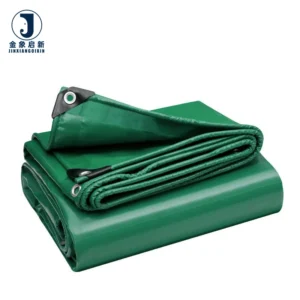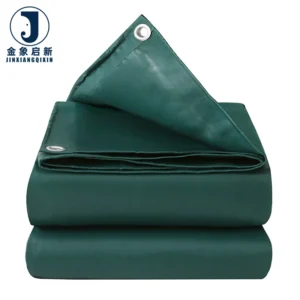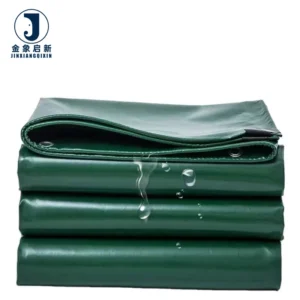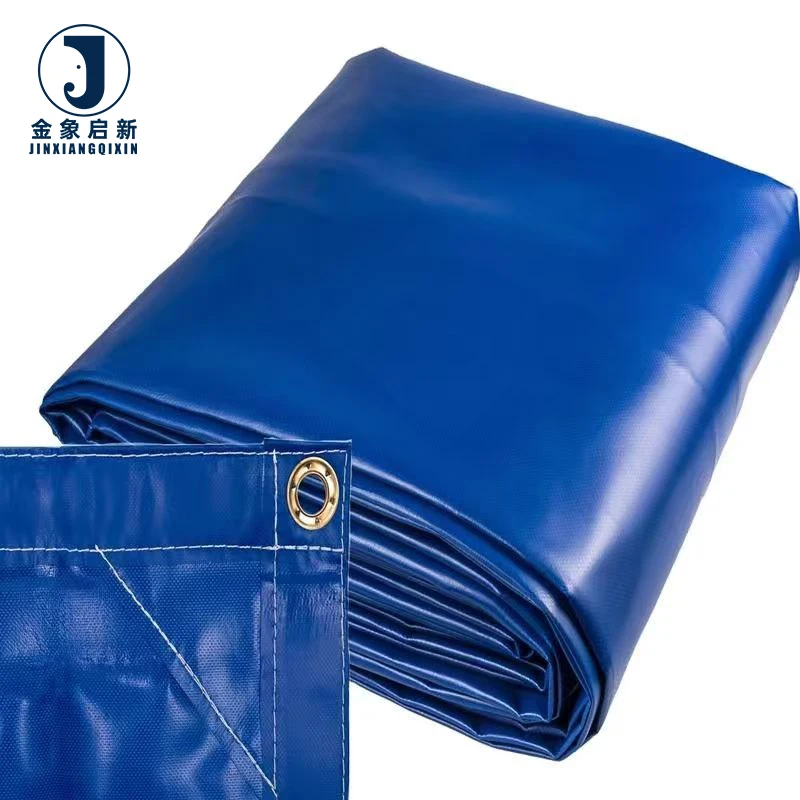
Coating Adhesion Control — Every roll undergoes peel-strength checks at the lamination stage to prevent delamination where the PVC meets the polyester base fabric during high-flex transport use.
Technical Specifications
| Parameter | Value |
|---|---|
| Product Type | PVC Coated Tarpaulin |
| Weight (GSM) | 250gsm-1500gsm |
| Base Fabric Denier | 200DX300D, 500DX500D, 840DX840D, 1000DX1000D |
| Coating Material | PVC |
| Coating Method | Coated and laminated |
| Color Options | Blue, yellow, black, green, white, or custom |
| Surface Finish | Glossy or matte |
| Temperature Range | -15ºC to 70ºC |
| UV Treatment | Customized — confirm test basis for your market |
| Flame Retardant Grade | FR treated — confirm the grade required for your market |
| Anti-Fungal | Anti-fungal treated |
| Waterproof Rating | Water-proof, rain-resistant |
| OEM / ODM | Accepted |
| Printing Option | Customized brand printing |
Application Suitability
| Application | Exposure & Requirement |
|---|---|
| Truck and trailer top covers | Direct rainfall, road spray, tie-down strap abrasion at contact edges, UV exposure across long haul routes |
| Side curtain fabric for curtain-siders | Constant flexing at curtain runners, wind load stress, repeated rolling and unrolling at loading bays |
| Train freight tarpaulin | High-speed airflow lift, vibration-induced fatigue at weld seams, extended weather exposure on open wagons |
| Swimming pool covers | Permanent water contact, chlorine and chemical exposure, UV degradation from full sun exposure |
| Sunshade and protection awning | Prolonged solar radiation, thermal expansion and contraction, wind uplift forces on fixed structures |
When a Truck Cover Cut to "Standard" Dimensions Fails Your Fleet
Exact vehicle model dimensions eliminate the slack that lets wind get underneath and tear the fabric from the inside.
Fleet operators ordering PVC coated tarpaulin for truck and transport covers often receive tarps cut to generic length and width. The result is excess material that flaps in highway airflow, creating internal abrasion against the load and accelerating seam failure at the points where the trailer flexes most. A cover that is three centimetres too wide on each side does not just look untidy — it acts as a sail that transfers lift force directly to the eyelet line, pulling brass rings through the fabric before the coating shows any sign of wear.
We see transport companies replace covers twice within a single operating cycle because the initial order used a standard size chart rather than the actual trailer measurement. The cost of early replacement is not just the tarp itself — it includes load damage claims when water penetrates through poorly tensioned panels. [NEED_CITE: wind load stress on loose-fitting transport covers during highway transit]
Fitment Accuracy That Generic Tarps Cannot Match
A PVC coated tarpaulin for truck and transport applications must be measured against the actual trailer bed, side rail height, and roof bow profile. Our custom sizing process starts with the vehicle model drawing or on-site measurement, then maps eyelet positions to the trailer’s load-rated lashing points rather than placing them at arbitrary intervals. This alignment prevents the uneven tension that causes diagonal creasing and eventual coating crack along the warp line.
Reinforcement at the Points That Actually Fail
The highest stress on any truck cover occurs where tie-down straps pass over the fabric edge and where the cover wraps around the rear roller mechanism. We reinforce these zones with additional PVC lamination layers matched to the base fabric denier, distributing strap pressure across a wider area. This targeted reinforcement works with the laminated construction to maintain adhesion integrity even when the trailer frame twists over uneven road surfaces. [NEED_CITE: lamination peel strength requirements for transport cover flex zones]
Why Base Fabric Denier Determines Curtain Life
The denier selection directly governs how the PVC coated tarpaulin behaves under the cyclic loading that side curtains experience every time a loading bay door opens. A 200DX300D base works for light-duty top covers on enclosed routes, while a 1000DX1000D weave provides the tear propagation resistance needed for side curtains on long-haul curtain-siders that face crosswind gusts. The weave density also determines how well the PVC coating penetrates between yarns — a tighter weave with proper lamination produces higher inter-yarn bond strength, which is what prevents the coating from lifting away from the base fabric at fold lines.
How Coating Method Affects Weld Seam Durability
The laminated coating process bonds the PVC film to the polyester base under heat and pressure, creating a mechanical interlock between the coating and individual yarn filaments. This matters most at welded seams, where high-frequency welding melts the PVC layers from two panels together. If the coating adhesion to the base fabric is weaker than the weld itself, the seam holds but the coating peels back from the fabric on either side — a failure mode we see regularly in covers where coating weight was reduced to lower cost. The coated and laminated method used here maintains consistent adhesion across the full roll width, so weld strength remains uniform regardless of where on the panel the seam falls. [NEED_CITE: high-frequency weld integrity testing methods for PVC laminated fabrics per ISO 1421]
Reading the Specifications Before You Order
The base fabric denier and the coating weight together determine how the PVC coated tarpaulin performs under load. Denier figures like 500DX500D describe the yarn thickness in warp and weft — higher denier means thicker individual yarns that resist cutting from sharp-edged loads. But denier alone does not predict tear strength; the weave pattern and coating penetration between yarns contribute equally. The temperature range of -15ºC to 70ºC defines the operational boundaries: below the lower limit, PVC becomes brittle and may crack when folded during winter dispatches; above the upper limit, the coating softens enough that tie-down straps can embed into the surface. The glossy or matte finish choice affects both cleanability and how the material handles on fabrication tables — glossy surfaces shed road grime more easily but can be slippery during installation, while matte finishes offer better grip for fabricators working with heavy panels.
What Happens When Colour Varies Across a Fleet Order
Transport companies that order multiple truck covers for a uniform fleet identity sometimes receive rolls where the shade shifts visibly between panels installed on adjacent trailers. This inconsistency does not just affect appearance — it signals uneven pigment dispersion during the coating process, which can also mean uneven UV stabiliser distribution across the batch. When UV treatment concentration varies within a single roll, some sections degrade faster than others, showing colour fade and surface chalking in patches that follow the original roll lay-flat pattern. [NEED_CITE: pigment dispersion consistency standards in PVC coated fabric production batches]
Why This PVC Coated Tarpaulin Source Works for Transport Buyers
Three full production lines and 36 sets of professional equipment handle bulk fleet orders with on-time delivery across multiple trailer configurations. The 10-person R&D team develops custom cut patterns from your trailer drawings and produces samples within days for fitment verification before the main production run begins. Dedicated QA/QC at every production stage includes coating weight checks and peel strength measurement, with 100% inspection before shipment documented in a pre-shipment inspection record. Deep process control over coating weight and adhesion developed over decades of coated fabric production ensures that the GSM stated on your quotation matches what arrives at your receiving dock. ISO and CE certified production provides the documentation framework your procurement team needs for compliance audits.
Documentation & Verification
- Material specification sheet confirming base fabric denier, coating weight, and colour reference for your order
- Weight verification per roll against the stated GSM before dispatch from the production line
- Test reports for UV and flame retardant treatment where these grades are specified in your inquiry
- Pre-shipment inspection record with photographs showing actual roll condition and packing
- Certificate of origin and customs documentation prepared for your destination market
Fabrication, Handling & Storage
- Heat-weld seams using parameters matched to the laminated coating thickness to achieve full PVC fusion at the joint
- Space eyelets at intervals aligned to the trailer lashing points specified in your vehicle drawing
- Store rolls horizontally on pallets to prevent permanent creasing in the base fabric weave structure
- Allow cold-stored rolls to reach ambient temperature before unrolling to avoid coating micro-cracking below -15ºC
- Clean glossy surfaces with mild detergent only to preserve the coating surface and anti-fungal treatment
- Cut panels using templates derived from actual trailer dimensions to avoid material waste and slack fitment
What We Need to Quote Your Transport Cover Project
Send us the trailer make, model, and year along with the type of cover required — top cover, side curtain, or full wrap. Specify the base fabric denier and GSM grade you need, along with any flame retardant or UV treatment requirements for your operating region. Let us know the quantity per size and whether you need custom brand printing on the panels.
Frequently Asked Questions
Q: How do I verify the GSM matches what was quoted before the shipment arrives?
A: We provide a pre-shipment inspection record that documents the actual weight measurement taken from sample cuts across the production batch. You can also request a certified scale reading per roll. On arrival, your receiving team can confirm by cutting a measured square from the roll edge and weighing it against the specification sheet included in the dispatch documentation.
Q: What dimensions do you need to cut a custom truck cover to my trailer model?
A: We require the trailer bed length, side rail height, roof bow profile, and the position of lashing points. If you provide the trailer manufacturer’s technical drawing, we can map the cover pattern directly. For side curtains, we also need the runner track type and the clearance at the rear roller mechanism to ensure smooth operation.
Q: Can you supply test reports for UV and flame retardant treatments?
A: Test reports are available for orders where UV or flame retardant treatment is specified and confirmed during the sample stage. The report documents the test method used and the result achieved. Confirm the grade or standard your market requires — such as a specific flame retardant classification — so we can match the treatment to your compliance needs.
Q: How do you handle colour matching when I order multiple covers for a fleet?
A: All panels in a single fleet order are produced from the same pigment batch to maintain colour consistency. The production run is scheduled as one continuous coating sequence rather than split across separate batches. A colour reference sample is sent for your approval before the main run begins, and the shade is verified against that reference during the pre-shipment inspection.
Q: What eyelet spacing and hem reinforcement options are available for tie-down loads?
A: Eyelet spacing is set to match your trailer’s lashing rail positions rather than a standard interval. Hems are folded and heat-welded to the panel body, with additional reinforcement layers applied at high-stress corners and strap contact zones. Specify your tie-down strap width and load rating so we can size the reinforcement accordingly.