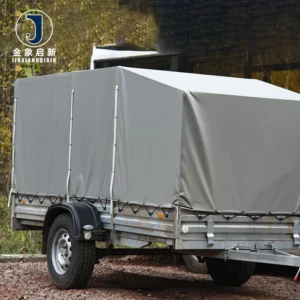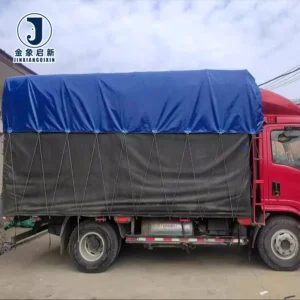
Precision Fitment Engineering — Every PVC Lumber Tarpaulin for Flatbed Truck is cut to your exact trailer deck dimensions with reinforced D-ring anchor points at the flex zones where highway loads shift most.
Technical Specifications
| Parameter | Value |
|---|---|
| Product Type | PVC Coated Truck Tarpaulin |
| Material | PVC coated fabric (1000×1000D, 20×20 / 18×18) |
| Weight | 610 gsm (18 oz) / 16 oz / 14 oz options |
| Thickness | 0.35–1.5 mm (medium to super heavy-duty grades) |
| Base Fabric Denier | 500D to 2000D range |
| Tensile Strength | Warp 1500–3000 N/5cm, Weft 1200–2800 N/5cm |
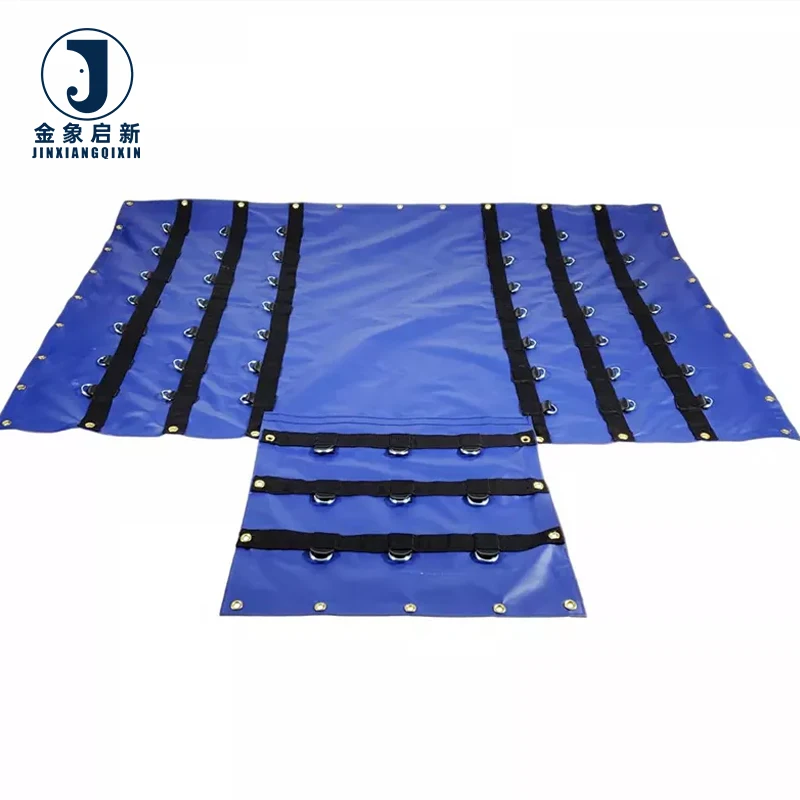
| Drop Options | 6 ft and 8 ft (3 rows of D-rings, tail wing); 4 ft (2 rows of D-rings) |
| Color | Black / Blue |
| Operating Temperature | -35 to 70 °C |
| Finish | Coated |
| Certification | ISO, CE |
Application Suitability
| Application | Exposure & Requirement |
|---|---|
| Flatbed lumber transport — stacked timber on long-haul routes | Continuous road vibration, wind uplift on tall stacks, rain ingress at deck edges |
| Wall panel and building material freight | UV exposure on open highway, debris impact from passing traffic, load flex at tie-down zones |
| Steel cargo and heavy industrial loads on flatbeds | Abrasion against sharp cargo edges, extreme temperature cycling, high tie-down tension at D-ring points |
Why Tie-Down Points Fail Before the Fabric Does
A PVC Lumber Tarpaulin for Flatbed Truck rarely fails because the coated fabric itself tears first. The split almost always starts at the D-ring anchor or the welded seam connecting the drop flap to the main body — the exact zone where highway vibration and load shift concentrate force into a small area.
Reinforcement at the anchor point matters more than the GSM of the main panel.
When a loaded flatbed hits uneven pavement at speed, the cargo mass shifts and the tarp flexes repeatedly at every tie-down location. Conventional tarps rely on a single layer of hem fabric around the D-ring. Under sustained vibration, that single layer fatigues, the weld delaminates, and the ring pulls free — leaving the load exposed within the first few hundred miles. [NEED_CITE: fatigue failure modes at tie-down anchor points in transport tarpaulins per ISO 1421 test methods]
How Flatbed Lumber Tarps Secure the Load at Every Flex Point
This PVC Lumber Tarpaulin for Flatbed Truck uses three rows of D-rings on the 6 ft and 8 ft drop variants, distributing tie-down tension across a wider area of the hem. Each ring is anchored through a reinforced patch that extends beyond the hem fold, so the pulling force spreads into the body fabric rather than concentrating at a single weld line. The tail wing on the longer drops wraps over the end of the load, preventing wind from lifting the tarp at the trailing edge where air turbulence is highest.
Trailer-Specific Fitment Over Generic Sizing
Generic-sized tarps leave excess fabric that flaps in the slipstream or fall short at the deck edges, exposing cargo to road spray. This PVC Lumber Tarpaulin for Flatbed Truck is produced against confirmed trailer deck dimensions — length, width, and drop depth — so the fabric lies flat against the load without tension points or slack zones. Fleet operators ordering for multiple trailer models receive individually sized tarps matched to each deck, with colour held consistent across the batch through controlled coating runs. [NEED_CITE: batch colour consistency standards for PVC coated fabrics in fleet applications]
Reading the Specification Sheet Beyond the GSM Number
The 610 gsm weight of the 18 oz variant reflects the combined mass of the base fabric and the PVC coating applied to both sides. Two tarps can share the same GSM yet perform differently on a flatbed if the base fabric denier and weave density diverge. A 1000×1000D base with a 20×20 weave provides a denser yarn grid than an 18×18 construction, which means the load of a tie-down strap distributes across more yarn intersections before any single yarn reaches its breaking point. Coating thickness then determines how well those yarns resist abrasion against rough cargo surfaces like unfinished lumber or steel edges. Operating across -35 to 70 °C means the PVC formulation stays pliable in winter freight without becoming brittle at the fold lines, and resists softening on hot deck surfaces in summer.
The Hidden Cost of Wrong Specification on the Highway
A tarp specified too light for the cargo profile will abrade through the coating at contact points within weeks, exposing the base fabric to moisture and UV breakdown. When flame retardant treatment is claimed but no test grade accompanies the shipment, the tarp may pass a visual inspection yet fail a roadside compliance check — resulting in load rejection and re-routing delays. Colour variation between rolls in a fleet order becomes visible the moment two tarps are deployed side by side on adjacent trailers, undermining the fleet’s professional appearance and prompting complaints from the customer’s client. [NEED_CITE: compliance rejection rates for transport tarpaulins lacking verified fire classification]
Why Source This Tarpaulin Through Jinxiang
Three full production lines and 36 sets of professional equipment support consistent output across fleet-scale orders, so lead times hold even when multiple trailer models are specified in one shipment. The 10-person R&D team handles pattern layout and D-ring placement against your trailer drawings before production begins, eliminating fitment guesswork. Every roll undergoes dedicated QA at each coating stage, with 100% pre-shipment inspection confirming actual GSM against the quoted weight. Nearly 30 years of focused coated fabric production means the process controls around coating adhesion and weld strength are embedded in the workflow, not added as an afterthought. Samples for custom dimensions and reinforcement layouts are developed within days, allowing fleet buyers to verify fitment before committing to a full order.
Documentation & Verification
- Material specification sheet stating verified GSM, base fabric denier, and coating weight per roll
- Pre-shipment inspection record confirming actual weight against the 610 gsm or selected grade
- Colour reference code matching the batch for fleet consistency traceability
- ISO and CE certificates covering the production facility and coated fabric output
- Roll packing list detailing dimensions, drop length, and D-ring configuration per unit
Fabrication, Handling & Storage
- Weld seams at D-ring patches using hot-air welding matched to the 610 gsm PVC coating for full adhesion
- Reinforced hem folding at 8 ft drop edges to distribute strap tension across the 1000D base fabric
- Store rolls upright on pallets to prevent flat-spot creases in the heavy-duty coated material
- Deploy tarps above -35 °C minimum to avoid stiffness-related cracking at fold lines during winter freight
- Clean with mild detergent only — solvents degrade the PVC coating surface on the 18 oz grade
Request a Fitment Quote
Provide your flatbed trailer make, deck length, width, and required drop depth so we can confirm cut dimensions and D-ring row count. Specify whether your freight profile demands the 610 gsm heavy-duty grade or the lighter 16 oz or 14 oz options. Let us know your fleet colour requirement and whether flame retardant certification is needed for your operating jurisdictions.
Frequently Asked Questions
Q: How do you verify the 610 gsm weight on arrival matches the quotation?
A: Every roll is weighed and recorded during pre-shipment inspection. The inspection report shipped with your order states the measured GSM per roll, so you can cross-check against the quoted 610 gsm immediately on delivery. We do not ship material that falls below the specified weight tolerance.
Q: Can the tarp be cut to my specific trailer deck dimensions rather than a generic size?
A: Yes. We produce against your confirmed deck length, width, and drop depth. Provide the trailer model or exact measurements, and the cut size is held to those dimensions across the entire order — no generic sizing applied to multiple trailer types.
Q: What reinforcement is available at D-ring and hem stress points?
A: The 6 ft and 8 ft drops carry three rows of D-rings, each anchored through a reinforced patch that extends into the body fabric. The 4 ft drop uses two rows. Hem folding is doubled at high-tension edges to spread strap load across the 1000D base weave.
Q: How is colour consistency maintained across multiple tarps in a fleet order?
A: All tarps in one fleet order are coated in the same production run using a single colour reference batch. The material specification sheet records the colour code, ensuring any future reorder can be matched to the original shade across the fleet.
Q: What documentation confirms material specs and quality before dispatch?
A: Your shipment includes a material specification sheet with GSM, denier, and coating weight, a pre-shipment inspection record, roll packing list, and ISO and CE certificates. Flame retardant test reports are provided where the grade has been specified and verified for your market.