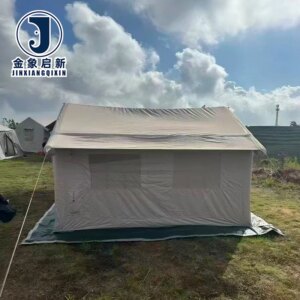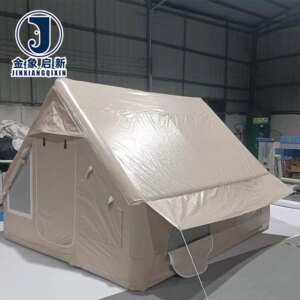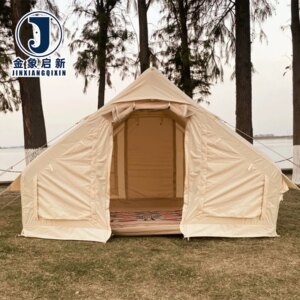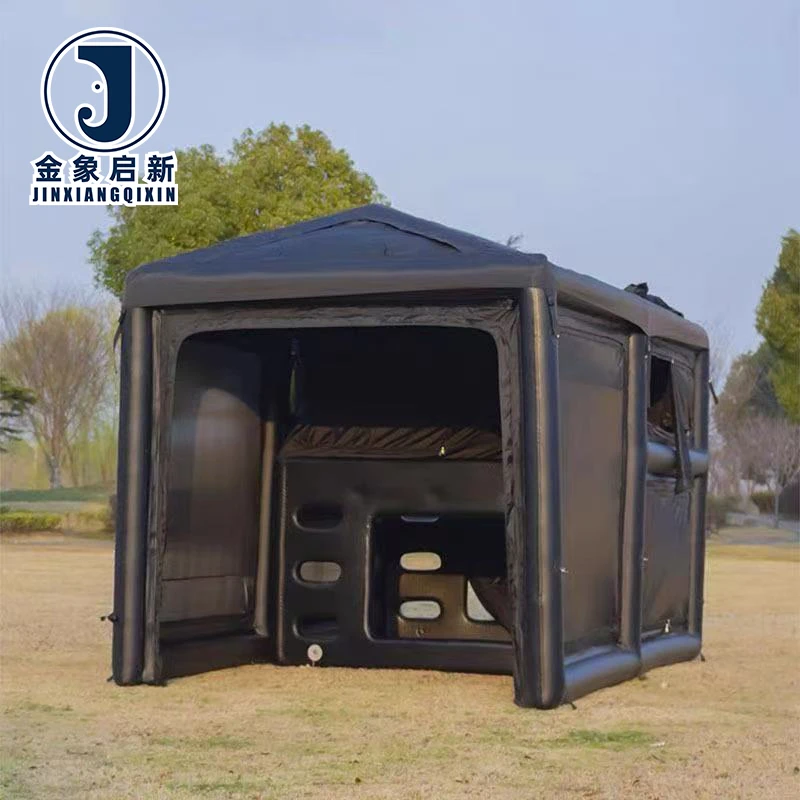
Production Line Control — Three full coating lines with in-process weight verification keep PVC tarpaulin rolls within tight GSM and thickness tolerances before they reach your cutting table.
Technical Specifications
| Parameter | Value |
|---|---|
| Product Type | Inflatable Tent |
| Core Material | PVC knife-coated tarpaulin |
| Waterproof Rating | Hydrostatic head ≥ 5000mm |
| UV Resistance | UPF 50+ |
| Fire-retardant Grade | EN 13501-1 Class B |
| Tear Strength | ≥ 300N |
| Anti-static Surface Resistance | 10⁶–10⁹Ω |
| Material Thickness Range | 0.4mm–1.2mm (available across product family — confirm grade for your structure) |
| Customization | OEM & ODM, size adjustments, pattern printing, reinforced seams |
| Production Lead Time | Up to 45 days for custom orders; sample production 7–10 days |
| Standards | ISO 9001, ISO 14001, ISO 45001, CE |
Application Suitability
| Application | Exposure & Requirement |
|---|---|
| Commercial inflatable rental tents | Repeated inflation/deflation cycles, public-use fire compliance, UV exposure during extended outdoor events |
| Construction site temporary shelters | Wind loading on inflated frames, debris abrasion, on-site fire safety codes |
| Expedition and four-season camping tents | Sustained rain and snow load, low-temperature flexibility, waterproof integrity at seam welds |
| Mining and industrial inflatable structures | Anti-static requirements in combustible dust environments, mandatory ventilation duct certifications |
| Event and exhibition dome structures | Large-span inflation pressure retention, aesthetic surface finish for branding, batch colour consistency |
Why Inflatable Tent Fabric Certification Matters More Than Stated Thickness
Fabricators sourcing inflatable tent fabric manufacturer supply often receive material that passes a basic thickness check but fails the fire or anti-static audit on site. Thickness alone does not prove compliance. A 0.9mm PVC roll without documented EN 13501-1 Class B testing will not satisfy a building inspector reviewing a temporary event structure, and missing anti-static certification can shut down a mining ventilation project entirely.
Every batch we ship carries test reports specific to that production run, not a generic datasheet borrowed from a different grade. [NEED_CITE: EN 13501-1 fire classification for construction and event materials] When a site safety officer asks for paperwork, your project documentation answers the question without delay.
Coating Weight and Adhesion Under Inflation Pressure
Inflatable structures place continuous stress on the coating-to-substrate bond. PVC knife-coated fabric achieves deeper penetration into the base weave than calendered or laminated alternatives, which directly affects peel strength at heat-welded seams. When the inflated frame flexes under wind load, the seam must hold without delaminating — a failure mode that originates in coating adhesion, not base fabric strength. This is the reason we specify knife-coated construction for every inflatable tent fabric manufacturer order destined for pressurised structures.
Fire and Anti-static Compliance Without Guesswork
EN 13501-1 Class B fire-retardant grading provides a recognised benchmark that maps to fire safety codes across European and many international jurisdictions. [NEED_CITE: mapping of EN 13501-1 Class B to local fire safety regulations] Anti-static surface resistance in the 10⁶–10⁹Ω range addresses environments where electrostatic discharge poses an ignition hazard. Both properties are confirmed through batch-level testing, so your compliance file stays current without chasing retrospective certificates.
Reading the Specification Sheet Against Your Design Requirements
Hydrostatic head of ≥ 5000mm indicates the fabric will resist water penetration under the sustained internal pressure of an inflated chamber, not just surface rainfall. Tear strength ≥ 300N matters most at anchor points and valve cut-outs where stress concentrates — the base fabric denier and weave density together determine whether a small nick propagates into a panel failure. UPF 50+ treatment slows polymer degradation from continuous sun exposure, preserving tensile properties over multiple deployment seasons. Thickness options from 0.4mm to 1.2mm span lightweight backpacking tent tubes through to heavy-duty industrial shelter beams, so confirming the exact grade at the inquiry stage prevents over-specification cost or under-specification risk. [NEED_CITE: relationship between PVC coating thickness and sustained inflation pressure retention]
The Hidden Cost of Batch Inconsistency Across Rolls
Colour drift between rolls in a single shipment becomes visible once panels are welded side by side on the production floor, forcing manufacturers to cull mismatched sections and absorb material waste. Coating weight variation within the same order alters heat-weld parameters — a setting that seals one roll cleanly may leave the next under-bonded or scorched. These inconsistencies do not show up on a certificate of conformity; they surface only during fabrication. Our QA protocol holds colour and coating weight within defined tolerances roll-to-roll, reducing rework and keeping your production schedule intact. [NEED_CITE: causes of colour variation in PVC coated fabric production runs]
Why Procurement Teams Specify This Material for Inflatable Structures
Deep process control over PVC coating weight and adhesion, maintained across three dedicated production lines, ensures that the knife-coated fabric you approve at sample stage matches bulk delivery.
A 10-person R&D team handles material selection, pattern printing layouts, and custom sizing, producing pre-production samples within 7–10 days so you validate weld behaviour before committing to volume.
Dedicated QA/QC checkpoints run from raw material tensile verification through 100% pre-shipment inspection, so dimensional accuracy and performance properties are confirmed per batch.
ISO 9001, ISO 14001, and ISO 45001 certified production provides an auditable quality management framework that satisfies procurement requirements for commercial and government tenders.
Custom width and pattern printing capability means you order rolls cut to your panel layout, reducing off-cuts and secondary trimming operations on your factory floor.
Documentation & Verification
- Material spec sheet confirming PVC coating weight, base fabric construction, and thickness for your ordered grade
- EN 13501-1 Class B fire-retardant test report tied to the specific production batch
- Anti-static surface resistance certificate documenting 10⁶–10⁹Ω range per shipment
- Pre-shipment inspection record covering dimensional accuracy and visual consistency across all rolls
- ISO and CE certificates included in the documentation package for tender and audit submissions
Fabrication, Handling & Storage
- Set heat-weld temperature and dwell time based on the specific PVC coating thickness to avoid under-bonding or burn-through at seams
- Reinforce valve cut-outs and anchor points with additional PVC patches to distribute stress beyond the base fabric tear strength
- Store rolls upright on pallets in a covered, ventilated area to prevent flat-spotting and surface marking on the knife-coated finish
- Allow cold-stored rolls to reach ambient temperature before unrolling to prevent coating micro-cracking in low-temperature conditions
- Use PVC-compatible cleaners only; solvent-based products can degrade the UPF 50+ treatment and fire-retardant surface layer
- Plan panel layouts around available roll widths to minimise longitudinal welds on inflated beam sections
Requesting the Right Grade for Your Inflatable Application
Provide the intended inflation pressure, operating temperature range, and the fire or anti-static codes your end market enforces so we can recommend the appropriate thickness and treatment grade from the 0.4mm–1.2mm range. If your project requires custom panel widths, pattern printing, or reinforced seam engineering, share your panel drawings and we will develop a pre-production sample for weld and fit validation.
Frequently Asked Questions
Q: What fire-retardant and anti-static certifications accompany inflatable tent fabric shipments?
A: Each batch carries an EN 13501-1 Class B fire-retardant test report and an anti-static certificate confirming surface resistance within 10⁶–10⁹Ω. Both documents reference the specific production run, not a generic product family rating, so your compliance file matches the material on site.
Q: Can you supply multiple rolls with consistent colour and coating weight across an order?
A: Yes. Our QA protocol monitors coating weight and colour at defined intervals during production. Rolls within a single shipment are held to tight tolerances on both parameters, reducing visible panel mismatch and weld setting variation on your fabrication floor.
Q: How does the sample approval process work for custom sizes or printed patterns?
A: Submit your panel dimensions, colour references, and any printing artwork. Our R&D team produces a sample within 7–10 days for your review. Once you approve weld strength, seam integrity, and print accuracy, we proceed to bulk production under the same process parameters.
Q: How do I choose the right material thickness for my inflatable structure?
A: Thickness selection depends on inflation pressure, structural span, and deployment conditions. Lighter grades around 0.4mm suit portable camping tent tubes, while heavier grades up to 1.2mm serve industrial shelters with sustained wind loading. Share your design parameters and we recommend the appropriate grade.
Q: What documentation is included with each inflatable fabric shipment?
A: You receive a material specification sheet, batch-specific fire-retardant and anti-static test reports, a pre-shipment inspection record, roll packing list, ISO and CE certificates, and a certificate of origin. All documents are cross-referenced to your purchase order for full traceability.