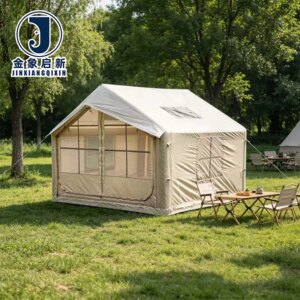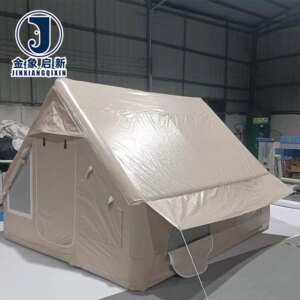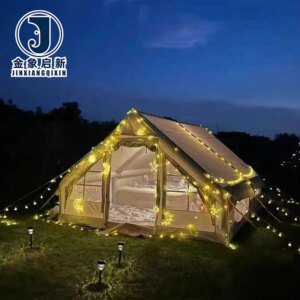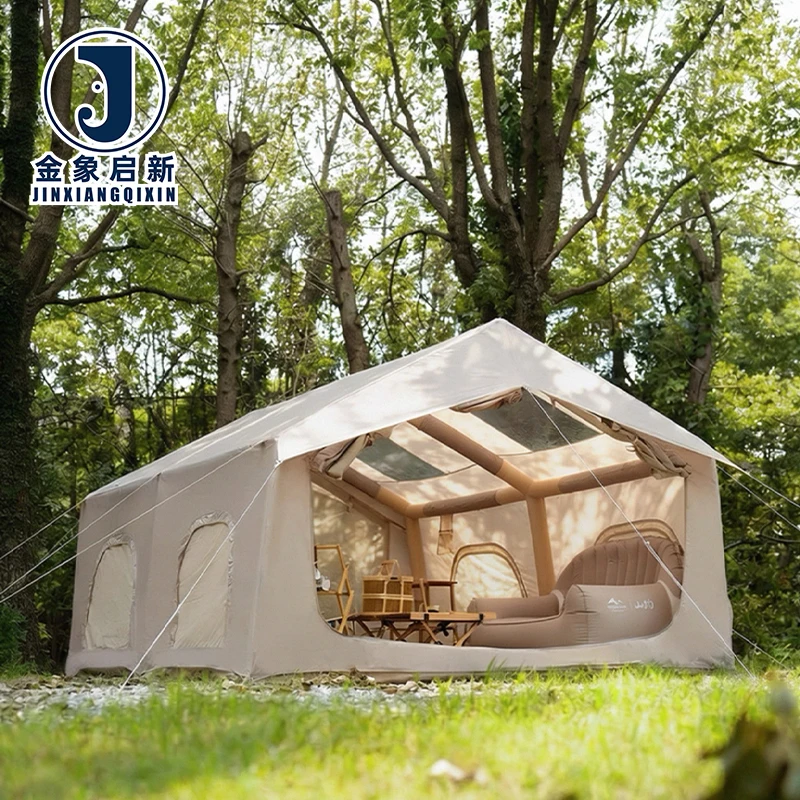
Coated Fabric Process Control — nearly 30 years focused on PVC coating delivers consistent adhesion and weld integrity across every inflatable tent unit we produce.
Technical Specifications
| Parameter | Value |
|---|---|
| Product Type | Inflatable Tent |
| Core Material | PVC Waterproof Fabric |
| Waterproof Rating | ≥1000mm water column (source value — verify against manufacturer catalog) |
| Tear Resistance | ≥300N (source value — verify against manufacturer catalog) |
| Flame Retardancy Standard | EN 13501-1 (source value — verify against manufacturer catalog) |
| Key Features | Waterproof, UV-resistant, Tear-resistant, Fire-retardant, Anti-static |
| Season Rating | Four-season |
| Product Form | Inflatable structure with quick automatic opening |
| Construction | Single layer, extended type |
| Customization Options | Size, color, pattern printing, valve types |
| Sample Development | 7–10 days |
| Lead Time | 30 days for standard orders |
| Certifications | CE, ISO9001, ISO14001, ISO45001 |
Application Suitability
| Application | Exposure & Requirement |
|---|---|
| Fleet operator emergency roadside shelter | Wind loading, rain ingress, rapid single-person deployment on hardstanding |
| Transport depot personnel and equipment cover | Prolonged UV exposure, forklift contact, dust and moisture ingress |
| Outdoor event management temporary shelter | Crowd safety fire compliance, repeated setup and teardown cycles, weather variability |
| Industrial site mobile command post | Flame retardant acceptance by site safety officer, anti-static requirement in fuel-handling zones |
Why Waterproof Ratings Alone Do Not Guarantee a Dry Interior
A stated water column value means nothing if the seams leak before the fabric does.
When an inflatable tent for transport and commercial shelter is deployed at a logistics yard or roadside breakdown scene, water finds the weakest point first. That point is almost always the welded seam or the valve surround, not the coated fabric itself [NEED_CITE: seam integrity test methods for inflatable coated fabric structures]. A ≥1000mm water column rating on the base PVC fabric is a useful baseline, but buyers should confirm that the finished, inflated unit has been tested as a complete assembly. Generic products frequently quote the fabric rating while the heat-welded joints fail at a fraction of that pressure, leaving cargo or personnel exposed during the first heavy rainfall.
Rapid Deployment Under Real Transport Timetables
Fleet operators and logistics managers cannot afford a shelter that takes two people twenty minutes to erect when a trailer is delayed at a loading bay. The quick automatic opening inflatable structure addresses this directly — a single operator connects the inflation valve, and the frame reaches full rigidity within minutes. This matters at depot staging areas where driver rest shelters or mobile inspection posts must appear and disappear around shifting vehicle schedules, and where every minute of manual setup is a minute the crew is not managing the load.
Fire Compliance at Industrial and Event Sites
Site safety officers at construction compounds, fuel depots, and commercial event venues do not accept verbal assurances about flame retardancy. They require documented test results against a recognized classification. The PVC fabric used in this inflatable tent is treated to meet EN 13501-1 flame retardant requirements, and the corresponding test documentation can be supplied with each batch [NEED_CITE: EN 13501-1 classification system for construction and temporary structure materials]. Buyers operating across multiple jurisdictions should confirm the grade required for their specific market and application before placing a production order.
Reading the Fabric Spec Sheet Beyond the Headline Numbers
The waterproof rating, tear resistance, and flame retardant grade listed above each describe a different failure mode. Waterproof performance depends on coating continuity and seam integrity; a high water column reading on the base fabric does not transfer to the finished inflatable unit unless the welds are executed at correct temperature and pressure. Tear resistance at ≥300N indicates how the PVC-coated fabric resists propagation once a puncture or cut occurs — relevant when the tent is dragged across gravel at a roadside stop or brushed by palletized cargo at a depot. The interplay between base fabric denier, weave density, and coating weight together determines whether a small nick stays local or runs across the panel. EN 13501-1 classification addresses the surface burning behaviour that site inspectors evaluate, and this standard should be cross-referenced with local fire codes governing temporary commercial structures [NEED_CITE: relationship between EN 13501-1 class and local temporary structure fire regulations].
The Cost of Overlooking Batch Consistency in Multi-Unit Orders
When a transport company orders several inflatable tents for deployment across different depots, colour variation between rolls becomes immediately visible once units are erected side by side at a shared site. More critically, inconsistency in coating weight from one batch to the next means that one tent may pass a flame retardant inspection while another from the same purchase order does not. Weld parameters set for one batch’s coating formulation may produce weak seams on the next, causing structural air leaks that appear only after the unit has been in service [NEED_CITE: coating weight variance impact on heat weld strength in PVC tarpaulin fabric]. These are failures that no single spec-sheet number can predict — they are caught only through in-process quality checks at every production stage.
Why Source This Inflatable Tent From Jinan Jinxiang
Our 10-person R&D team handles material selection, pattern printing, and custom sizing specifically for inflatable structures, developing samples within 7–10 days so buyers can validate fit and performance before committing to a production run. Three full production lines and 36 sets of processing equipment support bulk capacity with reliable scheduling for standard and custom orders. Every unit undergoes 100% pre-shipment inspection including inflation testing to verify structural airtightness, rather than relying on statistical sampling that leaves defects undetected. Deep process control over PVC coating weight and adhesion, built across nearly 30 years of coated fabric specialization, means the inflatable tent for transport and commercial shelter you receive matches the specification agreed at quotation stage. Dedicated QA and QC checkpoints at each production stage catch coating, weld, and dimensional issues before they reach the packing line.
Documentation & Verification
- Material specification sheet stating PVC fabric composition, coating weight, and performance parameters for each inflatable tent order
- Batch inspection report detailing waterproof performance, tear resistance, and flame retardancy test results against EN 13501-1
- Pre-shipment inflation test record confirming structural airtightness and valve integrity of every unit
- CE certification documentation and certificate of conformity prepared for import clearance in destination markets
- Roll and unit packing list with weight and dimension details for container loading planning
Fabrication, Handling & Storage
- Heat-weld seams at temperatures matched to the specific PVC coating weight to prevent delamination at flex points
- Store inflated units dry and fully deflated; avoid sharp folds that create permanent crease lines in the coated fabric
- Use compatible PVC repair patches and solvent cement for field repairs on punctures or valve surround damage
- Clean with mild detergent only; abrasive cleaners degrade the surface coating and reduce waterproof integrity
- Avoid dragging the PVC fabric across unpaved ground during deployment to minimize puncture and abrasion risk
Before You Request a Quotation
Provide your deployment environment details — whether the inflatable tent will serve as a roadside emergency shelter, a depot equipment cover, or an event structure — along with the wind and weather exposure expected at your sites. Confirm the flame retardant grade your local regulations require, and specify any custom dimensions, colour references, or valve type preferences. If your order involves multiple units, let us know whether batch colour consistency across all tents is critical for your installation.
Frequently Asked Questions
Q: How is the waterproof rating verified on each batch before shipment?
A: The PVC waterproof fabric undergoes hydrostatic pressure testing to confirm it meets the ≥1000mm water column threshold stated on the specification sheet. Beyond the base fabric, every finished inflatable tent is fully inflated and inspected for air leaks at seams, valve surrounds, and panel joints during pre-shipment quality control.
Q: What flame retardant grade does the tent fabric meet, and is test documentation provided?
A: The PVC fabric is treated to meet EN 13501-1 flame retardant requirements. A batch-specific test report referencing this standard can be supplied with your shipment. Buyers should confirm with their local authority whether EN 13501-1 satisfies the fire classification required for temporary commercial structures in their jurisdiction.
Q: Can the tent size, color, and valve types be customized for specific site requirements?
A: Yes. Size, colour, pattern printing, and valve configuration are all available as customization options. Our R&D team develops samples within 7–10 days so you can evaluate the finished inflatable tent against your deployment requirements before full production begins.
Q: How is structural airtightness tested and what maintenance is recommended for long-term use?
A: Each unit is inflated to operating pressure and held for inspection before dispatch, checking every weld line and valve fitting for leaks. For ongoing service, store the tent fully deflated and dry, inspect seams periodically for signs of peel or abrasion, and use PVC-compatible repair materials for any field damage.
Q: What documentation accompanies the shipment for customs and site compliance?
A: Each order ships with a material specification sheet, batch inspection report covering waterproof and flame retardant test results, CE certification documentation, a packing list with unit weights and dimensions, and a certificate of origin where required for customs clearance at the destination port.