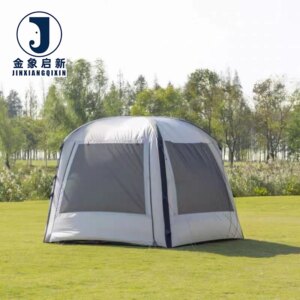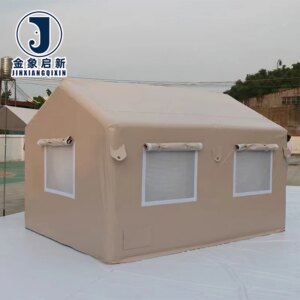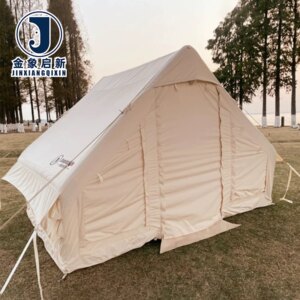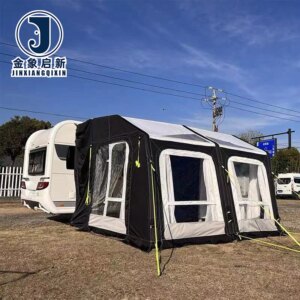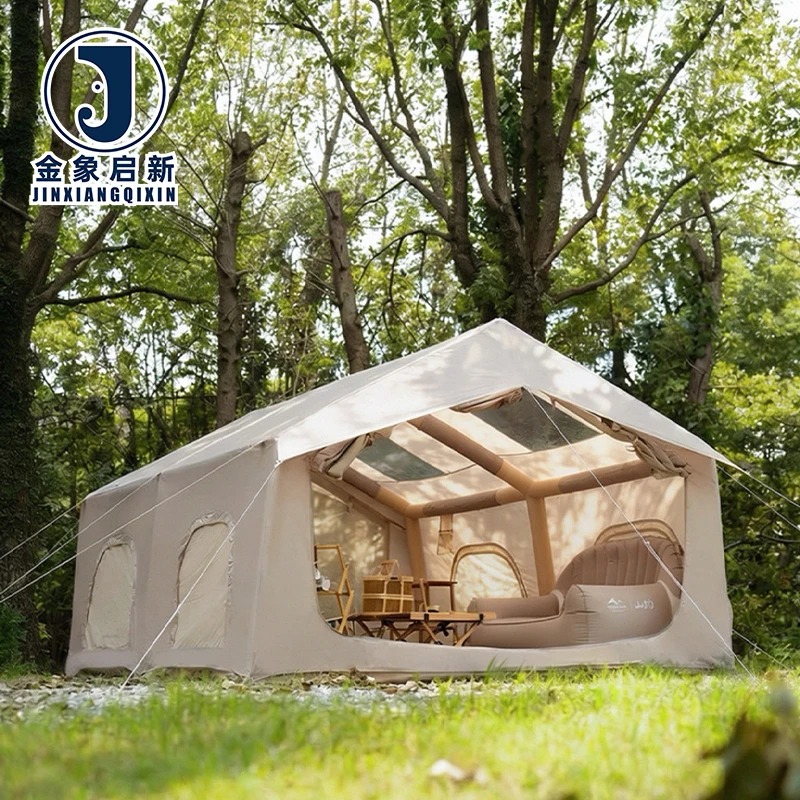
Deep Process Control — nearly 30 years focused on coated fabric, delivering verified GSM, coating weight, and adhesion across every inflatable tent roll we produce.
Technical Specifications
| Parameter | Value |
|---|---|
| Product Type | Inflatable Tent |
| Core Material | PVC tarpaulin |
| Waterproof | Fully waterproof coated construction |
| UV Resistance | UV-resistant (test basis not stated — confirm required standard) |
| Tear Resistance | Tear-resistant PVC coated fabric |
| Fire Retardancy | Fire-retardant (grade not stated — confirm grade required for your market) |
| Anti-Static | Anti-static (standard not stated — confirm site compliance requirement) |
| Opening Mechanism | Quick automatic opening inflatable structure |
| Customization | OEM & ODM, sample customization, pattern printing available |
| Certifications | ISO9001, ISO14001, ISO45001, CE |
Application Suitability
| Application | Exposure & Requirement |
|---|---|
| Logistics hub temporary shelters | Wind loading, UV exposure, rapid deployment at staging yards and loading docks |
| Emergency disaster relief command posts | Immediate shelter need, fire-retardant and anti-static compliance on-site, all-weather exposure |
| Construction and engineering site storage | Prolonged outdoor exposure, equipment protection from rain and debris, certified material documentation |
| Transport depot operational facilities | High-traffic temporary cover, repeated inflation and deflation cycles, abrasion at ground contact points |
Why "Fire-Retardant" Without a Test Report Puts Your Site at Risk
Certification claims without batch-specific test documentation leave transport fleet operators exposed during compliance audits.
Transport depot managers and logistics contractors often specify fire-retardant inflatable shelters for staging areas and temporary work zones. Generic quotations list fire retardancy as a feature, yet the material arrives without a test report matching the grade the site safety plan demands. This gap surfaces during inspections, not during purchasing. Inflatable Tent for Truck and Transport Application requires documented compliance before the structure is inflated on-site [NEED_CITE: fire-retardant test standards for temporary structures in industrial zones]. Our PVC inflatable tent material is available in fire-retardant grades — confirm the grade required for your market and request the corresponding batch test report before approving production.
Rapid Deployment When Minutes Determine Outcomes
Emergency logistics scenarios demand shelter structures that inflate and stabilise within minutes, not hours. The quick automatic opening mechanism built into each Inflatable Tent for Truck and Transport Application eliminates the manual pole assembly that slows conventional tents. Fleet operators deploying temporary covers at freight staging yards or roadside incident zones benefit from a single-operator inflation process that reduces setup exposure in adverse weather.
Compliance Documentation That Travels With the Product
Transport and logistics sites operating under strict safety frameworks require material documentation before any temporary structure is erected. Each batch of PVC inflatable tent fabric ships with the material specification sheet and certification references that match your site’s audit trail. The fire-retardant and anti-static treatment options are documented per batch, not asserted as a blanket claim, so procurement teams can cross-reference against site-specific safety requirements before deployment.
How Material Selection Determines Field Performance
The PVC tarpaulin core material forms the structural membrane of the inflatable tent, and its coating weight directly influences both air-holding integrity and resistance to puncture during ground contact. The base fabric weave density determines how well the material resists tear propagation when the inflated structure flexes under wind load. Fire-retardant and anti-static treatments are integrated during the coating stage, meaning their effectiveness depends on process control rather than post-production surface application [NEED_CITE: PVC coating adhesion and treatment integration methods]. Waterproof performance is inherent to the fully coated PVC construction, eliminating the need for secondary water-repellent treatments that degrade with field use. UV resistance is available as a treatment option — buyers should confirm the test basis required for their target deployment environment and expected exposure duration.
The Hidden Cost of Uncertified Material Claims
Logistics contractors who accept inflatable tent shipments without verifying fire-retardant grades against site requirements face two consequences: rejected structures during safety audits and unplanned replacement costs mid-project. Batch colour variation across multiple tent units in a single order creates visible inconsistency when structures are deployed side by side at transport depots. Welded seams on inflatable structures endure constant stress from internal air pressure — when the coating adhesion is weak, seam failure precedes fabric failure, leaving the entire structure deflated and unusable [NEED_CITE: seam integrity testing for inflatable PVC structures]. These failures are preventable when procurement specifies test-backed material grades and inspects pre-production samples under actual inflation conditions.
What 9,180 Square Metres of Dedicated Coated Fabric Production Means for Your Order
Three full production lines and 36 sets of professional processing equipment support bulk inflatable tent orders without sacrificing lead time reliability. A 10-person R&D team handles material grade selection, custom sizing, and pattern printing — samples are developed within days rather than weeks. Dedicated QA and QC staff conduct 100% inspection before shipment, catching coating weight deviations and colour inconsistencies before rolls leave the facility. ISO9001, ISO14001, ISO45001, and CE certifications underpin the production system, providing the compliance framework that transport fleet procurement teams require. Nearly 30 years of focused coated fabric experience translates into process control over coating adhesion and GSM consistency — the two factors that determine whether an inflatable tent membrane holds air reliably under field conditions.
Documentation & Verification
- Material specification sheet confirming PVC tarpaulin grade, coating weight, and base fabric construction per batch
- Fire-retardant and anti-static test reports matched to the specific production batch and grade ordered
- ISO9001, ISO14001, ISO45001, and CE certificate references included in shipment documentation
- Pre-shipment inspection record covering GSM verification, colour consistency, and weld integrity across every unit
- Certificate of origin and customs documentation prepared per destination country requirements
Fabrication, Handling & Storage
- Heat-weld seams at manufacturer-recommended temperature to preserve PVC coating adhesion on the inflatable membrane
- Store deflated tent units flat or loosely rolled to prevent permanent crease marks in the PVC tarpaulin coating
- Inspect inflation valves and air channels before each deployment to avoid uneven stress on welded seams
- Clean PVC surfaces with mild detergent only — solvent-based cleaners may degrade the fire-retardant treatment layer
- Repair minor punctures with compatible PVC patch kits before re-inflation to prevent tear propagation under air pressure
Before You Request a Quote
Provide your deployment scenario — whether the inflatable tent will serve as a temporary logistics shelter, disaster relief command post, or on-site equipment cover — along with the environmental exposure conditions expected. Specify the fire-retardant grade and anti-static standard your site safety framework requires, so we can match the correct material treatment and prepare the corresponding test documentation. Indicate whether you need OEM sizing, pattern printing, or standard dimensions, and confirm your target order volume to align production scheduling.
Frequently Asked Questions
Q: What fire-retardant grade options are available, and how do I verify compliance for my site?
A: Our PVC inflatable tent material is available in fire-retardant treatment options. The specific grade applicable to your deployment site depends on local regulations and your safety framework requirements. We recommend confirming the required test standard with your site safety officer, then requesting the batch-specific test report before approving production. This ensures documentation matches your compliance audit trail.
Q: How does the anti-static treatment work, and is it certified?
A: Anti-static treatment is integrated during the PVC coating process to reduce static charge accumulation on the inflatable membrane surface. The applicable standard depends on your operational environment and regulatory requirements. We provide anti-static treatment options and can supply test documentation per batch — confirm the standard your site requires so we align the correct specification before sampling.
Q: Can I get custom dimensions and branding on inflatable tents?
A: Yes. Our 10-person R&D team supports full OEM and ODM customization including custom sizing, pattern printing, and branding. We develop samples within days so you can evaluate the inflatable structure’s fit and finish before committing to production. Custom parameters are documented in the material specification sheet that ships with your order.
Q: How do you ensure colour consistency across multiple inflatable tent units in one order?
A: Colour consistency is managed through controlled PVC coating batches and dedicated QA inspection at each production stage. For large orders spanning multiple production runs, we conduct cross-batch colour comparison before dispatch. We recommend requesting a pre-production sample to approve the colour reference, which then serves as the benchmark for 100% pre-shipment inspection.
Q: What documentation ships with each inflatable tent order for compliance purposes?
A: Every shipment includes the material specification sheet, fire-retardant and anti-static test reports where applicable, ISO and CE certificate references, pre-shipment inspection records, and packing documentation. Certificate of origin and customs support documents are prepared based on your destination country requirements, ensuring your procurement team has the full compliance package on delivery.