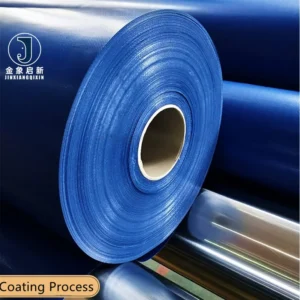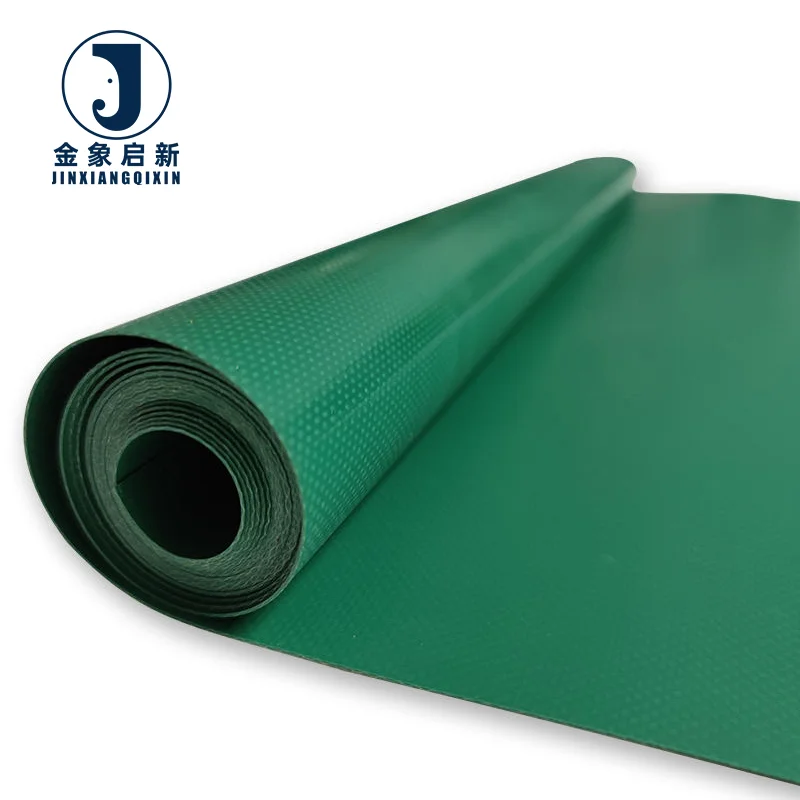
Deep Process Control — coating weight and adhesion verified at every production stage for PVC coated tarpaulin rolls, ensuring the GSM on the quotation matches the roll that arrives at your loading dock.
Technical Specifications
| Parameter | Value |
|---|---|
| Product Type | PVC Coated Tarpaulin Roll |
| Material Composition | PVC & Polyester |
| Coating Method | Double-Sided PVC Coating on Polyester Base |
| Base Fabric Denier Options | 500D×840D / 500D×1000D / 1000D×1000D / 1000D×1300D / 1300D×1300D / 1000D×2000D |
| Weight Grades (GSM) | 350 / 400 / 420 / 500 / 600 / 650 / 750 / 900 |
| Total Thickness | 0.29 mm (400 GSM) – 0.65 mm (900 GSM) |
| Mesh Density | 30×19 / 20×20 / 30×15 (varies by GSM grade) |
| Tensile Strength Warp | 1650 N (350 GSM) – 3900 N (900 GSM) |
| Tensile Strength Weft | 1600 N (350 GSM) – 3500 N (900 GSM) |
| Temperature Range | Brittle ≤ −50 to −60 °C; Softening ≥ 80 °C |
| Key Features | Water Resistant, Anti-UV (test basis not stated), Flame Retardant (grade not stated), Waterproof |
Application Suitability
| Application | Exposure & Requirement |
|---|---|
| Truck side curtain (curtainsider trailers) | Continuous flexing at highway speed, road abrasion, tie-down tension at eyelet points |
| Trailer top cover and load wrap | Direct UV exposure, rain ingress prevention, wind uplift on flatbed loads |
| Industrial shelter and site enclosure | Long-term weather exposure, wind loading on large panels, weld seam integrity |
| Machine and equipment cover | Abrasion from contact surfaces, moisture and dust ingress prevention |
| Awning and temporary structure | UV degradation, thermal cycling, structural seam stress under wind load |
Why Welded Seams Fail Before the Fabric Does on Truck Covers
Seam failure at flex points is the most common reason transport operators replace covers prematurely — and it is a construction problem, not a material problem.
When a PVC coated tarpaulin for truck cover applications flexes repeatedly over a moving load, the highest stress concentrates at the junction between the welded seam and the base fabric. If the heat-seal temperature or pressure is not calibrated to the specific GSM and coating thickness, the bond line develops micro-cracks that propagate under each flex cycle. The fabric itself may still have full tensile capacity while the seam has already delaminated. [NEED_CITE: heat-seal parameter calibration for PVC coated polyester fabrics]
I have seen heavy-grade coated rolls fail at the weld line on curtainsider trailers after months of daily opening and closing. The base fabric showed no visible wear, but the edge wrapping had lifted along the entire hem length. This is why construction method matters as much as material selection.
Matching Yarn Count to the Load Profile of Moving Covers
The base fabric denier determines how the PVC coated tarpaulin roll behaves when a trailer side curtain is pulled taut against tie-down straps. Lower denier counts like 500D×840D produce a lighter, more pliable fabric suited to smaller trailers with moderate flex frequency. As the vehicle size and wind loading increase, higher denier options up to 1000D×2000D provide the tensile reserve needed to resist tearing at the eyelet and hem stress points.
Selecting the correct yarn count is not simply choosing the heaviest option available. Over-specifying denier on a small delivery van cover adds weight and stiffness without improving service life, while under-specifying on a long-haul curtainsider leads to premature failure at the tie-down reinforcement zones. The right PVC coated tarpaulin for truck cover duty matches yarn count to the specific trailer model and its typical route conditions.
Edge Construction That Holds Under Multi-Directional Pulling
Standard truck and trailer covers experience pulling forces from multiple directions simultaneously — vertical tension from tie-down straps, horizontal stress from wind buffeting, and shear forces when the curtain is drawn along the track. The edge construction must distribute these loads across a wide area rather than concentrating them at a single point.
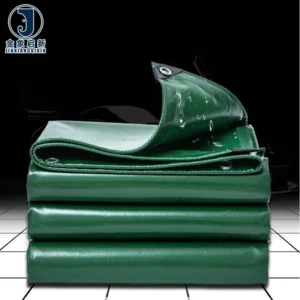
The 3cm enlarged aluminum alloy buttonholes with reinforced corners spread the tie-down load over a broader section of the base fabric. Combined with high temperature heat sealed seamless edge wrapping, this approach eliminates the glue cracking that occurs at hem stress points when conventional adhesive-bonded edges are subjected to thermal cycling on the road. [NEED_CITE: edge reinforcement methods for transport tarpaulin applications]
How GSM, Mesh Density and Denier Work Together on Coated Fabric
A common mistake in specifying PVC coated tarpaulin roll material is treating GSM as the sole indicator of strength. In reality, the tensile and tear performance of coated polyester fabric is determined by the interaction of three variables: the denier of the base yarn, the mesh density of the weave, and the weight of the PVC coating applied to both sides.
Consider two rolls both rated at 600 GSM. If one uses a 1000D×1000D base fabric at 20×20 mesh with a moderate coating weight, and the other uses a lower denier base with heavier coating to reach the same total weight, the first will have substantially higher tear resistance because the base yarn carries the structural load while the coating provides waterproofing and surface protection. Coating weight alone does not contribute to tensile strength — it adds mass without adding structural capacity.
Mesh density affects how tears propagate through the fabric. A tighter weave like 30×19 restricts tear spread because each yarn intersection acts as a mechanical stop. A more open weave like 20×20 allows a tear to run further before encountering the next yarn crossover point. This is why the PVC coated tarpaulin for truck cover applications on long-haul routes benefits from both high denier and appropriate mesh density rather than high GSM alone.
The coating method also plays a role in how well the PVC bonds to the polyester base. Double-sided coating with proper adhesion ensures that the coating does not separate from the base fabric during heat sealing or under flex stress. Delamination between coating and base is a distinct failure mode from seam failure, and it is controlled by the coating process parameters rather than the raw material specifications.
What Happens When Roll Specifications Do Not Match the Cover Design
Specifying a PVC coated tarpaulin roll without verifying how its properties translate to the finished truck cover creates a cascade of problems that only appear after installation. A fabric with insufficient tensile reserve for the tie-down system will show eyelet pull-through within the first weeks of use. A coating weight that is too heavy relative to the base fabric makes the material stiff and difficult to track along curtain rails, accelerating wear at the contact points.
Batch inconsistency across rolls in the same order is another hidden cost. When a fleet operator orders multiple covers from the same batch and the colour varies roll-to-roll, the installed covers present an unprofessional appearance across the fleet — a problem that is visible only after fabrication and installation, when replacement cost is at its maximum. [NEED_CITE: colour consistency standards for batch-produced coated fabrics]
Weld parameters set for one GSM grade will produce weak bonds if applied to a different grade without adjustment. A heat-seal temperature calibrated for 500 GSM material will under-bond on 750 GSM stock because the thicker coating requires more energy input to reach the correct fusion temperature. This mismatch is a frequent cause of seam failure on covers fabricated from mixed-grade roll stock.
Why Fleet Operators Source PVC Tarpaulin Roll Stock Here
Three full production lines and 36 sets of professional equipment support bulk roll output with consistent coating weight across the production run. This capacity means that when you order multiple rolls of a specific GSM and colour for a fleet standardization project, the material is produced within the same campaign rather than being split across separate runs with potential batch variation.
A 10-person R&D team handles material selection and sample development for custom sizing and colour requirements. When a transport equipment builder needs a PVC coated tarpaulin for truck cover applications on a new trailer model, samples are developed within days so the fabric can be tested on the actual frame before bulk commitment.
Dedicated QA and QC at every production stage with full inspection before dispatch catches GSM deviation, colour variance and coating defects before the roll leaves the facility. This is particularly important for fleet operators who cannot afford to discover material inconsistency after the cover has been fabricated and fitted to a vehicle already in service.
The facility maintains ISO and CE certification, providing documentation that satisfies procurement compliance requirements for transport companies and equipment builders operating under quality management systems.
Documentation & Verification
- Material specification sheet confirming GSM, base fabric denier and coating type for each roll
- Test report for UV and flame-retardant grades where applicable to your specification
- Pre-shipment inspection record verifying weight and dimensions against the quoted grade
- Roll packing list with individual roll identification for traceability after dispatch
- Certificate of origin and customs documentation for international shipment
Fabrication, Handling & Storage
- Set heat-seal temperature and dwell time according to the specific GSM and coating thickness of the PVC coated tarpaulin roll grade selected
- Position 3cm aluminum alloy buttonholes at intervals matching the tie-down strap spacing of the target trailer model
- Store rolls upright on pallets in a dry area to prevent flat spots and edge deformation on the coated surface
- Allow rolls to acclimatize before unrolling in cold conditions, as PVC stiffens near the brittle temperature range
- Use mild detergent for cleaning; avoid solvent-based products that can attack the PVC coating layer
Requesting the Right Specification for Your Fleet
To specify the correct PVC coated tarpaulin for truck cover applications, provide the trailer model, the type of cover required — side curtain, top wrap or full enclosure — and the tie-down system in use on your vehicles. If your fleet operates under specific fire safety or compliance requirements in your market, state the standard or grade needed so the material can be matched and tested accordingly.
Indicate whether you require roll stock for in-house fabrication or finished covers cut to the specific vehicle dimensions, along with any colour or custom printing requirements for fleet branding. For multi-roll orders, confirm the target colour reference so batch consistency can be verified before dispatch.
Frequently Asked Questions
Q: Which GSM and yarn count suits my trailer side curtain?
A: The correct combination depends on trailer size, flex frequency and tie-down load. Lighter trailers with moderate use typically perform well on mid-range GSM with 500D base fabric, while long-haul curtainsiders benefit from higher denier and tensile reserve. Share your trailer model and route profile for a specification recommendation.
Q: Can you supply flame-retardant certified material for transport compliance?
A: Flame-retardant PVC coated tarpaulin roll options are available, but the specific grade must match the standard required in your market. Confirm which fire classification or certification your application demands, and the material will be produced and tested to that grade with supporting documentation provided.
Q: How do you ensure colour consistency across multiple rolls in one order?
A: Multi-roll orders are produced within the same production campaign to minimize batch variation. Pre-shipment inspection includes colour comparison across rolls before dispatch. For fleet branding where exact colour matching is critical, a sample approval step is recommended before full production begins.
Q: What is the maximum roll width and minimum order for custom colour?
A: Roll width options and minimum quantities depend on the specific GSM grade and colour requested. Custom colours outside the standard range require a sample development step. Provide your target width, GSM and colour reference to receive the applicable lead time and minimum for your configuration.
Q: Do you provide samples before bulk commitment?
A: Samples are developed within days for custom requirements including specific GSM, colour and finish. This allows transport equipment builders and fleet operators to test the PVC coated tarpaulin roll material on the actual trailer frame and verify weld compatibility before placing a bulk order.