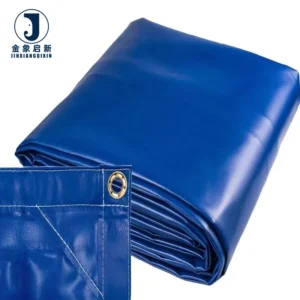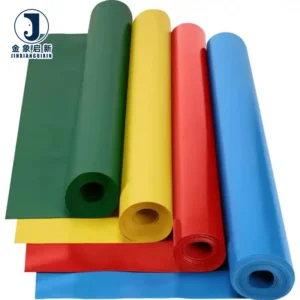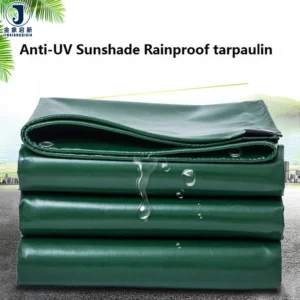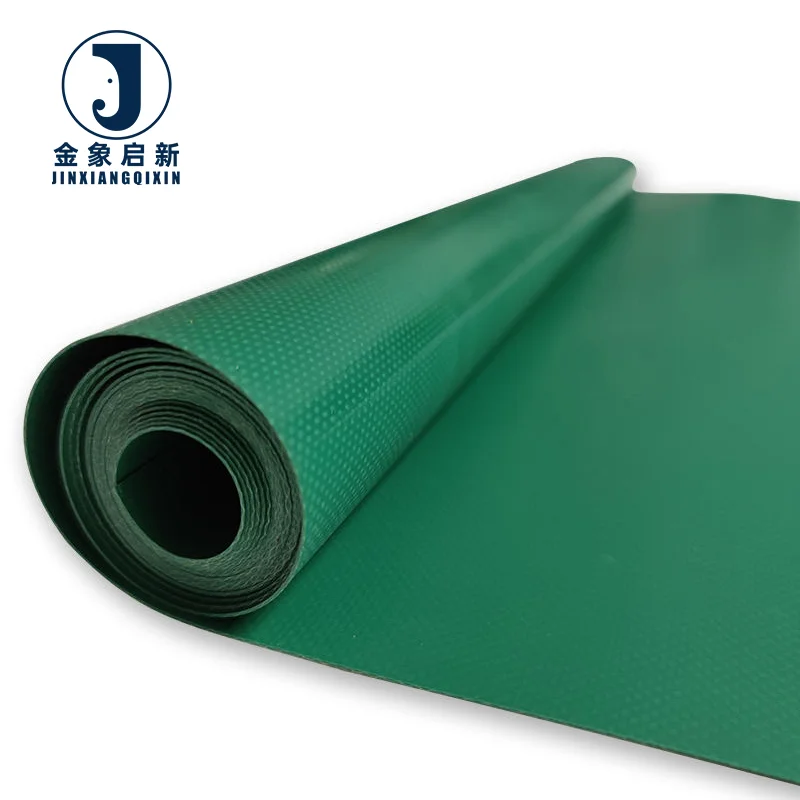
Roll-to-Roll Batch Consistency — Every PVC Coated Tarpaulin Roll undergoes dedicated QA/QC at each production stage with 100% inspection before dispatch, ensuring weight, colour and coating adhesion match the specification sheet across your entire fleet order.
Technical Specifications
| Parameter | Value |
|---|---|
| Product Type | PVC Coated Tarpaulin Roll |
| Material | PVC Coating on Polyester Base Fabric (Double-Sided) |
| Yarn Count Options | 500D840D, 500D1000D, 1000D1000D, 1000D1300D, 1300D1300D, 1000D2000D |
| Weight (GSM) | 350, 400, 420, 500, 600, 650, 750, 900 |
| Total Thickness | 0.29 mm (400 GSM), 0.32 mm (420 GSM), 0.38 mm (500 GSM), 0.44 mm (600 GSM), 0.46 mm (650 GSM), 0.55 mm (750 GSM), 0.65 mm (900 GSM) |
| Mesh Count | 3019 (350–500 GSM), 2020 (600–750 GSM), 30*15 (900 GSM) |
| Tensile Strength (Warp/Weft, N) | 1650/1600 (350 GSM) to 3900/3500 (900 GSM) |
| Softening Temperature | ≥ 80 °C |
| Brittle Temperature | ≤ -50 to -60 °C |
| Melting Point | 212 °C |
| Density | 1.15–2.00 g/cm³ |
| Edge Finishing | High Temperature Heat Sealed Seamless Edge Wrapping |
| Eyelets | 3 cm Enlarged Aluminum Alloy Buttonhole |
| Rope | 5 mm Thick Rope Without Splicing |
| Corner Reinforcement | Reinforced Corners on All Sides |
| Key Features | Water Resistant, Waterproof, Anti-UV (grade not stated), Flame Retardant (grade not stated) |
| Certifications | ISO, CE |
Application Suitability
| Application | Exposure & Requirement |
|---|---|
| Truck Side Curtain | Constant flexing at load points, road debris abrasion, UV exposure, tie-down tension at eyelets |
| Flatbed Trailer Cover | High wind lift forces, water ingress prevention, repeated folding and unfolding cycles |
| Fleet Load Enclosure | Mixed weather routes, mechanical stress from cargo shift, long-haul vibration |
| Transport Equipment Builder Fitment | Model-specific cut dimensions, seam integrity at welded joints, colour match across units |
| Logistics Tarpaulin Replacement | Rapid deployment, compatibility with existing tie-down hardware, durability under daily use |
Why Generic Sizing Fails Fleet Covers
Specify exact trailer dimensions and reinforcement layout — one size never fits every model in a mixed fleet.
A PVC Coated Tarpaulin for Truck and Transport cut to a generic dimension leaves excess fabric flapping in crosswinds or, worse, falls short at the corners where cargo is most exposed [NEED_CITE: field failure patterns in generic-size transport covers]. I have seen fleet operators replace covers repeatedly because the weld line cracked at a flex point the original pattern never accounted for. The cost is not the fabric — it is the downtime, the load damage claim, and the rework.
Fitment Accuracy Across Trailer Models
Each trailer model has distinct corner radii, buckle strap positions and roof bow spacing. A PVC Coated Tarpaulin for Truck and Transport must be patterned to these dimensions so that eyelets align with the vehicle’s tie-down rail and heat-sealed seams sit flat against the structural frame rather than bridging an air gap that invites wind lift.
Reinforcement at the Points That Actually Fail
The highest stress on any transport cover is where the load flexes during braking and cornering. Enlarged 3 cm aluminum alloy eyelets with reinforced corners distribute tie-down load across a wider fabric area, while high-temperature heat-sealed edge wrapping eliminates the stitched needle holes that become tear initiation points under road vibration [NEED_CITE: seam failure mechanics in coated fabric transport covers].
Reading the Specification Sheet Beyond the GSM Number
GSM tells you the weight per square metre but says nothing about how that weight is distributed between the base fabric and the coating. A 650 GSM roll with a 1000D1300D polyester base and a balanced coating will outperform a 650 GSM roll that achieves its weight through excessive coating on a lighter yarn, because tensile and tear strength come primarily from the woven base fabric denier and mesh count. The mesh count — 2020 for mid-weight grades, 30*15 for the 900 GSM option — defines how many yarns per centimetre share the load when a point force hits the fabric. Similarly, brittle temperature rated at -50 to -60 °C and softening temperature at 80 °C define the operating envelope: a cover that stiffens and cracks in a Nordic winter or softens and sags on a Middle Eastern tarmac has been specified outside its thermal boundaries.
The Hidden Cost of Specifying on Price per Kilogram Alone
When procurement selects a PVC Coated Tarpaulin for Truck and Transport based solely on cost per kilogram, the roll that arrives may hit the quoted GSM but achieve it through a heavier coating on a lighter base yarn. The result is a fabric that feels substantial on the scale yet tears easily at the eyelet under strap tension, or a coating that delaminates at the heat-sealed seam after a season of flex cycles [NEED_CITE: coating adhesion failure under cyclic mechanical load]. Colour variation between rolls in the same shipment becomes visible once installed side by side on adjacent trailers, forcing a full re-order to maintain fleet appearance.
Why Fleet Buyers Source This Range
Process control over coating weight and adhesion is maintained across three full production lines and 36 sets of professional equipment, giving bulk capacity without sacrificing roll-to-roll consistency. A 10-person R&D team handles pattern development for specific trailer models, producing cut-to-size samples within days so fitment is validated before the production run begins. Dedicated QA/QC checks at every stage — base fabric inspection, coating weight verification, colour matching, seam strength — mean the PVC Coated Tarpaulin for Truck and Transport you receive matches the material specification sheet you approved. Pre-shipment inspection is 100%, not sampled. Full documentation travels with every dispatch.
Documentation & Verification
- Material specification sheet stating exact GSM, base fabric denier and coating weight per roll
- Pre-shipment inspection record confirming weight and colour against the approved sample
- Test report for UV and flame retardant grades where applicable to your market
- ISO and CE certificates covering the production facility and processes
- Roll packing list with individual roll weights for container load planning
- Certificate of origin for customs clearance in your destination market
Fabrication, Handling & Storage
- Heat-seal at temperatures matched to the PVC coating thickness; the 0.55 mm grade at 750 GSM requires different dwell time than the 0.38 mm at 500 GSM
- Store rolls horizontally on racking to prevent flat-spotting and permanent creasing on the polyester base fabric
- Allow cold-stored rolls to acclimatise before unrolling; the brittle temperature threshold is -50 to -60 °C but handling stiffness increases well above that
- Use compatible PVC adhesive for field repairs; solvent-based cements bond to the coated surface without attacking the base weave
- Plan cut patterns to place heat-sealed seams along the trailer structural frame, avoiding mid-panel welds where flex load concentrates
What to Include in Your Enquiry
Provide the specific truck and trailer models in your fleet along with the cover type required — full enclosure, side curtain, or top-only sheet. State your target market so we can confirm the flame retardant grade and UV treatment level that local regulations demand. Indicate whether you need finished cut-to-size covers with eyelets and edge reinforcement, or roll stock for your own fabrication workshop.
Frequently Asked Questions
Q: How do I verify the GSM on arrival matches what was quoted for my truck cover order?
A: Every roll ships with a pre-shipment inspection record documenting actual weight measured against the specification sheet. You can perform a simple cut-and-weigh check on arrival using a 10 cm × 10 cm sample and a calibrated scale. Discrepancies are addressed under the documentation package before the container leaves the facility.
Q: What flame retardant grade is available for transport covers in my market?
A: Flame retardant treatment is available in multiple grades — confirm the specific standard your market requires, such as DIN 4102, NFPA 701 or a local building code classification. The applicable test report is included in the documentation package when a rated grade is specified at the inquiry stage.
Q: Are heat-sealed seams more durable than stitched seams at trailer flex points?
A: Heat-sealed seams create a continuous bonded joint without needle perforations that become tear initiation sites. The high-temperature heat-sealed edge wrapping on this PVC Coated Tarpaulin for Truck and Transport eliminates stitch-line cracking under the cyclic load that side curtains and trailer roofs experience during transit.
Q: Can I order custom sizes and eyelet spacing for specific trailer models?
A: Yes. Provide the trailer make, model and year, and the R&D team will develop a cut pattern with eyelet positions matched to your vehicle’s tie-down rail layout. Samples are produced within days for fitment approval before the full production run proceeds.
Q: What roll widths and loading quantities apply to fleet-scale orders?
A: Rolls are supplied in widths up to approximately 2 m depending on the grade selected. Container loading is planned by roll count and total weight to maximise utilisation. A detailed packing list accompanies each shipment for your receiving and inventory planning.