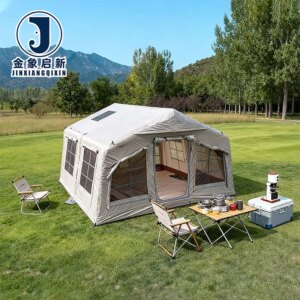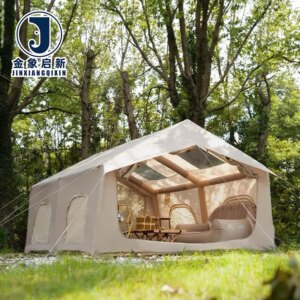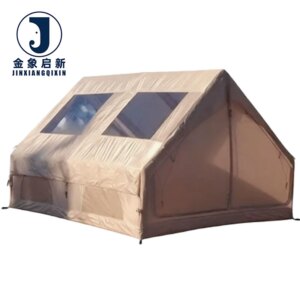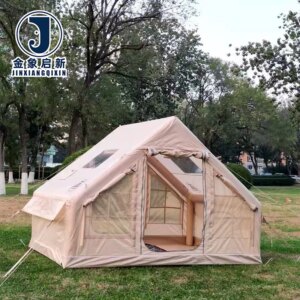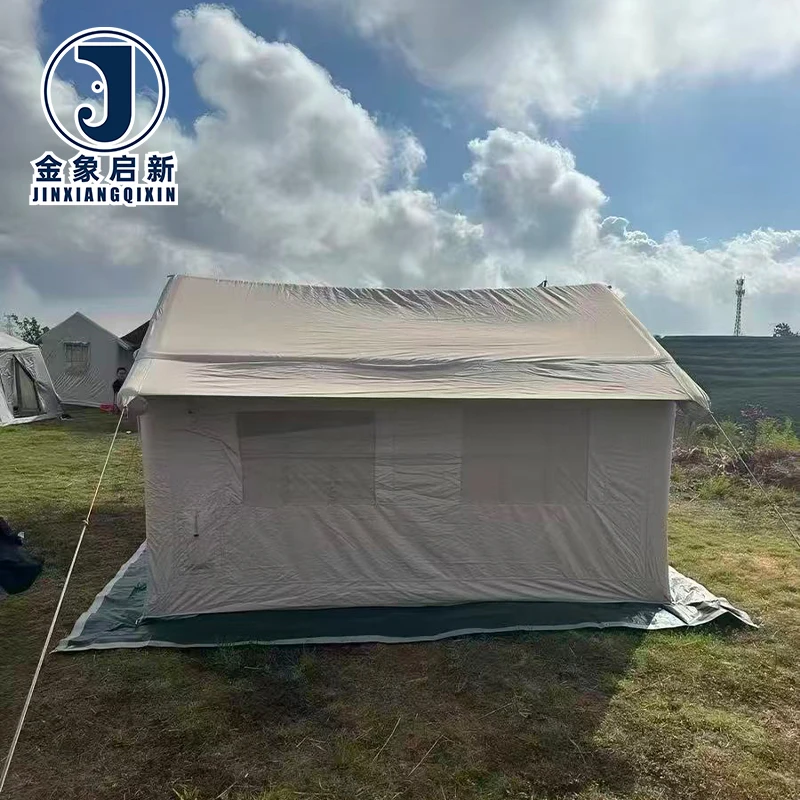
Rapid Deployment Capability — 3 full production lines enable consistent batch output of inflatable tent structures, ensuring commercial projects receive uniform quality without extended delays.
Technical Specifications
| Parameter | Value |
|---|---|
| Product Type | Inflatable Tent |
| Core Material | Oxford Fabric |
| Capacity | 4-6 Person |
| Design | Four-Season, Single Layer Construction, Extended Type |
| Key Performance | Waterproof, Quick Automatic Opening |
| Customization Service | OEM & ODM (material selection, product design) |
| Quality Control System | Strict full-process quality inspection with dedicated QA & QC staff |
| Standards | ISO9001, ISO14001, ISO45001, CE |
Application Suitability
| Application | Exposure & Requirement |
|---|---|
| Commercial Camping Grounds | Constant weather exposure, frequent guest turnover, rapid deployment for seasonal operations |
| Construction Site Temporary Shelters | Rain, wind, dust, and UV exposure; requires durable waterproof barrier for personnel and equipment protection |
| Outdoor Marketing Events & Logistics | High visibility branding needs, quick setup and teardown between venues, abrasion from repeated transport |
| Industrial Site Temporary Workspaces | Moisture protection for materials and tools, wind resistance, extended duration use in uncontrolled environments |
Why Setup Time Defines Commercial Tent Viability
Quick automatic opening mechanisms eliminate pole-based assembly, converting hours of labor into minutes of operational readiness.
When a sudden storm threatens an outdoor event or a construction crew needs immediate shelter, traditional frame tents demand multiple workers and significant time to erect. This delay exposes personnel and equipment to weather damage while incurring labor costs [NEED_CITE: operational downtime costs during emergency weather shelter deployment]. Commercial operators managing tight schedules cannot afford setup processes that consume resources better allocated to core operations. The inflatable camping tent manufacturer approach replaces mechanical complexity with pneumatic simplicity, allowing a single operator to achieve full deployment rapidly.
Deployment Speed as an Operational Multiplier
Fleet operators and site managers evaluating shelter solutions prioritize how quickly equipment becomes functional. The quick automatic opening mechanism integrated into this inflatable tent structure reduces setup from a multi-person task to a single-operator procedure. This capability directly impacts project timelines where weather windows are unpredictable or where multiple temporary structures must be deployed across dispersed locations within a single workday.
Waterproof Integrity Under Sustained Field Conditions
Oxford fabric construction provides the moisture barrier that commercial and industrial applications demand. Unlike lighter recreational materials, this fabric maintains waterproof performance through repeated inflation cycles, transport abrasion, and prolonged rain exposure. The single layer design balances this protection with the portability that mobile operations require, avoiding the bulk and weight penalties of multi-layer constructions that complicate storage and transport logistics [NEED_CITE: waterproof rating degradation in coated fabrics after repeated flex cycles].
Understanding Four-Season Single Layer Construction
The four-season rating indicates the tent structure can withstand temperature variations and weather conditions beyond mild summer use. Single layer construction achieves this through material selection rather than added layers, keeping the packed weight and volume manageable for transport between sites. Oxford fabric serves as the primary barrier against moisture and wind, while the extended type design maximizes usable interior space for equipment staging or personnel shelter. This configuration suits operators who need reliable performance across changing conditions without maintaining separate seasonal inventory.
The Cost of Underspecifying Temporary Shelter
Procurement decisions based solely on capacity ratings or price points often result in field failures that exceed the initial savings. Tents deployed in commercial environments face higher stress cycles than recreational equivalents—daily inflation and deflation, transport vibration, UV exposure during extended setups, and abrasion from contact with rough ground surfaces. Material that lacks adequate waterproof treatment or structural integrity will fail at seams and stress points, forcing unplanned replacements and operational interruptions [NEED_CITE: premature failure rates in commercial temporary shelters due to material underspecification]. Batch inconsistency compounds this problem when different tents in a fleet exhibit varying performance characteristics.
Why Production Control Matters for Fleet Consistency
Commercial operators purchasing multiple units require every tent to perform identically. The 10-person R&D team handles material selection and product design customization, ensuring specifications match the deployment environment. Dedicated QA and QC staff conduct inspections at each production stage rather than relying on sampling, catching deviations before they reach shipment. Three full production lines and 36 sets of professional equipment provide the capacity to fulfill bulk orders within project timelines. Samples are developed within days, allowing buyers to validate material feel, waterproof performance, and inflation behavior before committing to production quantities.
Documentation & Verification
- Material specification sheet confirming Oxford fabric type, waterproof treatment, and capacity rating
- Batch-specific inspection report with waterproof verification and dimensional check
- Pre-shipment inspection record confirming 100% quality check before dispatch
- ISO9001, ISO14001, ISO45001, and CE certificates available for compliance documentation
- Certificate of origin and customs support documentation for international shipments
Fabrication, Handling & Storage
- Oxford fabric requires heat sealing parameters matched to coating thickness; verify temperature settings before production runs
- Store deflated tents in dry, ventilated areas to prevent mildew formation on fabric surfaces
- Avoid dragging packed tents across abrasive surfaces; use carrying bags to protect fabric during transport
- Clean with mild soap and water; harsh solvents may degrade waterproof coating on Oxford material
- Inspect inflation valves and seams periodically; repair minor leaks with compatible adhesive patches immediately
- Extended type designs require adequate flat space for full inflation; verify clearance before deployment
Requesting a Specification Match
Provide your typical deployment environment, expected frequency of setup and teardown cycles, and any specific waterproof or wind resistance requirements your operations demand. Specify whether you need standard sizing or custom dimensions to accommodate particular equipment or personnel counts. Indicate your target delivery timeline and whether sample evaluation is required before bulk order confirmation.
Frequently Asked Questions
Q: What customization options are available for size, material, and branding?
A: OEM and ODM services cover material selection from the Oxford fabric range, capacity adjustments beyond the standard 4-6 person configuration, and custom pattern printing for branding requirements. The R&D team develops samples within days, allowing you to evaluate material weight, waterproof performance, and printed color accuracy before approving full production runs.
Q: Can I request a sample before committing to a bulk order?
A: Sample development is standard practice for custom inflatable tent orders. You receive a production-representative unit to test inflation behavior, waterproof integrity, and dimensional accuracy under your actual deployment conditions. Sample approval triggers bulk production, ensuring the final shipment matches verified performance expectations.
Q: What is the typical delivery cycle for custom inflatable tent orders?
A: Custom orders involving material selection, sizing adjustments, or printed branding require production scheduling across the available lines. Standard configurations move faster than heavily customized specifications. Confirm your required delivery date during inquiry so production capacity can be allocated appropriately to meet project timelines.
Q: How do I verify the waterproof performance and material specifications of my batch?
A: Each shipment includes a batch-specific quality inspection report documenting waterproof rating verification and material composition confirmation. Pre-shipment inspection records show that every unit underwent full quality checks before dispatch. Request these documents upon order placement to ensure they accompany your delivery.
Q: What storage and handling practices extend the service life of the tent?
A: Store deflated tents in dry conditions away from direct sunlight when not in use. Clean Oxford fabric with mild detergents; avoid solvents that compromise waterproof coatings. Inspect seams and inflation points after each deployment cycle, addressing minor damage before it escalates. Proper packing in protective bags prevents abrasion during transport between sites.