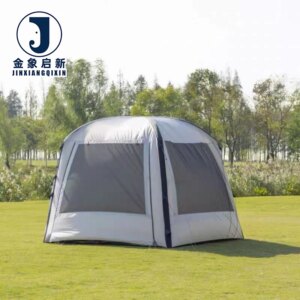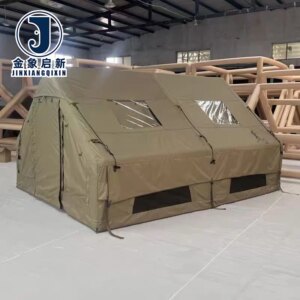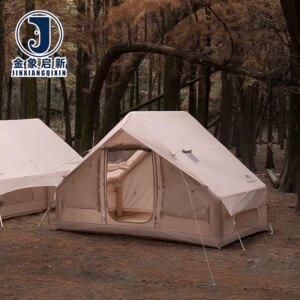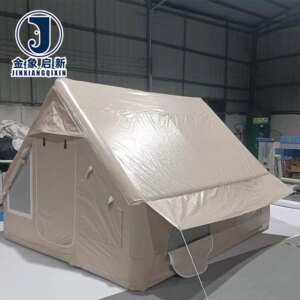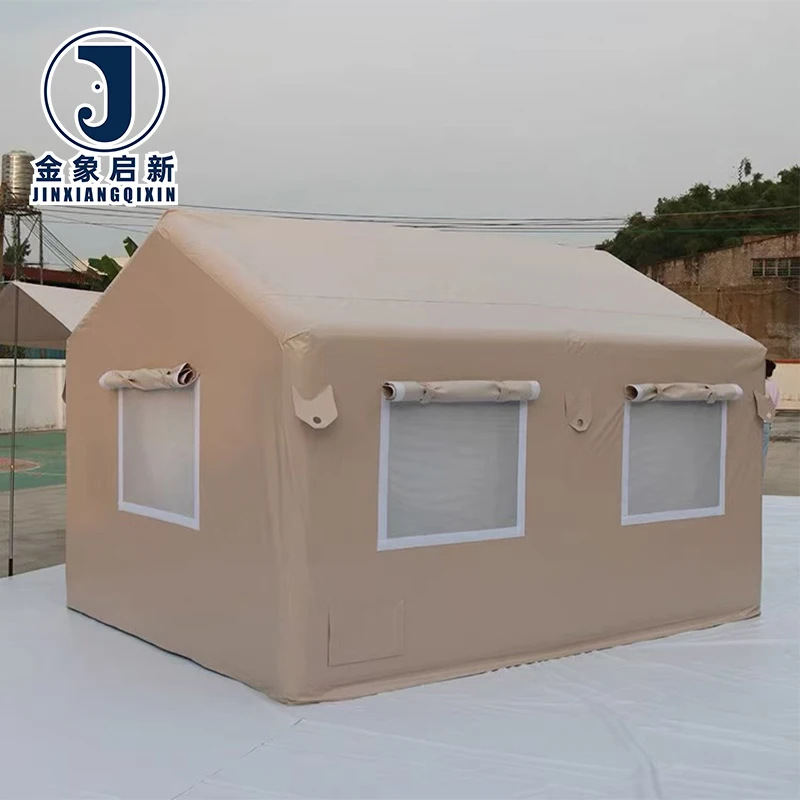
Proven Coating Control — Nearly 30 years of coated fabric production ensures consistent PVC weight, adhesion, and seam integrity across every inflatable tent batch we ship.
Technical Specifications
| Parameter | Value |
|---|---|
| Product Type | Inflatable Tent |
| Capacity | 6-8 person |
| Opening Mechanism | Quick automatic opening |
| Design Classification | Four-season |
| Construction | Single layer |
| Configuration | Extended |
| Core Material | PVC |
| Customization Service | OEM & ODM supported |
| Flame Retardant Grade | Available in flame retardant grades — confirm the grade required for your market |
| UV Treatment | Available with UV treatment — confirm test basis for your region |
| Anti-Static | Available with anti-static treatment — confirm standard required for your site |
| Manufacturing Standards | ISO9001, ISO14001, ISO45001, CE |
Application Suitability
| Application | Exposure & Requirement |
|---|---|
| Emergency command centers at industrial accident sites | Rapid deployment under pressure, exposure to debris, need for immediate weather protection and visibility |
| Temporary site offices during infrastructure development | Continuous occupancy, wind loading on inflated structure, dust and moisture ingress at ground level |
| Mobile workspace solutions for remote engineering projects | Transport over rough terrain, repeated inflation and deflation cycles, temperature extremes across seasons |
| Temporary storage facilities for disaster response equipment | UV exposure during extended outdoor staging, protection of sensitive gear from rain and contamination |
Why Quick Deployment Matters More Than Fabric Weight Alone
The fastest shelter to fail on-site is the one that takes too long to erect while conditions deteriorate.
Industrial emergency response demands structures that inflate and stabilize within minutes, not hours spent assembling pole frames in wind or rain. Many buyers focus entirely on material weight when specifying a PVC Inflatable Tent for Truck and Transport scenarios, overlooking the opening mechanism as a critical failure point. When an incident occurs at a logistics hub or along a transport corridor, the window to establish a command post is measured in minutes. A heavy-grade fabric that requires complex manual assembly offers no advantage if it cannot be operational when needed [NEED_CITE: emergency shelter deployment standards for industrial incident response].
Automatic Inflation Eliminates Assembly Variables
The quick automatic opening mechanism on this PVC inflatable event tent removes the dependency on trained assembly crews. In transport-related emergencies — a tanker rollover, a multi-vehicle incident, or a fleet maintenance staging situation — the personnel on-site are operators and drivers, not tent erectors. A single-layer inflated structure reaches its operational form through air pressure alone, with the PVC-coated panels expanding into their engineered geometry as the blower runs. This design eliminates pole alignment errors, missed connection points, and the uneven tension that causes fabric stress concentrations in frame-based shelters.
Extended Layout for Equipment and Personnel Coordination
The extended configuration provides functional floor area beyond the stated 6-8 person capacity, accommodating the equipment staging that real site operations require. Communication gear, lighting rigs, first-aid supplies, and incident documentation materials all occupy space inside a working command post. The PVC Inflatable Tent for Truck and Transport applications must account for this operational footprint, not just the headcount. The four-season design classification means the PVC Inflatable Event Tent maintains structural rigidity when internal air temperature diverges sharply from the outside environment — a common scenario when heaters run inside during cold-weather response [NEED_CITE: thermal differential effects on inflatable structure stability].
Reading the Specifications That Actually Determine Field Performance
Single-layer PVC construction means the fabric itself serves as both the structural envelope and the weather barrier. The coating weight and base fabric denier together determine how the material handles puncture risk from ground debris and how well welded seams hold under the cyclic stress of inflation and deflation. Coating adhesion to the base fabric directly influences whether the material delaminates at fold points after repeated transport cycles. Buyers evaluating this PVC inflatable event tent should cross-reference the material specification sheet with the specific mechanical demands of their deployment scenario — a remote mining exploration camp places different loads on the fabric than a paved-logistics-yard emergency drill. The relationship between GSM, base weave density, and tear propagation resistance is not linear, and a higher weight does not automatically mean better performance in an inflatable application where flex fatigue governs material lifespan [NEED_CITE: tensile and tear test methods for coated fabrics per ISO 1421].
The Cost of Specifying the Wrong Inflatable Shelter
A PVC inflatable event tent that arrives without the fire-retardant documentation your site safety officer requires will not pass inspection, regardless of how well the fabric itself performs. Similarly, a batch with inconsistent coating weight across panels will inflate unevenly, creating stress points at the seams that accelerate failure during wind events. We have seen orders rejected at the port of entry because the certificate of origin did not match the invoice description — a documentation gap, not a product defect, but the operational consequence is identical: no shelter on-site when it is needed [NEED_CITE: customs documentation requirements for coated fabric products entering regulated markets].
Why Procurement Teams Source This PVC Inflatable Event Tent From Jinxiang
Three full production lines and 36 sets of professional equipment allow us to hold delivery schedules on custom-dimension inflatable tents without shifting your order behind larger volume runs. The 10-person R&D team handles sizing adjustments, branding layout, and material selection for specific deployment environments, developing samples within days rather than weeks. Dedicated QA/QC at every production stage catches coating weight deviations and seam inconsistencies before the tent leaves the factory. ISO9001, ISO14001, ISO45001, and CE certifications are maintained across our production system, giving procurement teams the audit trail their compliance departments require. Every PVC Inflatable Tent for Truck and Transport application ships with full documentation — not a promise to provide it later upon request.
Documentation & Verification
- Material specification sheet stating PVC coating weight, base fabric denier, and color reference per batch
- Flame retardant and anti-static test reports aligned to your site compliance framework
- Pre-shipment inspection record with full QA/QC coverage and batch traceability
- Certificate of origin and ISO/CE certificates for cross-border procurement clearance
- Roll and unit packing list matched to shipment contents for receiving verification
Fabrication, Handling & Storage
- Welded seams require calibrated heat settings matched to the PVC coating weight to prevent delamination at flex points
- Store deflated tents in dry, ventilated conditions away from direct sunlight to prevent surface tackiness on the PVC layer
- Avoid folding along identical crease lines across transport cycles to distribute stress evenly across the single-layer PVC surface
- Clean with mild detergent and soft cloth — abrasive scrubbing damages the PVC coating finish and compromises water shedding
- Inspect air valves and inflation ports before each deployment to ensure seals remain intact after repeated pressurization cycles
Before You Request a Quotation
Provide your typical deployment scenario, including the climatic range and ground conditions where the inflatable tent will operate. Specify any fire-retardant grades, anti-static standards, or UV treatment test bases your site regulations mandate. Indicate whether you need OEM branding, custom dimensions beyond the standard 6-8 person extended layout, or specific color references for fleet or project identification. If your procurement cycle requires sample approval before bulk confirmation, note this in your initial inquiry so the R&D team can prioritize sample development.
Frequently Asked Questions
Q: What flame-retardant grade and test standard does the PVC inflatable tent fabric carry?
A: The base specification supports flame retardant treatment, but the specific grade must be confirmed against your local site regulations. We provide test reports aligned to the standard you require — whether DIN 4102, NFPA 701, or another regional framework. State your compliance target in the inquiry and we will match the test documentation to your shipment.
Q: How is batch-to-batch color and coating weight consistency verified before shipment?
A: Every production batch undergoes coating weight verification against the stated material specification sheet, and color is checked per roll against the confirmed reference sample. Our pre-shipment inspection record documents these checks with batch traceability, so you receive evidence of consistency rather than a general assurance statement.
Q: What custom sizing, printing, and branding options are available for fleet or project-specific orders?
A: Our R&D team supports OEM and ODM customization including non-standard dimensions, pattern printing, and logo placement on the PVC inflatable event tent surface. Samples are developed within days for approval before bulk production begins. Provide your artwork files and dimensional requirements with the initial inquiry for the fastest turnaround.
Q: What is the lead time and minimum order for custom-dimension inflatable tents?
A: Lead times depend on the extent of customization and current production scheduling across our three lines. Custom dimensions, colors, and printed branding each add processing stages. Confirm your required delivery window and order volume in the inquiry so we can provide an accurate production schedule before you commit.
Q: How are welded seams tested to ensure they hold under repeated inflation and flex cycles?
A: Welded seams on this PVC inflatable tent are produced using calibrated heat settings matched to the specific coating weight. Seam integrity is checked during the in-process QA stage and again at final inspection. The single-layer PVC construction concentrates flex stress at panel junctions, making weld consistency critical for long-term deployment reliability.