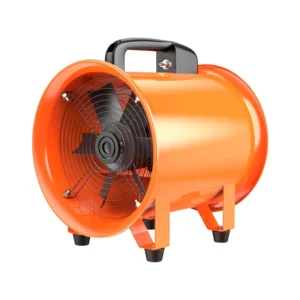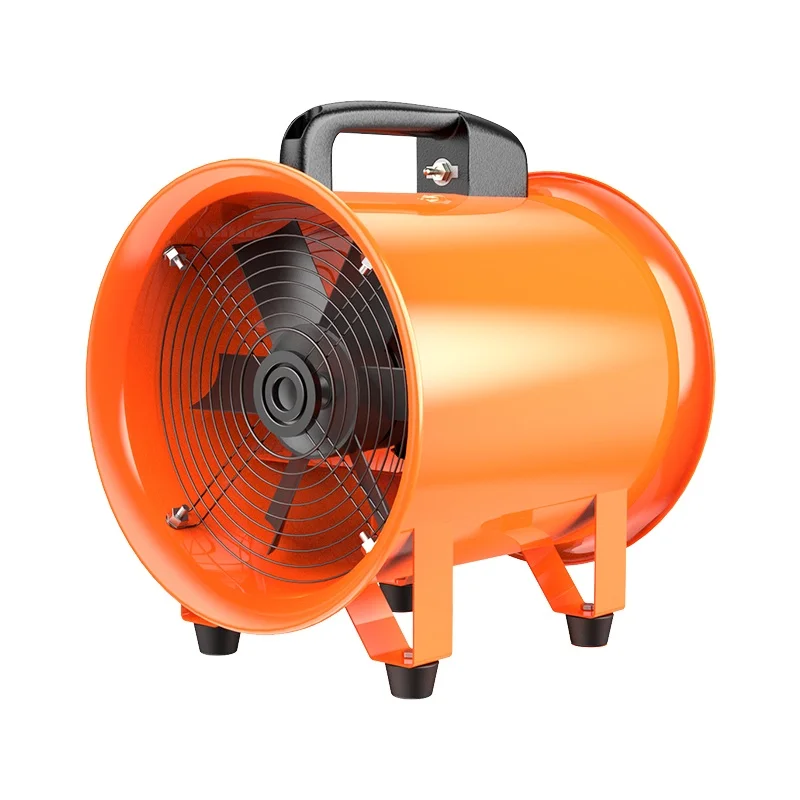
Precision Fitment — every ventilation unit undergoes dimensional verification against the stated trailer compartment model before dispatch, ensuring bolt-on readiness without on-site modification.
Technical Specifications
| Parameter | Value |
|---|---|
| Product Type | Industrial Ventilation Fan |
| Size Options | 200mm, 250mm, 300mm, 350mm, 400mm, 450mm, 550mm, 650mm, 750mm, 850mm, 900mm |
| Power Range | 250W to 5500W |
| Air Volume | 1300 m³/h to 28000 m³/h |
| Total Pressure | 140 Pa to 320 Pa |
| Voltage | 220V / 380V |
| Noise Level | 57–88 dB(A) depending on size |
| Bearing Type | Ball Bearing |
| Housing Material | Cast Iron |
| ODM Service | Available |
Application Suitability
| Application | Exposure & Requirement |
|---|---|
| Truck and trailer cargo area ventilation | Constant vibration, road shock, confined mounting envelopes requiring compact fan profiles |
| Enclosed equipment transport | Sustained air circulation in sealed compartments where heat buildup degrades sensitive cargo |
| Fleet maintenance bay spot ventilation | Intermittent high-volume exhaust in partially enclosed work areas with limited clearance |
| Refrigerated trailer air circulation | Continuous operation in low-temperature environments with condensation exposure |
Why Generic Fans Fail in Transport Compartments
Specifying a portable axial flow exhaust fan for a trailer without verifying the mounting envelope leads to either dead air zones or physical interference with cargo restraint systems.
Fleet operators routinely pull generic industrial fans from a catalogue and discover mid-installation that the housing protrudes into the load space, or that the airflow pattern leaves the rear corners stagnant. The problem is rarely the fan’s capacity — it is the mismatch between a standard frame and a compartment shaped around palletised freight. [NEED_CITE: airflow distribution modelling for rectangular cargo compartments]
A portable axial flow exhaust fan selected for transport duty must account for the vibration spectrum of a loaded trailer at highway speed, where sustained oscillation loosens fasteners and fatigues sheet-metal housings not rated for mobile use.
Sizing the Fan to the Compartment, Not the Catalogue
Choosing the right diameter from the 200mm to 900mm range depends on the compartment’s cross-sectional area and the target air change rate. A 450mm unit moving 8500 m³/h may clear a standard dry van in minutes but will create excessive noise and draft in a smaller refrigerated box. Conversely, undersizing forces the motor into continuous high-load duty, shortening bearing life. The eleven available diameters let fleet engineers match the fan to the actual internal volume rather than rounding up to the nearest stock size.
Vibration Endurance Under Road Conditions
Ball bearing construction is not a luxury in transport ventilation — it is the difference between a fan that survives a cross-country haul and one that seizes before the first service interval. Cast iron housing adds mass that dampens harmonic resonance from the trailer chassis, and the rigid mounting interface transfers less vibration into the bearing race. For fleet-wide deployment, this means maintenance intervals align with scheduled vehicle inspections rather than unplanned roadside failures. [NEED_CITE: bearing fatigue life under variable-amplitude vibration loading]
Interpreting the Air Volume and Pressure Curve
Air volume alone — whether 1300 m³/h at the smallest size or 28000 m³/h at the largest — tells only half the story. Total pressure between 140 Pa and 320 Pa determines how well the fan pushes air through duct runs, filters, or louvres that add static resistance. In a truck compartment with partial obstructions from cargo bars or insulation baffles, a higher-pressure variant maintains flow where a high-volume, low-pressure unit stalls. Selecting on both axes prevents the common failure mode where the fan spins freely but moves almost nothing.
The Cost of Getting the Voltage Wrong
Specifying 220V when the fleet’s shore power or auxiliary generator outputs 380V does not just trip a breaker — it can damage the motor winding insulation over repeated start cycles, leading to intermittent faults that are difficult to diagnose in the field. Conversely, running a 380V motor on 220V through a step-down transformer adds weight, heat, and another failure point in the electrical chain. Confirming the exact supply voltage at the mounting location before ordering eliminates both scenarios and avoids the downtime of rewiring an entire batch. [NEED_CITE: three-phase voltage tolerance standards for industrial motors]
Procurement and Fitment Support for Fleet Orders
Every unit leaves the production line with a dimensional check against the specified diameter and mounting pattern, reducing the chance of receiving a fan that requires bracket fabrication on the dock. The 10-person engineering team handles ODM requests for non-standard mounting flanges, specialised grilles, or voltage configurations that fall outside the 220V/380V range. Production capacity across three lines supports fleet-scale rollouts without splitting an order across multiple lead times. Pre-shipment inspection covers electrical continuity, bearing free-spin, and housing integrity — not just cosmetic checks.
Documentation & Verification
- Dimensional inspection record confirming fan diameter and bolt pattern match the specified trailer model
- Electrical test certificate stating voltage rating, current draw, and insulation resistance at dispatch
- Material specification sheet listing housing grade, bearing type, and motor winding class
- ISO and CE certificates supporting fleet compliance audits across regulated transport markets
- Packing list with serial numbers traceable to individual production batch records
Fabrication, Handling & Storage
- Mount cast iron housings with vibration-isolating gaskets to prevent resonance transfer into thin-gauge trailer panels
- Verify 220V or 380V wiring matches the compartment junction box before energising any portable axial flow exhaust fan unit
- Store spare units upright on pallets to avoid bearing brinelling from prolonged lateral load on stationary ball races
- Use only non-corrosive cleaners on housing surfaces to preserve the cast iron finish in humid cargo environments
- Inspect ball bearing free-spin after any drop or impact during installation to catch early race damage
Moving From Enquiry to Confirmed Specification
Tell us the trailer model or compartment dimensions, the target air change rate, and the available voltage at the mounting point. If your fleet operates under specific noise regulations or requires fire-rated components for certain cargo classes, include those requirements in the initial brief. We will return a recommendation with the matching diameter, pressure rating, and any ODM modifications needed for your application.
Frequently Asked Questions
Q: How do I confirm the fan diameter fits my specific trailer compartment?
A: Provide the compartment’s internal width, height, and the available mounting surface dimensions. We cross-reference these against the fan’s housing envelope and bolt pattern for the selected diameter, and return a fitment drawing for your approval before production. This avoids the common issue of discovering interference with cargo rails or insulation after delivery.
Q: What vibration resistance does the ball bearing design provide for road use?
A: Ball bearings tolerate the multi-axis vibration spectrum typical of loaded trailers at highway speed far better than sleeve bearings, which rely on a continuous oil film that breaks down under shock loads. The cast iron housing adds damping mass that reduces harmonic amplification, extending service intervals to align with standard fleet maintenance schedules.
Q: Is 220V or 380V the better choice for fleet ventilation installations?
A: The correct choice depends on the electrical architecture already present in your vehicles. Most auxiliary generators on heavy trucks supply 380V three-phase, while shore power at depots is commonly 220V single-phase. We supply both configurations and can advise on the most efficient match once you share the supply details for each vehicle in the fleet.
Q: What is the minimum order for custom-sized ventilation units?
A: Minimum quantities depend on the degree of modification. Standard diameters from our 200mm to 900mm range carry low minimums, while ODM changes to mounting flanges, grille geometry, or non-standard voltage windings require a larger batch to justify tooling setup. Share your annual volume and we will confirm the threshold for your configuration.
Q: How long does a fleet-wide ventilation equipment order typically take?
A: Lead time depends on the number of units, the mix of sizes, and whether ODM modifications are involved. Standard configurations from stock sizes move through production and inspection faster, while customised units add time for tooling and sample approval. We confirm the schedule at quotation stage so you can align delivery with your fleet maintenance calendar.