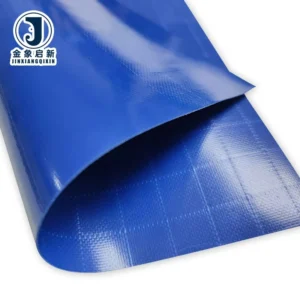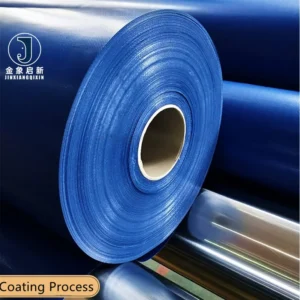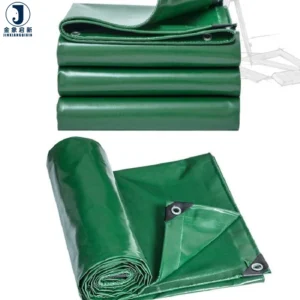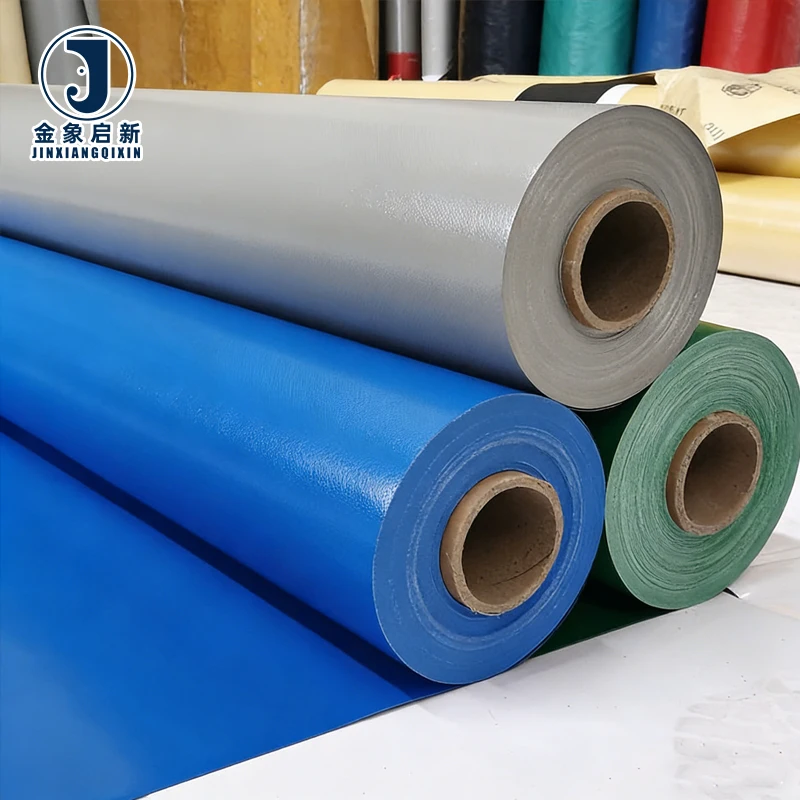
Proven Coating Adhesion Control — three full production lines maintain consistent bond strength across hot-melt coated polyester base fabric, critical for tarpaulin covers that flex under road vibration and tie-down tension.
Technical Specifications
| Parameter | Value |
|---|---|
| Product Type | PVC Coated Tarpaulin Roll |
| Material | PVC coated high-strength polyester mesh fabric |
| Coating Technology | Laminated & Hot-melt Coating |
| Weight Range | 350gsm / 420gsm / 500gsm / 550gsm / 600gsm / 750gsm (confirm the grade for your application) |
| Thickness Range | 0.32mm / 0.35mm / 0.40mm / 0.45mm / 0.50mm / 0.65mm (confirm the grade for your application) |
| Roll Width | 2m / 2.1m |
| Roll Length | 75m (2m width) / 50m (2.1m width) |
| Surface Finish | Glossy or Matte |
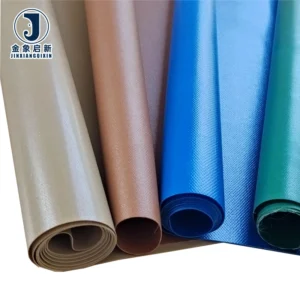
| Colour Options | Blue / Red / Yellow / Light Blue / Grey (customizable) |
| Key Features | Fully waterproof, anti-mildew treated, cold crack resistant, anti-static treatment applied, UV treated (test basis not stated in source) |
| Certifications | ISO, CE |
Application Suitability
| Application | Exposure & Requirement |
|---|---|
| Truck side curtains | Constant flexing at folds, road spray, UV exposure, abrasion from load contact |
| Flatbed trailer covers | Tie-down strap tension at edge hems, wind flutter fatigue, weather exposure |
| Tipper truck tarps | Heavy load abrasion, repeated deployment and folding, stone impact |
| Cargo ship deck covers | Salt-laden moisture, sustained UV, large-span tensioning |
| Lorry tarpaulin replacement | Fleet colour consistency, model-specific cut dimensions, weld seam durability |
Why Quoted GSM Alone Will Not Protect Your Fleet
GSM tells you how much material was used — not whether the coating actually bonds to the base fabric under road stress.
Fleet operators have received tarpaulin rolls where the quoted weight checked out on a scale, yet the PVC layer delaminated within months at the exact points where the cover bends over the load. The adhesion between coating and polyester mesh matters as much as total weight when the material is welded into truck covers and subjected to daily flex cycles. Hot-melt coated rolls from a PVC Coated Tarpaulin Roll aftermarket supplier address this by bonding the PVC directly into the mesh structure rather than laying it on top. [NEED_CITE: peel strength testing methods for coated fabrics per ISO 2411]
Covering a Moving Load Demands More Than Thickness
A truck side curtain flexes thousands of times per journey. Every fold, every tie-down point, every contact with the load tests the boundary between the PVC coating and the polyester base. Hot-melt coating technology forces the PVC into the mesh openings under heat and pressure, creating a mechanical bond that resists separation at these stress zones. Laminated technology provides an alternative production route for grades where a smooth surface finish is the priority.
Fleet Colour and Finish Consistency Across the Order
When a transport company replaces tarpaulins across multiple trailers, visible colour variation between rolls becomes a branding problem the moment vehicles are parked side by side. This PVC Coated Tarpaulin Roll range is available in blue, red, yellow, light blue, and grey with custom colour matching. Glossy or matte surface options are available depending on whether the priority is cleanability for printed fleet branding or reduced glare on operational sites. Consistent pigment dispersion across the production run is controlled through dedicated QA/QC at each stage. [NEED_CITE: colour fastness evaluation methods for PVC coated textiles]
Reading the Specification Sheet Beyond the Weight Number
Weight in GSM and total thickness in millimetres are often treated as proxies for strength, but they describe mass, not performance. The denier of the polyester yarns and the weave density of the mesh determine how the fabric resists tear propagation when a puncture starts at a weld line. A 550gsm roll with a coarse, low-density base may tear more easily than a 500gsm roll built on a tighter, higher-denier mesh. Coating method also changes behaviour: hot-melt coated fabric typically delivers stronger peel adhesion at welded seams, while laminated construction can achieve comparable thickness at different cost points. Thickness readings from 0.32mm through to 0.65mm span from light flexible covers suitable for curtain applications to heavier grades intended for flatbed and tipper use where abrasion resistance is the primary requirement.
What Happens When the Specification Does Not Match the Route
A cover specified for regional haulage may survive perfectly on paved motorways, yet fail at the hem welds when the same trailer is used on construction access roads where the load shifts violently. Welded seams are the first point of failure when the coating-to-base bond is insufficient for the flex frequency of the actual route. Colour inconsistency across rolls in a fleet order can force an operator to reject an entire shipment rather than deploy mismatched covers. Ordering without a pre-shipment GSM verification record leaves the buyer with no recourse when the material on arrival is lighter than quoted. [NEED_CITE: weld seam peel testing standards for flexible PVC tarpaulin materials]
Why Source This PVC Tarpaulin Roll from Jinxiang
Three full production lines with 36 sets of professional equipment provide the capacity to deliver fleet-scale roll orders without extended delays. A 10-person R&D team handles material selection and sample development so that cut-to-model covers are validated before bulk production runs begin. Dedicated QA/QC operates at every production stage with full pre-shipment inspection, not spot-check sampling. The hot-melt coating process is controlled in-house, maintaining batch-to-batch adhesion consistency. Custom width, colour, and GSM grade options are available with sample approval workflows designed for transport equipment builders and fleet procurement teams.
Documentation & Verification
- Material specification sheet stating GSM, base fabric, coating method, and colour reference per roll
- Weight verification checked against the quoted grade before each roll is released for dispatch
- UV treatment documentation available — confirm the test basis required for your market
- Pre-shipment inspection record covering coating adhesion, surface finish, and dimensional accuracy
- Roll packing list with certificate of origin for customs clearance support
- ISO and CE certificates provided with shipment documentation
Fabrication, Handling & Storage
- Hot-melt coated rolls tolerate standard high-frequency welding; adjust dwell time to the selected GSM grade
- Matte surface rolls accept solvent-based fleet marking inks better than glossy variants
- Store 2.1m × 50m rolls upright on cores to prevent flat-spot creasing across the width
- Allow cold-stored rolls to reach ambient temperature before unrolling to avoid coating micro-cracking
- Cut patterns should account for 2m and 2.1m widths to minimise offcuts on standard trailer dimensions
- Reinforced hem folding should match the 0.40mm–0.65mm thickness range for tie-down load zones
What We Need to Quote Your Roll Order Accurately
Provide the trailer models in your fleet or the specific cover dimensions you need fabricated, along with the exposure conditions your vehicles encounter — motorway haulage, construction site access, or port operations. Specify your preferred GSM grade and whether glossy or matte finish is required for your fleet appearance standards. Let us know if you need roll stock only or finished covers with welded hems, and whether sample approval is required before the production run.
Frequently Asked Questions
Q: How is the GSM weight verified before my rolls are shipped?
A: Every roll undergoes weight verification against the material specification sheet during pre-shipment inspection. The dispatch documentation includes the confirmed GSM grade so you can reconcile what was quoted with what arrives at your facility. Dedicated QA/QC staff check coating weight and base fabric at each production stage, not just at final packing.
Q: Can I get a test report for UV or flame-retardant treatment?
A: UV treatment is stated as a feature of this PVC Coated Tarpaulin Roll range, though the specific test basis is not detailed in the current source documentation. Flame retardant grades are available — confirm the grade required for your market and application. We provide available test documentation upon request during the quotation stage.
Q: How do you control colour consistency across multiple rolls in one fleet order?
A: Pigment batching is controlled at the compounding stage before coating begins. Rolls within a single order are produced in the same batch run to minimise colour variation. The pre-shipment inspection includes a visual consistency check across the order, and the roll packing list documents batch references for traceability.
Q: What is the process for custom cut-to-model truck covers?
A: You provide the trailer model or exact dimensions. Our R&D team develops a sample for your approval before bulk production. Once approved, the covers are cut, welded, and finished to your specification. This sample-first approach ensures the cover fits the specific trailer model rather than relying on generic sizing.
Q: How does cold crack resistance affect winter transport operations?
A: The PVC formulation includes cold crack resistant properties that help the coating remain flexible in low-temperature transport environments. This reduces the risk of the coating becoming brittle and cracking at fold lines when covers are deployed or removed in cold weather. Confirm the specific low-temperature threshold required for your operating region during the inquiry stage.