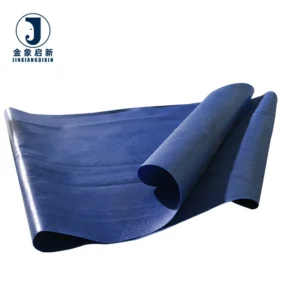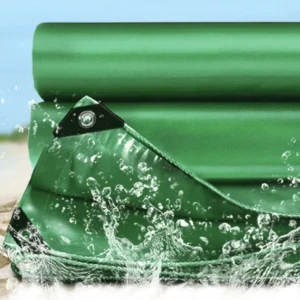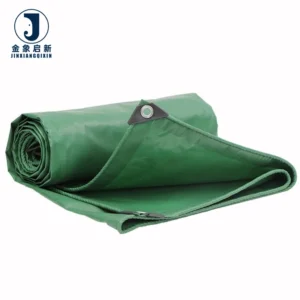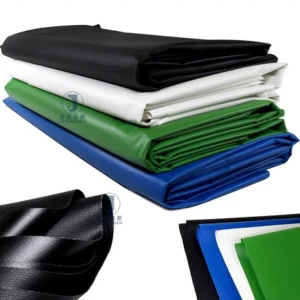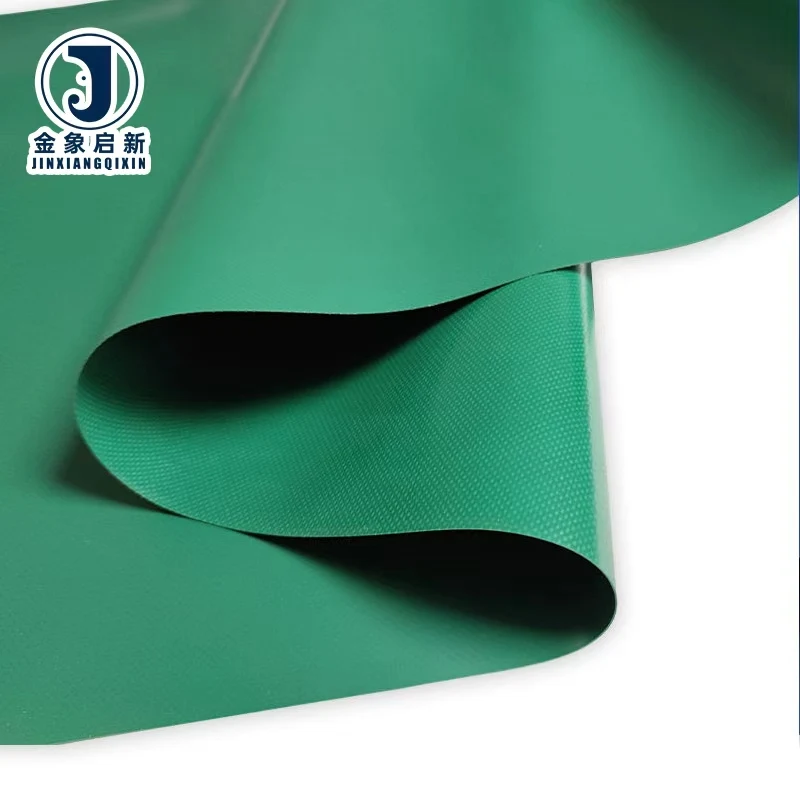
Precision Edge Construction — High-temperature heat-sealed edge wrapping on this 510Gsm PVC coated tarpaulin roll eliminates the flex-point seam failures common on moving loads, backed by dedicated QA at every production stage.
Technical Specifications
| Parameter | Value |
|---|---|
| Product Type | PVC Coated Tarpaulin Roll |
| Material | Double-sided PVC coating on polyester base fabric |
| Yarn Count Options | 500D×840D / 500D×1000D / 1000D×1000D / 1000D×1300D / 1300D×1300D / 1000D×2000D |
| Weight | 510 GSM |
| Thickness Range | 0.29 mm to 0.65 mm (variant-dependent) |
| Tensile Strength (Material) | 50–80 MPa |
| Density | 1.15–2.00 g/cm³ |
| Brittle Temperature | ≤ −50 to −60 °C |
| Softening Temperature | ≥ 80 °C |
| Melting Point | 212 °C |
| Surface | Smooth, leather-like texture |
| Edge Construction | High-temperature heat-sealed seamless edge wrapping |
| Rope Reinforcement | 5 mm rope without splicing |
| Eyelets | 3 cm enlarged aluminum alloy buttonhole, brass eyelets every 1 m |
| Corner Reinforcement | Reinforced corners on all sides |
| Flame Retardant | Available in flame retardant grades — confirm the grade required for your market |
| UV Treatment | Anti-UV treatment available — confirm test basis for your operating environment |
| Water Resistance | Fully waterproof coated construction |
Application Suitability
| Application | Exposure & Requirement |
|---|---|
| Truck side curtain | Constant flexing at load points, road abrasion, sustained weather exposure |
| Trailer top cover | UV exposure, wind uplift tension, pooled water drainage |
| Flatbed load cover | Tie-down strap friction, multi-directional pull at eyelets |
| Container roof sheet | Standing water, thermal expansion and contraction cycles |
| Construction equipment cover | Job-site dust ingress, puncture from sharp edges, frequent handling |
Why Generic Sizing Costs More Than a Custom PVC Tarpaulin Roll
A cover cut to your exact trailer model outlasts a generic size because it eliminates the loose fabric that flaps, abrades and tears at highway speed.
Fleet operators routinely replace truck covers that fail within months, not because the fabric itself gave out, but because generic dimensions leave excess material that billows under aerodynamic load. That billowing concentrates stress at eyelet rows and welded hems, accelerating fatigue. When the PVC coated tarpaulin for truck and trailer is cut to match the specific trailer geometry, tension distributes evenly across the entire panel. [NEED_CITE: tensile and tear test methods for coated fabrics per ISO 1421]
How Yarn Denier Shapes Load-Bearing Behaviour
The polyester base fabric in this PVC coated tarpaulin for truck and trailer is available in denier options from 500D×840D up to 1000D×2000D. Heavier denier yarns increase the number of filaments per thread, which directly raises the force required to initiate a tear. For side curtain applications where the fabric flexes continuously during transit, a higher-denier base delays crack propagation along the weave direction.
Heat-Sealed Edges vs. Conventional Sewn Hems
Conventional stitched hems introduce needle holes through the coating layer, creating pathways for water ingress and starting points for delamination under repeated flexing. The high-temperature heat-sealed seamless edge wrapping used on this material bonds the PVC coating to itself without puncturing the substrate. The 5 mm rope reinforcement distributes tie-down tension across a wider area, reducing the point load that causes eyelet pull-through on long-haul routes. [NEED_CITE: weld adhesion and peel strength testing for PVC coated polyester fabrics]
Reading GSM and Base Fabric Density Together
A 510 GSM weight rating describes the total mass per square metre, combining the base fabric and both PVC coating layers. What determines actual field performance is how that mass is distributed. A roll with a dense 1000D×1300D base and thinner coating will resist tearing better than a roll at the same GSM achieved through heavy coating on a sparse weave. The mesh count options — 30×19, 20×20, 30×15 — indicate how tightly the yarns are woven, and tighter weaves restrict tear propagation. Coating weight separately influences abrasion resistance and surface durability, which matters when tie-down straps rub against the same contact point on every journey.
The Hidden Cost of Inconsistent Roll Colour
When a fleet orders multiple rolls to cover a trailer fleet, colour variation between rolls becomes visible the moment the covers are installed side by side. Beyond aesthetics, inconsistent pigmentation can signal uneven coating dispersion, which in turn affects UV protection uniformity across the panel surface. Pre-shipment inspection with roll-to-roll colour comparison prevents this issue before material reaches the loading bay. [NEED_CITE: colour consistency standards and measurement methods for coated technical textiles]
Procurement Advantages Built Into This Material
Three full production lines support bulk volume requirements with on-time delivery scheduling, so fleet replacement programmes stay on track without extended downtime. The 10-person R&D team develops samples within days for custom sizing, enabling transport equipment builders to validate fitment on specific trailer models before committing to full production runs. Dedicated QA and QC inspection at every production stage, with 100% pre-shipment checking, catches GSM deviation and coating defects before rolls leave the facility. Each roll ships with documentation matching the specification you ordered — not a generic data sheet.
Documentation & Verification
- Material specification sheet stating GSM, base fabric denier, coating weight and colour reference for each roll
- Pre-shipment inspection record confirming roll-to-roll colour consistency across the order
- Test report for UV and flame retardant grades where applicable to the fleet operating environment
- ISO and CE certificates aligned with shipment documentation
- Custom sizing confirmation sheet showing exact trailer model dimensions before bulk cutting
Fabrication, Handling & Storage
- Heat-seal welding parameters must account for the 510 GSM total weight and double-sided PVC coating thickness to achieve full bond penetration
- Brass eyelet insertion at 1 m spacing should align with the 5 mm rope reinforcement channel to distribute strap load evenly
- Store rolls upright on pallets to prevent permanent creasing in the polyester base fabric at the contact point
- Avoid unfolding at temperatures near the −50 °C brittle threshold; allow the material to acclimatise before field installation
- Clean the smooth leather-like surface with mild detergent only — solvent-based cleaners degrade the PVC coating layer
- When cutting panels for specific trailer models, nest patterns to maximise yield from the roll width and minimise offcuts
What We Need to Quote Accurately
To provide an accurate specification for your truck or trailer cover programme, share the trailer model designation, the panel dimensions required, your preferred yarn denier from the available range, and whether flame retardant or anti-UV treatment applies to your operating jurisdiction. If you need finished panels rather than roll stock, include the eyelet spacing and tie-down configuration so we can confirm the reinforcement layout matches your fleet’s securing system.
Frequently Asked Questions
Q: Can truck covers be cut to specific trailer model dimensions rather than generic sizes?
A: Yes. The R&D team develops cut-to-size samples based on your trailer model designation and panel geometry. Once the sample is approved for fitment, bulk production follows the same pattern. This eliminates the loose fabric edges that cause wind-flap abrasion on generic-size covers, extending service life at the flex points where most failures originate.
Q: How do you verify GSM on arrival matches the quotation for each roll?
A: Every roll undergoes weight verification during the 100% pre-shipment inspection. The inspection record included with your shipment documents the measured GSM for each roll, cross-referenced against the material specification sheet. If any roll deviates from the stated 510 GSM, it is flagged and replaced before dispatch rather than shipped and disputed after delivery.
Q: What UV treatment options are available and what is the test basis for outdoor service life?
A: Anti-UV treatment is available and can be applied to match the exposure conditions of your fleet routes. We recommend confirming the specific test standard required by your market before production begins. Where applicable, a test report documenting the UV treatment level is included with the shipment documentation for your compliance records.
Q: How is colour consistency controlled across multiple rolls in a single fleet order?
A: Colour matching is verified during production and again at the pre-shipment inspection stage, where rolls from the same order are compared side by side under controlled lighting. Any roll showing visible deviation is removed before packing. The inspection record documents the colour reference used, so reorders can be matched to the original batch when you need to expand your fleet coverage.
Q: What eyelet spacing and hem reinforcement options are available for different tie-down configurations?
A: Standard brass eyelets are placed every 1 metre with 3 cm enlarged aluminum alloy buttonholes and reinforced corners on all sides. The 5 mm rope reinforcement runs continuously through the hem without splicing. For custom tie-down configurations, eyelet spacing and corner reinforcement layout can be adjusted during the sample development phase to match your fleet’s securing hardware.