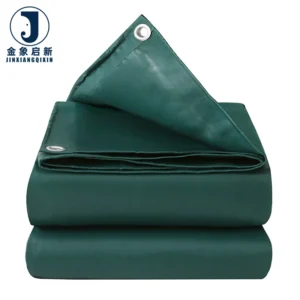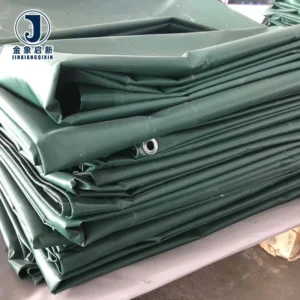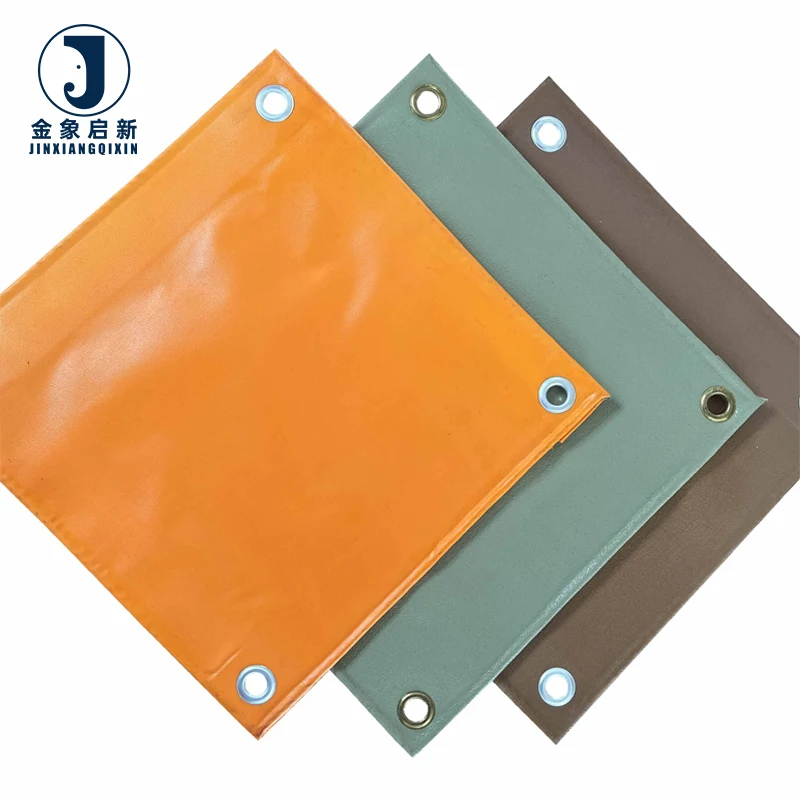
Deep Process Control Over Coating Weight — Every roll of Anti-Static Printable PVC Coated Tarpaulin passes through in-process QA checkpoints, ensuring the stated GSM matches what arrives at your dock, with 100% pre-shipment inspection before dispatch.
Technical Specifications
| Parameter | Value |
|---|---|
| Product Type | Anti-Static Printable PVC Coated Tarpaulin |
| Base Fabric | 100% high tenacity polyester yarn |
| Coating Technology | Lamination and hot melt coating |
| Weight (Medium-duty) | 400–500 g/m² |
| Weight (Heavy-duty) | 700–1000 g/m² |
| Weight (Super Heavy-duty) | 1100–1500 g/m² |
| Yarn Denier (Medium-duty) | 500D |
| Yarn Denier (Heavy-duty) | 1000D |
| Yarn Denier (Super Heavy-duty) | 500D–2000D |
| Thickness (Medium-duty) | 0.35–0.45 mm |
| Thickness (Heavy-duty) | 0.70–1.0 mm |
| Thickness (Super Heavy-duty) | 1.2–1.5 mm |
| Tensile Strength (Medium-duty) | Warp 1500–2000 / Weft 1200–1800 N/5cm |
| Tensile Strength (Heavy-duty) | Warp 2000–2500 / Weft 1800–2200 N/5cm |
| Tensile Strength (Super Heavy-duty) | Warp 2500–3000 / Weft 2200–2800 N/5cm |
| Cold Crack Resistance | −30 °C |
| Anti-Static | Treatment applied (surface resistance standard — confirm requirement) |
| Waterproof | Yes |
| Anti-Mildew | Mold proof treatment |
| Printing Option | Printable surface |
| Certification | ISO, CE |
Application Suitability
| Application | Exposure & Requirement |
|---|---|
| Truck side curtain | Constant flexing at load points, road debris abrasion, weather exposure, tie-down stress at eyelets |
| Flatbed and trailer cover | Wind uplift on highway runs, UV and rain exposure, repeated folding and unfolding at depot |
| Exhibition booth backdrop | Indoor and outdoor event environments, printable surface for branded graphics, anti-static for dust control |
| Mobile event display | Transport between venues, frequent rigging and de-rigging, surface abrasion from handling |
| Industrial pipe canopy | Outdoor weathering, thermal cycling, structural wind load on tensioned spans |
| Tensioned structural fabric | Sustained mechanical load, long-term weathering, membrane stress at anchor points |
Why Generic-Size Covers Fail Where the Load Flexes Most
A truck cover cut to a generic rectangle will never match a trailer that flexes, shifts, and vibrates under load.
Fleet operators ordering PVC coated tarpaulin for truck and transport applications often specify dimensions from a catalogue without accounting for the actual trailer profile. The result is excess fabric that flaps in highway wind, or fabric pulled too tight across a curved load that concentrates stress at the welded seams. [NEED_CITE: wind load and fabric stress on moving transport covers per EN 12195] The seams are typically the first failure point — not because the weld is poorly executed, but because the generic cut forces the seam to absorb flex energy that a properly fitted panel would distribute across the base fabric.
Covering a Moving Load: Fitment and Reinforcement
Specifying PVC coated tarpaulin for truck and transport means starting with the trailer model, not just length and width. Side curtain applications demand fabric that can fold and unfold hundreds of times without cracking at the crease line, while flatbed covers need enough drape to shed water without pooling. The three weight tiers — medium-duty from 400–500 g/m², heavy-duty from 700–1000 g/m², and super heavy-duty from 1100–1500 g/m² — allow you to match the grade to the exposure profile rather than over-specifying or under-specifying across your fleet.
Reinforcement at the Points That Take the Strain
Tie-down straps and bungee cords concentrate load at every eyelet. Hot melt coating and lamination technology create high adhesive strength between the polyester base fabric and the PVC layer, which helps the welded hem distribute that point load rather than tearing through the fabric edge. The cold crack resistance rated to −30 °C ensures that reinforcement patches and hem welds remain flexible during winter transport, preventing the brittle fractures that appear when a frozen cover is folded at the depot. [NEED_CITE: low-temperature flex performance of PVC coated polyester fabrics]
Reading the Specifications Beyond Weight
Coated fabric buyers often lead with GSM, but gsm alone does not determine how a truck side curtain behaves after two years of road use. The base yarn denier — 500D for medium-duty up to 500D–2000D for super heavy-duty — controls how much energy a single yarn can absorb before it breaks, while the weave density determines how many yarns share the load. A 700 g/m² fabric woven from 1000D yarn in a tight weave will resist tear propagation differently than a 700 g/m² fabric built on a lighter base with a heavier coating. The coating method matters equally: lamination bonds the PVC film to the base under heat and pressure, producing a distinct interface layer, while hot melt coating penetrates the weave and locks in from both sides. Hot melt typically delivers stronger weld performance because the coating itself becomes the weld material, whereas a laminated fabric requires the heat to penetrate through the film layer to reach the adhesive bond.
The Hidden Cost of Getting the Specification Wrong
Ordering a PVC coated tarpaulin for truck and transport without confirming the cold crack threshold means discovering the problem only when the cover cracks during the first winter fold. Ordering without a surface resistance report for anti-static grades means your exhibition backdrop attracts dust on the trade show floor, and your compliance auditor flags the missing documentation. Batch colour variation across rolls in the same order becomes visible only when panels are installed side by side on a truck curtain — by which point the fabric is already cut, welded, and fitted, making replacement the only option. [NEED_CITE: colour consistency standards for coated fabric batches per ISO 105 series]
Why Source Anti-Static Printable PVC Tarpaulin Here
Three full production lines and 36 sets of professional equipment support bulk roll output with reliable on-time delivery across the medium, heavy-duty, and super heavy-duty weight tiers. A dedicated 10-person R&D team handles custom sizing matched to specific trailer models, pattern printing development for exhibition graphics, and sample approval before production begins. QA/QC checkpoints run at every production stage — coating weight verification, base fabric inspection, and weld strength testing at flex points — with 100% pre-shipment inspection recorded before dispatch. Samples are developed within days for custom requirements, so you can verify hand feel, print adhesion, and weld behaviour before committing to a production run. The combination of deep process control over coating weight and nearly 30 years of coated fabric production experience reduces the variability that causes GSM shortfalls and inconsistent surface treatment.
Documentation & Verification
- Material specification sheet confirming GSM, base yarn denier, coating method, and colour reference for every roll
- Anti-static surface resistance test report supplied with applicable grades — confirm the standard required for your market
- Pre-shipment inspection record documenting dimensions, weight verification, and treatment compliance before dispatch
- ISO and CE certificates covering the production facility and product range
- Roll packing list with individual roll identification for traceability
- Certificate of origin and customs documentation for international shipment
Fabrication, Handling & Storage
- Hot melt coated fabric welds cleanly at standard PVC heat weld temperatures — test weld parameters on each new roll batch
- Reinforce eyelet zones with additional PVC patches on heavy-duty and super heavy-duty grades to distribute tie-down loads
- Store rolls upright on end caps to prevent flat-spot deformation on the heavier 1100–1500 g/m² grades
- Allow cold-stored rolls to reach ambient temperature before unrolling to prevent coating crease marks at −30 °C rated flexibility
- Use non-solvent cleaners on the printable anti-static surface to preserve both the print receptor layer and the static treatment
- Lay out cut panels flat before welding to eliminate trapped folds that create weak points in the seam line
What to Include with Your Enquiry
Provide the specific trailer model dimensions or structure span measurements, the weight grade tier you are targeting, and whether you require rolls or finished cut-and-welded covers. If the application involves exhibition or event graphics, confirm the print method and any anti-static compliance standard your venue or market requires. State the target market for any regulatory documentation, along with colour references and whether multiple rolls must match within a single batch.
Frequently Asked Questions
Q: How is the anti-static treatment verified — do you supply a surface resistance test report?
A: Anti-static treatment is applied during the coating process, and a surface resistance test report can be supplied with applicable grades. Because different markets and venues reference different static dissipation standards, we recommend confirming which standard applies to your application before sampling. This ensures the test documentation aligns with your compliance requirements.
Q: How do you ensure the truck cover is cut to my exact trailer model, not a generic size?
A: We work from your trailer model drawings or physical measurements rather than standard catalogue dimensions. The R&D team develops a cutting pattern that accounts for drape, fold allowance, and eyelet placement specific to your trailer profile. A sample panel can be produced for fitment verification before the full production run begins.
Q: What eyelet spacing and hem reinforcement options are available for tie-down loads?
A: Eyelet spacing and hem reinforcement are configured to match your tie-down system and load profile. Heavier grades in the 700–1000 g/m² and 1100–1500 g/m² tiers support wider spacing under high tension, while additional PVC patches at each eyelet point distribute the concentrated strap load across the base fabric rather than pulling through the coating layer.
Q: How do you control batch colour consistency across rolls in the same order?
A: Colour matching is controlled through reference standards at the coating stage, with in-process QA checks at each production phase. A pre-shipment inspection record documents the colour verification for every roll in the order. For multi-roll orders where panels will be installed side by side, we recommend requesting batch colour confirmation before dispatch.
Q: What is the cold crack performance, and is it tested to −30 °C?
A: The PVC coated tarpaulin is formulated for cold crack resistance to −30 °C, which covers year-round road exposure in northern climates. This ensures that side curtains, flatbed covers, and welded seams remain flexible during winter folding and unfolding without brittle fracture. Confirm your lowest operating temperature during the enquiry stage to validate suitability.