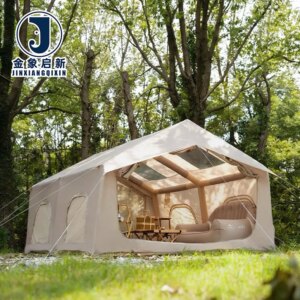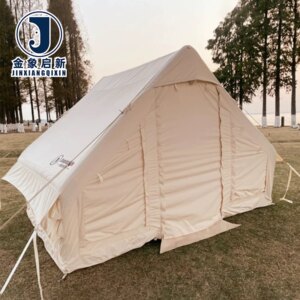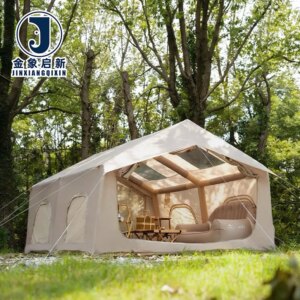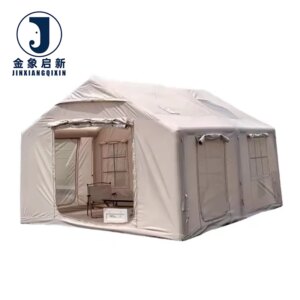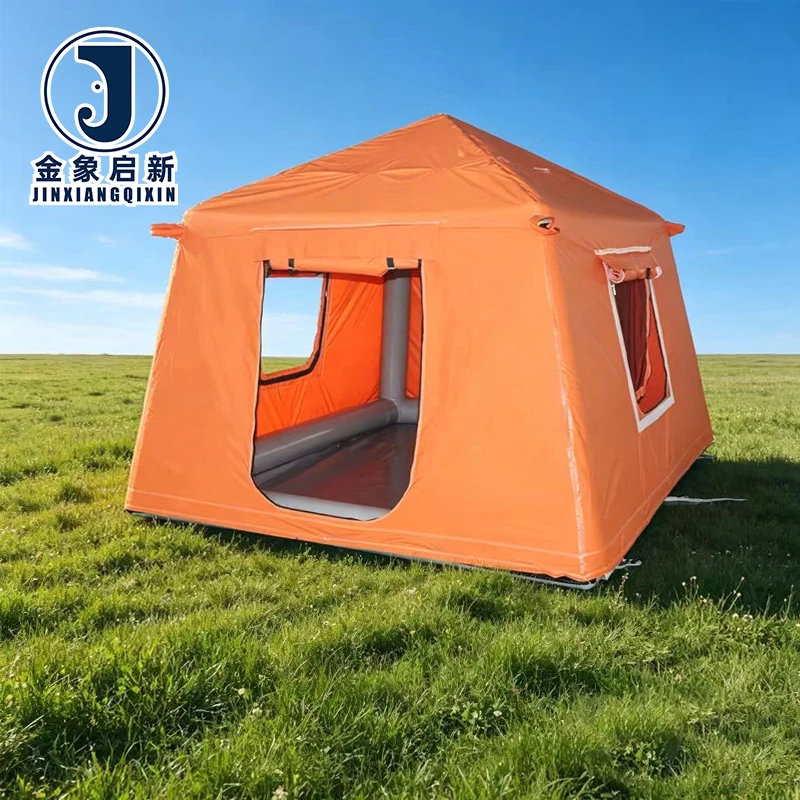
Proven Process Control — Nearly 30 years of coating expertise applied to inflatable tent fabric, with dedicated seam testing and inflation cycle validation at every production stage.
Technical Specifications
| Parameter | Value |
|---|---|
| Product Type | Inflatable Tent |
| Core Material | 420D Oxford Cloth |
| Construction | Single Layer |
| Design | Four-Season, Quick Automatic Opening |
| Capacity | 5–8 Person |
| Tensile Strength | ≥300N/5cm (test basis not stated in source) |
| Abrasion Resistance | ≥500 cycles (test basis not stated in source) |
| UV Treatment | UPF 50+ (test basis not stated in source) |
| Waterproof Rating | 1000mm water column (test basis not stated in source) |
| Weight | ≤8kg (source value — verify against manufacturer catalog) |
| Seam Strength | ≥250N (test basis not stated in source) |
| Deployment Cycle Testing | 500+ cycles |
| Customization | OEM & ODM, sample customization, pattern printing |
| Standards | ISO 9001, ISO 14001, ISO 45001, CE |
Application Suitability
| Application | Exposure & Requirement |
|---|---|
| Commercial camping operations | Repeated inflation cycles, ground abrasion, prolonged sun and rain exposure |
| Transport fleet field shelters | Rapid deployment at roadside or remote sites, wind loading, vehicle proximity |
| Industrial event accommodation | High-frequency setup and teardown, crowd wear, variable weather conditions |
| Professional field operations | Quick automatic opening under time pressure, single-layer weight efficiency |
| Team accommodation at remote sites | Multi-person capacity, four-season thermal considerations, transport logistics |
Why Inflatable Tent Seams Fail Before the Fabric Does
Welded seams failing before the fabric does, at the point the structure flexes most — this is the defining failure mode for any inflatable tent deployed in commercial or professional environments. The inflation cycle places concentrated stress at every bonded joint, and when seam strength is unverified, the shelter deflates at the worst possible moment. Seam integrity is not a material property — it is a process outcome, controlled by heat settings, dwell time, and in-line QA. [NEED_CITE: tensile and tear test methods for coated fabrics per ISO 1421]
Manufacturers routinely quote base fabric tensile values while leaving seam performance to assumption. In commercial camping operations, a tent that deflates mid-event triggers refunds, reputational damage, and fleet-level returns. The gap between stated seam strength and actual field performance widens with every inflation cycle. For the Inflatable Camping Tent aftermarket supplier category, this gap is where procurement decisions succeed or fail.
Automatic Opening Reliability Across Deployment Cycles
The automatic opening system in this inflatable tent has been validated through over 500 deployment cycles, simulating the inflation and deflation rhythm of commercial rental fleets and field operation teams. Each cycle tests not only the valve and air beam integrity but the bonded seam network that holds the structure rigid. Fabric that cannot sustain repeated pressurization will delaminate at the joint lines long before the base material shows wear.
This level of cycle testing matters most for buyers integrating an Inflatable Camping Tent into product lines where end users expect instant setup without manual pumping. The four-season design means the fabric encounters temperature swings that shift coating flexibility, and every cycle at low temperature tests whether the bond holds under reduced material compliance.
Single-Layer Construction and Field Transport Economics
Single-layer 420D Oxford cloth construction balances structural stability against transport weight, keeping the total unit under 8kg for the 5–8 person configuration. For fleet operators and event companies moving dozens of units between sites, this weight efficiency reduces per-trip logistics cost and storage footprint. The trade-off against multi-layer builds is thermal insulation, which four-season design compensates for through material density and coating selection rather than added layers. [NEED_CITE: DIN 4102 fire classification for building materials]
Buyers sourcing inflatable tents for commercial outdoor deployment need to understand that single-layer does not mean lightweight-duty — the 420D denier base fabric provides the tensile backbone, and the coating system adds waterproof and UV protection without a separate laminate. This construction approach simplifies repair in the field, as single-layer patches bond directly without delamination risk.
Reading the Specification Sheet Beyond Headline Numbers
Tensile strength of ≥300N/5cm and seam strength of ≥250N together define the structural envelope of this inflatable tent. Tensile strength measures the base fabric’s resistance to pulling force, while seam strength captures what happens at the joints where inflation pressure concentrates. When seam strength falls below 80% of base tensile, the structure becomes joint-limited — meaning the fabric could handle more load than the bonds allow.
The 420D denier indicates the yarn thickness in the Oxford weave, where higher denier values generally correlate with greater abrasion resistance and tear propagation resistance. Oxford weave distributes load across interlaced warp and weft yarns, reducing the risk that a single puncture propagates into a full-panel tear. The stated abrasion resistance of ≥500 cycles reflects surface durability under contact wear, relevant for ground sheets and high-touch zones during setup.
Waterproof rating expressed as water column height measures hydrostatic pressure resistance before leakage occurs, while UPF 50+ treatment addresses UV degradation that embrittles coating over extended sun exposure. Neither value operates in isolation — UV degradation reduces coating flexibility, which then reduces waterproof performance at stress points.
What Inconsistent Batch Quality Costs a Commercial Buyer
Colour variation between production batches forces commercial camping operators to reject entire shipments when tents intended for the same site arrive visibly mismatched. Beyond aesthetics, batch inconsistency in coating weight produces units with different inflation pressures, different waterproof thresholds, and different UV degradation timelines — none of which are apparent until the tents are deployed side by side in the field. [NEED_CITE: ISO 9001 quality management requirements for coated fabric batch consistency]
For buyers integrating an Inflatable Camping Tent into branded product lines, a single batch with off-spec coating weight can trigger customer complaints, warranty claims, and distributor returns that far exceed the unit cost difference between verified and unverified supply.
Why Procurement Teams Source This Inflatable Tent Fabric Here
Deep process control over coating weight and adhesion, developed across nearly 30 years of coated fabric production, ensures the 420D Oxford base receives consistent treatment across every production run.
Three full production lines and 36 sets of professional equipment support bulk inflatable tent orders with reliable on-time delivery, reducing the inventory risk for commercial distributors.
A 10-person R&D team handles custom sizing, pattern printing, and sample development within days, allowing OEM buyers to validate fitment and branding before committing to full production.
Dedicated QA/QC at every production stage with 100% inspection before shipment catches seam defects, coating inconsistencies, and inflation retention failures before they reach the buyer.
ISO 9001, ISO 14001, ISO 45001, and CE certification underpin every inflatable tent order, supporting compliance requirements for North American, European, and Asian market imports.
Documentation & Verification
- Material specification sheet stating 420D denier, coating type, and treatment references per batch
- Pre-shipment inspection record covering seam strength, waterproof rating, and inflation retention
- Test reports for UV and waterproof grades where applicable to the order specification
- Certificate of origin and customs documentation for cross-border inflatable tent shipments
- Roll and unit packing list matching production batch to purchase order line items
Fabrication, Handling & Storage
- Heat-seal seams at temperatures matched to the 420D Oxford coating to avoid delamination under inflation pressure
- Store folded units in dry conditions to prevent coating adhesion loss between contact surfaces
- Use compatible patch adhesive matched to the single-layer coating for field repairs on punctured air beams
- Avoid prolonged compression during warehouse storage to maintain air beam shape memory
- Clean with mild detergent only — aggressive solvents degrade the UPF treatment and waterproof coating
- Inspect valve seats and bonded joints before each deployment cycle to catch early-stage seam fatigue
Requesting a Specification Match
Provide your deployment environment details — expected inflation frequency, temperature range, and exposure conditions — so the 420D Oxford specification can be confirmed or adjusted for your application. Specify target market compliance requirements, annual volume, and whether you need finished units or fabric for your own manufacturing line. Confirm any custom sizing, pattern printing, or colour requirements early, as sample approval is required before production begins.
Frequently Asked Questions
Q: How is seam strength tested at inflation stress points on this inflatable tent?
A: Seam strength is verified through controlled tensile testing at bonded joints, with results reported as ≥250N. In-process QA checks seam integrity during production, and pre-shipment inspection includes inflation retention testing to confirm joints hold under pressurization. Specific test methodology documentation is available upon request for your compliance requirements.
Q: What is the test basis for UV protection and waterproof claims?
A: The UPF 50+ and 1000mm water column ratings are stated source values. Test reports confirming these ratings are produced during batch testing and can be supplied with your shipment. Buyers should specify the exact certification standard required by their target market so testing can be aligned before production.
Q: How does the automatic opening system perform across repeated cycles?
A: The system has been validated through over 500 deployment cycles under controlled conditions, testing valve function, air beam rigidity, and seam endurance. Commercial operators running high-frequency rental rotations should request cycle test documentation matched to their expected deployment volume.
Q: What custom sizing and printing options are available for OEM integration?
A: OEM and ODM customization covers sample development, custom sizing, and pattern printing. Samples are developed within days for validation before production. Lead time and minimum order depend on the complexity of custom requirements and colour matching across the production batch.
Q: How is batch-to-batch colour and material consistency controlled?
A: Production runs operate under ISO 9001 quality management with in-process checks on coating weight and colour reference. Pre-shipment inspection includes batch comparison against approved samples. Buyers requiring tight colour tolerance should specify reference standards at the inquiry stage so matching targets are established before sampling.