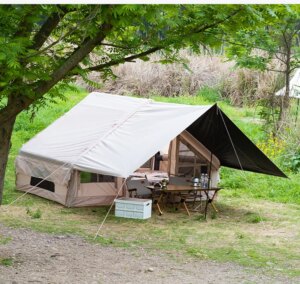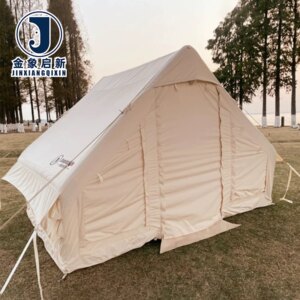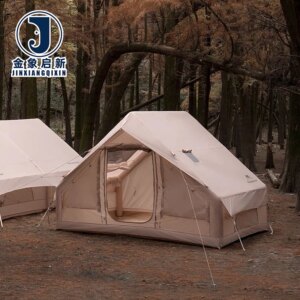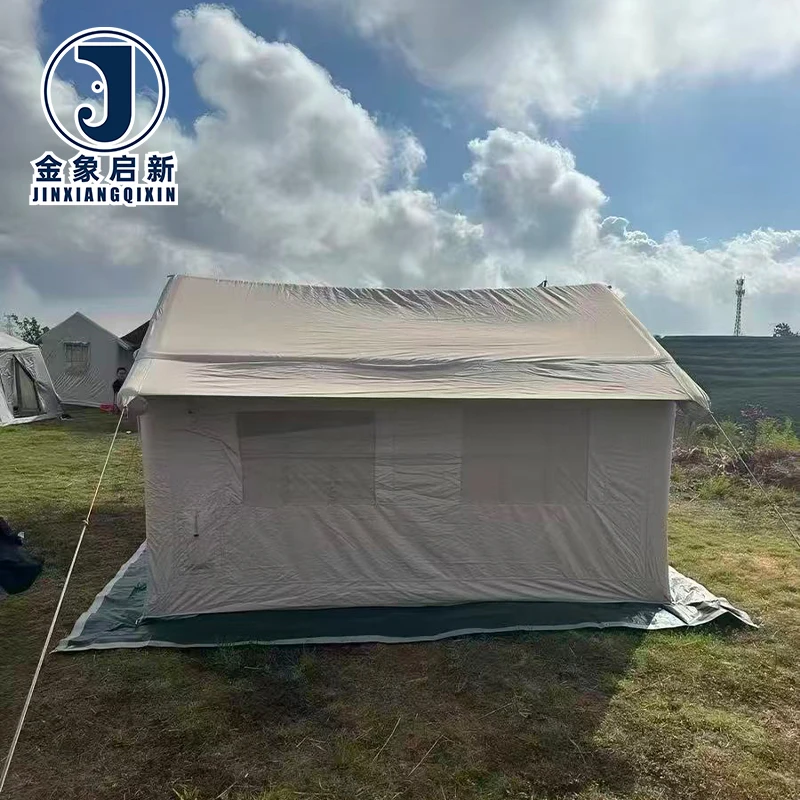
Custom Fabrication Depth — nearly three decades of coated fabric process control applied to inflatable structure manufacturing, ensuring each tent meets field deployment demands.
Technical Specifications
| Parameter | Value |
|---|---|
| Product Type | Inflatable Tent |
| Core Material | Oxford Fabric |
| Capacity | 4-6 Person |
| Design Configuration | Single Layer Construction, Extended Type |
| Seasonal Rating | Four-Season |
| Key Performance | Waterproof (test basis not stated), Quick Automatic Opening |
| Customization Service | OEM & ODM — material selection, product design, size adjustments, pattern printing |
| Production Facility | 9,180 m² with 3 full production lines and 36 sets of professional equipment |
| R&D Support | 10 technicians handling design and sample development |
| Quality Control | Full-process inspection with dedicated QA & QC staff, 100% pre-shipment inspection |
| Export Experience | 20+ countries across North America, Europe, and Asia |
| Certifications | ISO9001, ISO14001, ISO45001, CE |
Application Suitability
| Application | Exposure & Requirement |
|---|---|
| Fleet depot temporary loading bay shelter | Rain and wind during cargo transfer, frequent setup and teardown cycles, ground abrasion |
| Roadside breakdown and cargo transfer cover | Rapid deployment under pressure, vehicle proximity, uneven ground surfaces |
| Transport hub staging area | Extended outdoor exposure, UV degradation risk, high foot traffic around structure |
| Emergency rapid deployment scenario | Minutes-to-deploy requirement, operation in adverse weather, minimal crew assembly |
| Equipment storage at logistics yards | Dust and moisture ingress prevention, secure coverage over extended periods |
Why Setup Time Matters More Than Tent Weight for Fleet Operations
An inflatable tent that opens automatically in minutes removes the single biggest bottleneck in roadside logistics: manual assembly under pressure.
Fleet operators routinely lose operational hours when sudden weather disrupts loading schedules. Traditional frame tents require multiple crew members and considerable time to erect, often in conditions that make the work itself hazardous. When cargo sits exposed on a trailer bed while workers struggle with poles and guy lines, the financial exposure compounds by the minute [NEED_CITE: cost of weather-related delays in freight operations]. The quick automatic opening mechanism in this Inflatable Tent for truck and transport operations eliminates that friction entirely — one operator with a pump can have the structure standing and protecting cargo before a storm front arrives.
Deployment Speed as a Logistics Variable
Fleet scheduling depends on predictable turnaround times. When a tent takes forty minutes to erect manually, that window must be built into every contingency plan. The Inflatable Tent for truck and transport changes that calculation. The automatic opening system inflates the structural beams to full rigidity, creating a weatherproof enclosure over a loading zone or damaged vehicle without requiring a crew to assemble a frame piece by piece. This matters most at unscheduled stops — a breakdown on a motorway hard shoulder, a delivery point with no covered bay, a cross-dock operation in an open yard.
Protecting Cargo During Transitional Moments
The highest risk of moisture damage to freight occurs during the transitional moments: when a trailer door opens and the load is exposed before it moves indoors. Oxford fabric with waterproof construction provides a barrier during these vulnerable windows. The extended type configuration gives sufficient interior clearance for palletised goods to be staged under cover, and the single layer construction keeps the overall packed weight manageable for crews who need to carry the tent between vehicles or store it in a cab.
What Oxford Fabric Means for Field Durability
Oxford fabric is selected for inflatable structures because it offers a balance between tear resistance and packed flexibility. The weave pattern distributes stress across multiple yarn intersections, which matters when the structure flexes under wind load or when crew members brush against the walls while moving equipment through the doorway. For transport applications specifically, the material must tolerate repeated folding, compression into a carry bag, and redeployment without the coating delaminating at the fold lines [NEED_CITE: Oxford fabric fatigue resistance in repeated inflation cycles].
Reading the Specifications That Actually Matter
The 4-6 person capacity rating indicates usable floor area rather than a literal sleeping count — for logistics staging, this translates to sufficient space for two workers to move pallets with a hand truck and still have clearance around the perimeter. Four-season design means the material and seam construction are rated for temperature ranges that include freezing conditions, which matters when fleet operations continue through winter months. The single layer construction trades insulation for portability, an appropriate compromise when the structure serves as a weather shield rather than an occupied workspace. Waterproof performance should be verified with a hydrostatic head test report specific to the batch you receive — request this documentation before confirming your order.
The Cost of Getting the Specification Wrong
Specifying a tent for transport logistics without considering how often it will be deployed and repacked leads to premature failure at predictable points. Seam separation at the inflatable beam junctions is the most common field complaint when the structure is inflated and deflated daily [NEED_CITE: inflatable structure failure points under cyclic loading]. Colour variation between tents purchased in the same batch becomes visible when multiple units are deployed side by side at a logistics hub, which matters less for function than for the professional impression your operation presents to clients visiting the yard. Ordering without confirming the packed dimensions against your vehicle storage capacity can mean the tent simply does not travel with the fleet.
Why Procurement Teams Source This Inflatable Structure Here
Three full production lines operating simultaneously mean your custom order enters the queue without waiting for a single line to free up. The 10-person R&D team develops samples within days when you need non-standard dimensions for a specific trailer configuration or loading bay footprint. Every unit receives 100% inspection before dispatch, not a statistical sample from the batch. The Oxford fabric specification is verified against the material data sheet at incoming inspection, so the tent you receive matches what was quoted. Pattern printing and branding are handled in-house, which means colour matching happens under the same quality system as the structural fabrication.
Documentation & Verification
- Material specification sheet confirming Oxford fabric composition and coating details
- Batch-specific quality inspection report with waterproof performance data included
- ISO9001, ISO14001, ISO45001, and CE certificates provided for cross-border compliance
- Pre-shipment inspection record with photographic evidence of each unit
- Roll and unit packing list with weights for customs and freight forwarding
- Certificate of origin documentation for preferential tariff claims where applicable
Fabrication, Handling & Storage
- Heat-sealed beam seams require specific temperature profiles matched to Oxford fabric thickness to maintain airtight integrity
- Fold the tent along original crease lines to avoid creating stress points in the waterproof coating layer
- Store compressed in a dry environment to prevent mildew formation between the Oxford fabric layers
- Clean with mild detergent only — aggressive solvents will degrade the waterproof treatment on the fabric surface
- Inspect valve connections before each inflation cycle, as grit accumulation causes slow leaks at the fitting
- Allow the tent to dry fully before repacking to preserve coating adhesion across repeated deployment cycles
What to Include in Your Enquiry
Provide the specific deployment scenario — whether this tent will serve a fixed loading bay or travel with individual vehicles — so the dimensional recommendation matches your actual clearance requirements. Specify any branding or colour requirements that must align with your fleet livery, as custom colours carry different lead times than stock options. Confirm the target market for your operation, as certification requirements vary by jurisdiction and we need to prepare the correct documentation package for your compliance audit.
Frequently Asked Questions
Q: Can the Inflatable Tent for truck and transport be customised to fit a specific loading bay or trailer footprint?
A: Yes. The OEM and ODM service covers size adjustments to match your vehicle dimensions or depot layout. The R&D team develops a sample based on your drawings within days, allowing you to verify fit and clearance before committing to a production run. Minimum order quantities depend on the degree of customisation required.
Q: How is waterproof performance verified before shipment?
A: Each batch undergoes full-process inspection with dedicated QA and QC staff. The pre-shipment inspection record includes waterproof performance data specific to your order. We recommend requesting the batch test report and conducting a visual seam inspection upon arrival to confirm integrity after transit.
Q: What is the expected longevity of the Oxford fabric under frequent inflation cycles?
A: Oxford fabric is selected for its balance of tear resistance and flexibility under repeated folding. Actual service life depends on deployment frequency, UV exposure levels, and storage conditions between uses. We provide material specification sheets so you can assess the fabric against your operational tempo and plan replacement intervals accordingly.
Q: How do you control colour consistency across multiple tents ordered for the same fleet?
A: All units in a single production run are cut from fabric processed in the same batch, and in-house pattern printing ensures colour matching stays within the same quality control system. If your order spans multiple production runs, request a colour reference sample from the first batch to hold against subsequent deliveries.
Q: What documentation ships with each order for compliance purposes?
A: Every shipment includes ISO9001, ISO14001, ISO45001, and CE certificates, a material specification sheet, a batch inspection report, a packing list, and a certificate of origin. Additional documentation can be prepared to meet specific import or industry requirements — confirm these needs at the enquiry stage so they are ready at dispatch.