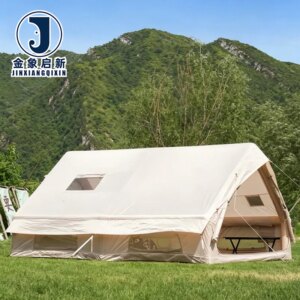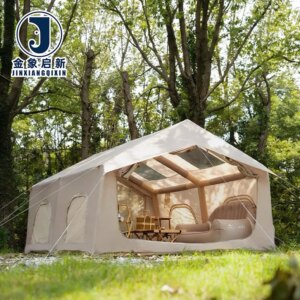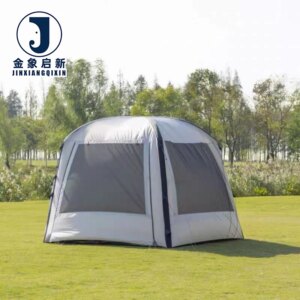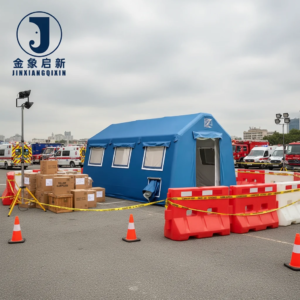
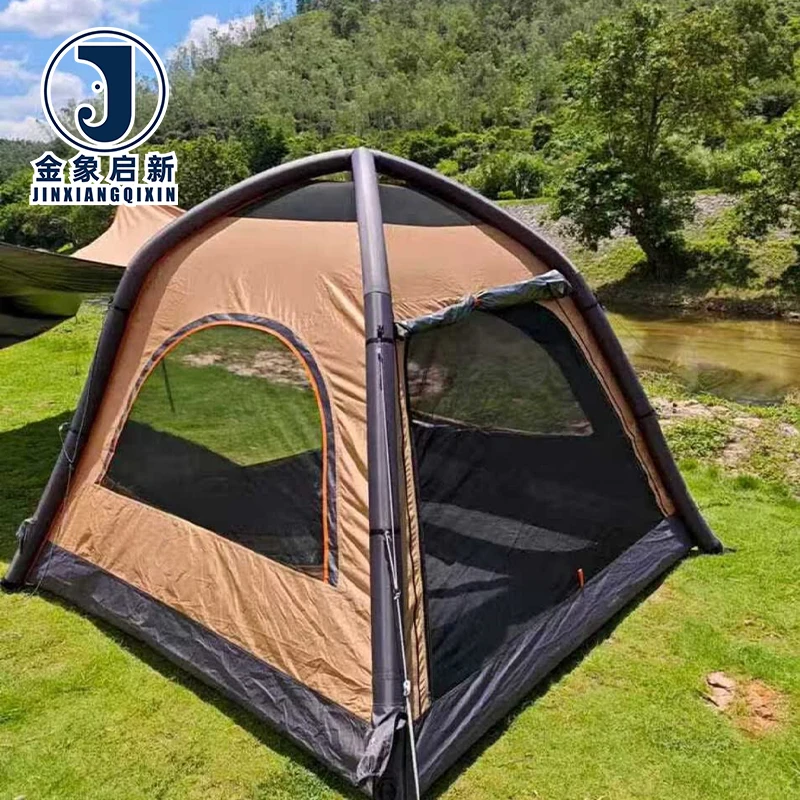
Proven Coating Adhesion Control — Nearly three decades of PVC coating process expertise ensures every inflatable tent membrane maintains structural integrity at the seams where flex stress concentrates most.
Technical Specifications
| Parameter | Value |
|---|---|
| Product Type | Inflatable Tent |
| Core Material | PVC tarpaulin (knife coated fabric) |
| Construction | Single-layer |
| Capacity | 8-10 Person |
| Season Rating | 4 Season |
| Waterproof Rating | ≥2000mm water column (source value — verify against manufacturer catalog) |
| Tear Resistance | ≥300N/5cm (test standard not stated in source) |
| Flame Retardancy | MEFB 1-1997 (referenced for flame retardancy test) |
| Key Features | Waterproof, UV-resistant, tear-resistant, fire-retardant, anti-static, rapid automatic opening |
| Customization | OEM & ODM (sample customization, pattern printing) |
| Standards | ISO9001, ISO14001, ISO45001, CE |
Application Suitability
| Application | Exposure & Requirement |
|---|---|
| Emergency Response Command Posts | Rapid deployment under adverse weather, requiring reliable waterproofing and structural stability during inflation cycles |
| Construction Site Temporary Shelters | Prolonged UV exposure, wind loads, and physical abrasion from equipment movement on site |
| Industrial Event Pavilions | Large span coverage with branding requirements, demanding batch color consistency across multiple units |
| Mobile Fieldwork Stations | Repeated inflation and deflation cycles, transport abrasion, and varying climatic conditions |
| Commercial Outdoor Shelter Projects | Year-round deployment requiring fire-retardant compliance for public access environments |
Why Inflatable Structures Fail at the Weld Line Before the Fabric Gives Way
Seam welding quality and coating adhesion determine the true service life of an inflatable tent, not the base fabric weight alone.
When sourcing custom inflatable tent solutions, buyers often specify a particular GSM expecting it to guarantee durability. Yet field failures consistently occur at the heat-welded joints where the structure flexes most during inflation and under wind load. The coating must bond completely to the base fabric and maintain that bond through repeated thermal cycling [NEED_CITE: tensile and tear test methods for coated fabrics per ISO 1421]. Without verified coating adhesion data, a heavy-grade fabric can still delaminate at the seams within the first season of commercial use.
Coating Adhesion and Weld Integrity in Inflatable Applications
Inflatable tent manufacturer capability extends beyond cutting and sewing — it requires precise control over the heat welding process to ensure seams match or exceed the parent material strength. The PVC knife coated fabric used in this inflatable tent provides a consistent coating thickness that responds predictably to thermal welding parameters.
When the coating bonds uniformly to the polyester base fabric, the welded seam distributes stress across a wider area rather than concentrating force at the joint edge. This becomes critical in inflatable structures where internal pressure creates constant tension across every seam. A custom inflatable tent designed for four-season deployment must withstand temperature fluctuations that cause the coating to expand and contract repeatedly without cracking or peeling away from the weld zone.
Structural Load Distribution Across the Inflatable Envelope
The single-layer construction of this inflatable tent relies on the PVC tarpaulin membrane itself to carry all structural loads once inflated. Unlike traditional pole-supported tents where the frame bears the primary stress, inflatable designs transfer wind loads, snow accumulation, and internal pressure directly through the fabric [NEED_CITE: structural analysis of inflatable membrane structures under variable wind loads].
The tear resistance rating of ≥300N/5cm indicates how the material resists propagation once a puncture or cut initiates. In emergency response deployments where the tent may encounter sharp debris during rapid setup, this tear resistance prevents a small damage point from expanding into a catastrophic failure across the entire panel.
Reading the Specification Sheet for Inflatable Tent Procurement
The waterproof rating of ≥2000mm water column specifies the hydrostatic pressure the coated fabric can withstand before water penetration occurs. For inflatable shelters deployed in heavy rain or used as temporary medical facilities, this rating provides a measurable benchmark rather than an unqualified "waterproof" claim.
The knife coating process applies PVC directly to the woven polyester base fabric under controlled tension, producing a uniform coating weight on both sides. This differs from lamination or calendering methods where the coating may not penetrate the weave as completely, potentially affecting long-term adhesion and weldability. Fire-retardant treatment tested to MEFB 1-1997 indicates the material has undergone flame exposure testing, though buyers should confirm the specific grade required for their target market’s building or temporary structure codes. The anti-static property addresses dust attraction and spark risk in certain industrial environments, though the surface resistance value or applicable standard should be requested for compliance-sensitive projects.
The Hidden Cost of Specifying Inflatable Tent Fabric on Weight Alone
Purchasing decisions based solely on quoted GSM frequently lead to field failures that appear unrelated to material specification. A tent that arrives at the stated weight but with poor coating adhesion will fail at the welded seams during the first strong wind event, while a lighter fabric with superior bond strength performs reliably across multiple seasons.
Batch color variation across an order of multiple inflatable tents creates visible mismatches once the units are installed side by side at an event site or construction compound. Without confirmed color consistency protocols, a commercial buyer may face complete rejection of a deployment where visual uniformity matters [NEED_CITE: color measurement standards for coated technical textiles]. Thermal welding performed outside the optimal temperature range for the specific coating formulation produces brittle seams that crack under flex stress, even though the fabric itself remains intact and within specification.
Why Procurement Teams Source Inflatable Tent Projects Through This Facility
The three full production lines and 36 sets of professional processing equipment provide capacity for bulk inflatable tent orders while maintaining consistent welding parameters across every unit in a production run.
The 10-person R&D team develops samples within days when a project requires custom sizing, pattern printing, or non-standard color matching — enabling physical evaluation before committing to a full production order. Dedicated QA/QC inspection at every production stage, with 100% pre-shipment verification, catches coating adhesion defects, dimensional deviations, and seam integrity issues before the inflatable tent leaves the facility. The PVC knife coated fabric production process is controlled from raw material through finished membrane, meaning coating weight, base fabric selection, and surface treatment are managed as a single integrated system rather than sourced separately and assembled.
Documentation & Verification
- Material specification sheet detailing PVC coating type, base fabric denier, and confirmed waterproof rating for each production batch
- Flame retardancy test report referencing MEFB 1-1997 or equivalent standard applicable to your destination market
- Pre-shipment inspection record covering seam weld integrity, dimensional tolerances, and inflation test results
- Color reference sample retained against production batch for consistency verification across repeat orders
- ISO9001, ISO14001, ISO45001, and CE certificates provided with shipment documentation for customs and compliance clearance
Fabrication, Handling & Storage
- Heat welding parameters must be calibrated to the specific PVC knife coated fabric thickness to prevent seam embrittlement
- Inflated storage or display avoids permanent crease lines that can weaken the coating at fold points over time
- Repair patches should use the same PVC tarpaulin material with compatible solvent cement for lasting adhesion
- Transport in cold conditions requires gradual warming before inflation to prevent low-temperature coating cracking
- Cleaning agents must be compatible with PVC surfaces to avoid plasticizer extraction and premature stiffening
- Pattern printing should be confirmed on production samples before full-run application to verify ink adhesion to the coating
Starting Your Inflatable Tent Inquiry
To move from specification review to sample development, provide your intended deployment environment including typical wind loads, temperature range, and expected inflation cycle frequency. If your market requires specific fire-retardant certification for temporary structures, state the applicable code or standard so the correct treatment grade can be confirmed before sampling. Indicate whether you require complete finished inflatable tents or membrane panels for your own fabrication, along with any color, sizing, or branding requirements for the project.
Frequently Asked Questions
Q: How is batch color consistency maintained across multiple inflatable tents in one order?
A: Production runs use retained color reference samples from approved material batches. Each inflatable tent in a bulk order is produced from the same coating batch where possible, and color variance is checked during pre-shipment inspection. For large orders requiring multiple coating batches, color matching against the approved standard is verified before the PVC tarpaulin proceeds to cutting and welding stages.
Q: What fire-retardant documentation is supplied with custom inflatable tent orders?
A: Orders include a test report referencing the MEFB 1-1997 flame retardancy standard. Buyers requiring compliance with specific national or regional building codes for temporary structures should provide the target regulation during inquiry so the appropriate fire-retardant grade can be confirmed and documented on the material specification sheet before production.
Q: Can custom dimensions and branding be accommodated for inflatable tent projects?
A: The OEM and ODM customization service covers custom sizing, pattern printing, and sample development. A physical sample is produced within days for buyer approval before full production commences. This allows verification of weld quality, print clarity on the PVC coated surface, and dimensional accuracy under inflation prior to committing the complete order.
Q: How is seam weld integrity verified before shipment?
A: Every inflatable tent undergoes 100% pre-shipment inspection covering seam weld continuity, inflation retention, and dimensional checks. The inspection record accompanies the shipment documentation. Weld parameters are calibrated to the specific PVC knife coated fabric grade being processed, ensuring consistent bond strength across all seams in the production run.