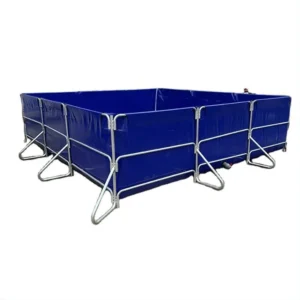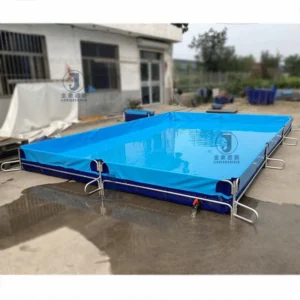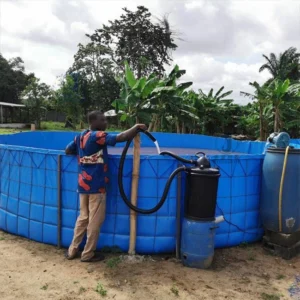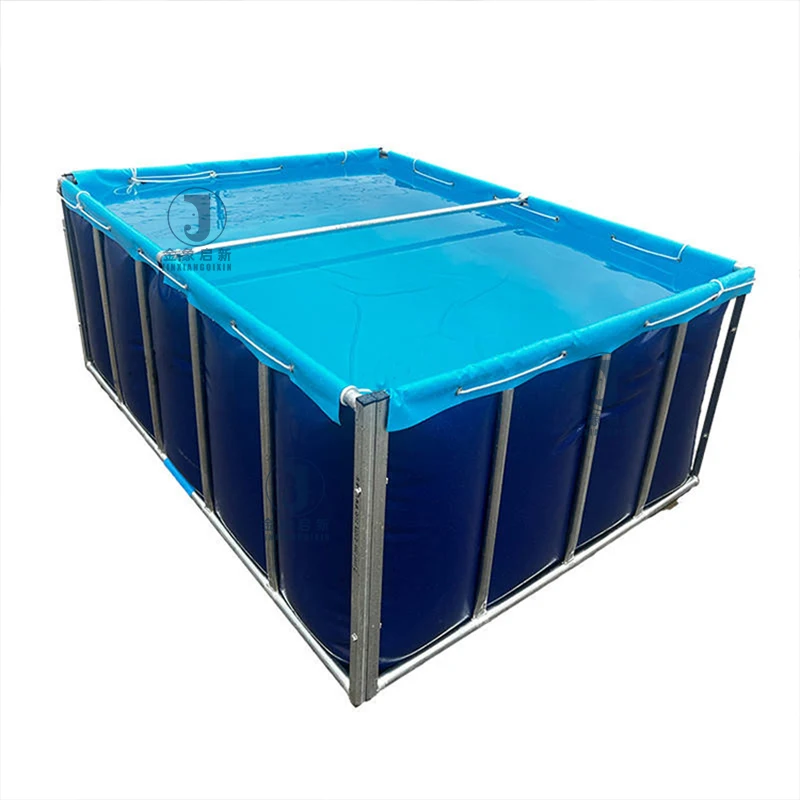
Laminated coating adhesion — PVC layers are thermally bonded to a high-tenacity polyester mesh base, ensuring welded seams on pond liners hold under continuous water pressure and flex stress at containment edges.
Technical Specifications
| Product Type | PVC Coated Tarpaulin (Pond Liner Application) |
|---|---|
| Material | PVC + High-strength polyester mesh fabric |
| Coating Method | Laminated / Hot-melt Coating |
| Weight (GSM) | 350gsm, 420g, 500gsm, 550gsm, 600gsm, 750gsm |
| Total Thickness | 0.32mm, 0.35mm, 0.4mm, 0.45mm, 0.5mm, 0.65mm |
| Roll Size | 2m width × 75m length / 2.1m width × 50m length |
| Color | Blue, Red, Yellow, Light blue, Grey (Customized) |
| Finish Product Size | Custom as per customer’s needs |
| Key Features | Waterproof, anti-mildew, cold crack resistance, color fastness, flexibility; anti-static and flame-retardant treatments available (grade not stated) |
| Service Life | 3–7 years under normal circumstances (source value) |
| Certifications | ISO, CE |
Application Suitability
| Application | Exposure & Requirement |
|---|---|
| Fish pond and aquaculture liner | Permanent water contact, soil chemistry exposure, puncture risk from substrate, UV exposure at waterline |
| Above ground swimming pool | Continuous hydrostatic pressure, chlorine or salt treatment, seasonal temperature variation |
| Truck and trailer cover | Road weather, abrasion at tie-down points, flexing at load edges, UV and thermal cycling |
| Tent and awning fabric | Prolonged sun exposure, rain pooling, repeated folding at stress lines |
Why Welded Seams Fail Before the Liner Does
Seam integrity depends on coating adhesion, not just fabric weight.
A pond liner holding thousands of litres of water places constant hydrostatic pressure on every welded joint. When the PVC coating does not bond fully to the polyester mesh, the weld line becomes the weakest point — and leaks appear long before the panel itself degrades. Laminated and hot-melt coating processes create a continuous bond between coating and base fabric, which is what allows heat-welded seams to carry load rather than peel apart under stress [NEED_CITE: weld shear strength test methods for coated fabrics per ISO 1421].
Coating Bond and Seam Reliability in Water Containment
For any PVC coated tarpaulin used as a pond liner, the coating method determines whether welded joints survive long-term immersion. Laminated and hot-melt coating processes fuse the PVC layer to the polyester mesh under controlled heat and pressure, producing adhesion strong enough to resist peeling when seams are subjected to water load and ground movement. This is why pond liners fabricated from laminated PVC coated tarpaulin consistently outperform calendered alternatives at the joint line, even when GSM values are identical.
GSM Selection for Pond Depth and Substrate Conditions
Heavier GSM grades within the 350gsm to 750gsm range provide greater puncture resistance when liners are installed over rough substrate or sharp-edged pond frames. Thicker coatings in the 0.45mm to 0.65mm range add an additional barrier against root penetration and soil chemistry attack. The correct specification depends on pond depth, base preparation and whether the liner will be exposed to livestock or mechanical cleaning equipment [NEED_CITE: puncture resistance classification for geomembrane liners].
How Coating Weight and Base Fabric Work Together
GSM alone does not predict liner performance. A 500gsm fabric with a dense polyester mesh and balanced coating distribution will resist tearing more effectively than a 600gsm fabric with a loose weave and uneven coating. The laminated process used here ensures that coating weight is distributed consistently across the roll, so every welded seam carries the same adhesion strength. Thickness values from 0.32mm to 0.65mm correspond to the GSM range, allowing buyers to match specification to containment depth and expected mechanical exposure.
Cold Crack Resistance and Seasonal Installation
Pond liners installed in cooler climates must withstand low-temperature handling without the coating becoming brittle. The cold crack resistance of this laminated PVC coated tarpaulin allows fabrication and welding to proceed in lower ambient conditions, reducing the risk of micro-cracks forming at fold lines or seam edges during installation. This is particularly relevant for above ground pool liners deployed in regions with significant seasonal temperature swings.
The Hidden Cost of Specifying Liner Weight Without Adhesion Data
Buyers who select pond liner material based on GSM alone often discover that welded seams fail within the first season. When coating adhesion is weak, heat welding creates a joint that looks sound but separates under hydrostatic load — and the cost of draining, repairing and refilling a pond far exceeds the price difference between laminated and calendered fabric. Requesting a pre-shipment inspection record with GSM verification and a material specification sheet stating base fabric and coating weight is the only way to confirm that the delivered roll matches the quoted performance [NEED_CITE: coating adhesion peel test per ISO 1421].
Production Control and Consistent Roll Quality
Three full production lines and 36 sets of coating and finishing equipment allow batch-consistent output across rolls ordered for the same pond project. A dedicated 10-person R&D team handles material selection and sample development, so buyers can approve a physical sample before bulk production begins. Every roll undergoes 100% inspection before shipment, with GSM, thickness and colour checked against the order specification. This level of process control is what separates a liner that performs for years from one that fails at the first weld.
Documentation and Verification
- Material specification sheet stating GSM, base fabric, coating method and colour reference
- Pre-shipment inspection record with weight and thickness verification per roll
- Test report for anti-UV and flame-retardant treatments where applicable
- ISO and CE certificates for material compliance
- Roll packing list with dimensions, weight and batch reference
- Certificate of origin and customs support documentation
Fabrication, Handling and Storage
- Heat-welding parameters must match the 0.32mm–0.65mm thickness range to avoid under- or over-penetration at the seam
- Store rolls upright on a flat, dry surface to prevent permanent creasing in the laminated coating layer
- Allow rolls to acclimatise to site temperature for 24 hours before unfolding and welding in cold conditions
- Clean the liner surface with mild detergent only; solvent-based cleaners can degrade the PVC coating
- Cut panels to size with a sharp blade, leaving adequate seam allowance for welded joints at stress points
Specifying the Right Liner for Your Pond Project
To receive an accurate specification recommendation, provide the pond dimensions, expected water depth, substrate conditions and whether anti-UV or flame-retardant treatment is required for your market. Indicate whether you need roll stock for on-site fabrication or finished cut panels with welded seams. Sample development is available before bulk production, so you can verify coating adhesion and colour before committing to a full order.
Frequently Asked Questions
Q: What GSM is recommended for a fish pond liner versus an above ground pool?
A: For shallow ponds with smooth substrate, 350gsm to 500gsm in the 0.32mm–0.4mm thickness range is typically sufficient. Above ground pools with higher hydrostatic pressure and potential chemical exposure benefit from 550gsm to 750gsm in the 0.45mm–0.65mm range. The final choice depends on depth, base preparation and whether the liner will face mechanical stress.
Q: How are welded seams reinforced at high-stress points on a pond liner?
A: Welded seams on laminated PVC coated tarpaulin rely on the coating-to-mesh adhesion created during the hot-melt process. For high-stress areas such as corners, pipe penetrations and overflow outlets, double-welded seams or reinforced patches cut from the same material are applied. The laminated structure ensures the weld carries load without peeling under hydrostatic pressure.
Q: Can I order custom width and length with printed branding for a pond liner project?
A: Custom width and length are available within the production capability of 2m to 2.1m roll width, with panels welded to larger dimensions on-site or in the factory. Pattern printing and branding can be applied to the liner surface, though colour fastness and print durability should be confirmed for permanent water immersion conditions.
Q: What test reports are provided for anti-UV and flame-retardant claims?
A: Test reports for anti-UV and flame-retardant treatments are provided where applicable, though the specific grade and standard must be confirmed at the inquiry stage. Buyers should specify the market compliance requirement — such as DIN 4102 for flame retardancy or a minimum UV exposure hour rating — so the correct treatment grade can be applied and documented.
Q: What is the lead time for custom colour and cut-size pond liner orders?
A: Standard stock colours and GSM grades are dispatched within typical multi-week lead times. Custom colour matching and cut-to-size panel fabrication require sample approval before production begins, which adds to the overall timeline. Buyers planning large pond projects should allow sufficient time for sample development, approval and bulk production.