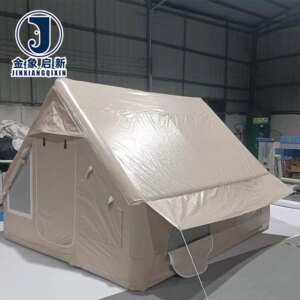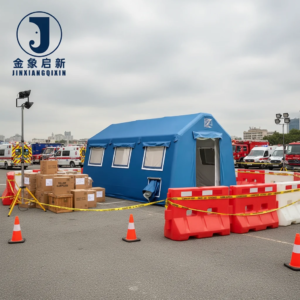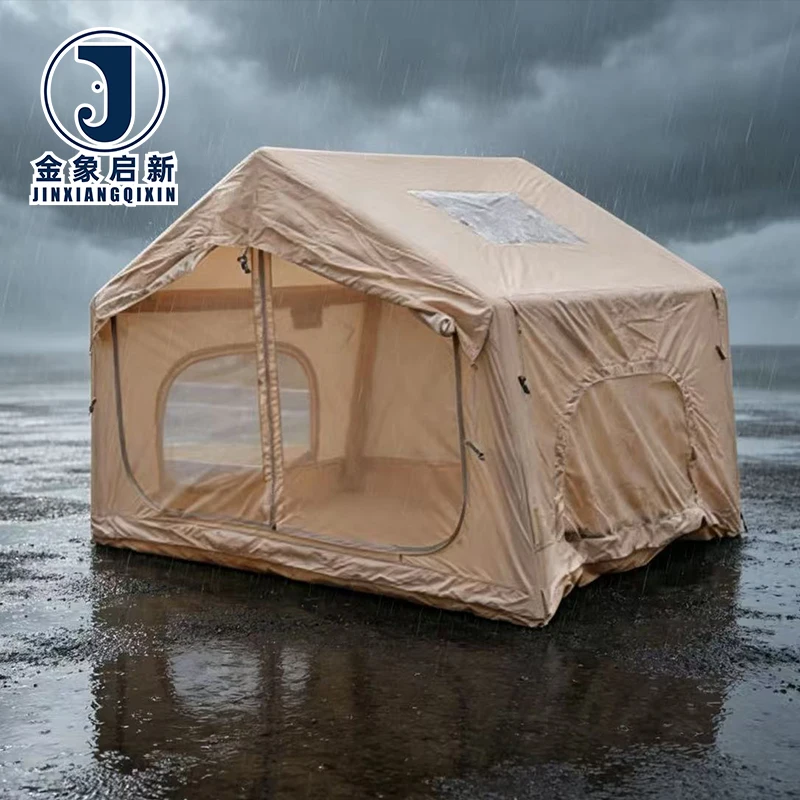
Deep Coating Process Control — maintaining consistent PVC coating weight and adhesion across every roll of inflatable tent fabric through a 36-equipment production setup.
Technical Specifications
| Parameter | Value |
|---|---|
| Product Type | Inflatable Tent |
| Core Material | PVC tarpaulin |
| Capacity | 5-8 Person |
| Season Rating | 4-Season |
| Opening Mechanism | Automatic inflatable opening |
| Waterproofing | Fully waterproof coated construction |
| UV Resistance | UV-resistant treatment available — confirm test basis for your market |
| Tear Resistance | Tear-resistant PVC coated fabric |
| Customization | OEM & ODM (sample customization, pattern printing) |
| Standards | ISO 9001, ISO 14001, ISO 45001, CE |
Application Suitability
| Application | Exposure & Requirement |
|---|---|
| Construction temporary site offices | Continuous weather exposure, ground abrasion, repeated inflation cycles |
| Outdoor event mobile command centers | Rapid deployment demand, UV exposure, crowd-area branding visibility |
| Industrial field operation shelters | Remote site logistics, temperature variation across four seasons, transport handling stress |
| Commercial outdoor shelter deployments | Frequent assembly and disassembly, wind loading on inflatable frame, surface wear from relocation |
Why Batch Consistency Matters More Than the Quoted Specification for Inflatable Tent Fabric
A single roll that deviates in colour or coating weight from the rest of the order can reject an entire container of finished inflatable tents.
When procurement teams source inflatable tent material across multiple purchase orders, the specification sheet often matches on paper but diverges on the warehouse floor. Colour shifts between batches become visible once two tents stand side by side at an event site. Coating weight variation — even within a tolerance that looks acceptable on a lab report — changes how the fabric behaves during heat welding of inflatable beam sleeves. I have reviewed field reports where seam failures clustered on tents built from rolls received in different shipments, each individually within spec but collectively inconsistent [NEED_CITE: tensile and tear test methods for coated fabrics per ISO 1421].
How PVC Tarpaulin Construction Supports Inflatable Tent Performance
The PVC tarpaulin used in this custom inflatable tent provides a continuous coated barrier that resists water ingress at every seam and fold point. For commercial shelters that undergo inflation and deflation cycles daily during a project, the coating adhesion to the base fabric determines whether micro-cracks develop along beam channels. A manufacturer with controlled coating processes can deliver fabric that holds its structural integrity through repeated pressurisation events, which is essential for any Inflatable Tent manufacturer producing units for rental fleets or project-based deployment.
Rapid Deployment Demands Placed on the Fabric
Automatic inflatable opening mechanisms place concentrated stress on the beam sleeve zones during pressurisation. The fabric must resist stretching at these anchor points while remaining flexible enough to fold compactly for transport. For outdoor event command centers and mining site shelters, this balance between rigidity and pack-down flexibility defines whether the tent can be redeployed across locations without fabric fatigue. The 4-season rating indicates performance across temperature ranges that cause lesser materials to stiffen or soften unpredictably.
Reading the Specification Sheet Beyond the Surface Weight
The relationship between PVC coating weight and the base fabric denier determines the actual tear and tensile performance of inflatable tent material. A heavier coating on a low-denier base may produce an impressive GSM figure while offering poor tear propagation resistance — the coating carries the load rather than the woven structure. Surface finish selection, whether glossy or matte, affects how the fabric accepts pattern printing for branding and how easily field dirt releases during cleaning between deployments [NEED_CITE: coating adhesion and peel strength test standards for PVC tarpaulin]. Buyers specifying material for commercial inflatable tents should request the base fabric construction details alongside the total weight to understand the real performance envelope.
What Happens When Inflatable Tent Fabric Specifications Are Wrong
Ordering inflatable tent fabric based solely on a GSM figure without verifying the base fabric density leads to beam sleeve failures that appear mid-project rather than during initial testing. UV-resistant treatment claimed without a stated test basis means the fabric may degrade unpredictably in high-exposure environments, leaving event organisers replacing tent skins between seasons. Welded seams on inflatable beam structures fail first when the coating adhesion is lower than the fabric tensile capacity, because the heat-affected zone becomes the weakest link under cyclic inflation pressure [NEED_CITE: heat welding parameters and seam strength retention in PVC coated fabrics]. Batch colour mismatch across a large order forces the buyer to sort and segregate rolls, delaying production and increasing waste.
Why This Source Supports Repeat Inflatable Tent Orders
Nearly 30 years of focused PVC coated fabric production means the coating formulation and application parameters have been refined across thousands of production runs, not adjusted per order. Three full production lines with 36 sets of professional equipment provide the capacity to fulfil container-volume inflatable tent fabric orders within a single production cycle, reducing the batch-splitting that causes colour drift. A 10-person R&D team handles material selection, pattern printing setup, and sample development in-house, so customisation requests do not pass through external brokers. Dedicated QA/QC inspection at every production stage catches coating weight deviation before it reaches the cutting table, and 100% pre-shipment inspection verifies roll consistency against the agreed specification.
Documentation & Verification
- Material specification sheet confirming PVC base fabric, coating type, and weight per roll
- Pre-shipment inspection record with 100% roll check before container loading
- UV treatment test report — verify test basis with supplier for your regional requirements
- ISO 9001, ISO 14001, ISO 45001, and CE certificates included with dispatch documentation
- Colour reference standard documented for batch-to-batch matching on repeat orders
- Certificate of origin and customs documentation prepared for export shipments
Fabrication, Handling & Storage
- Heat weld beam sleeves at parameters matched to the PVC coating type to avoid adhesion failure at inflation points
- Store rolls upright on cores to prevent flat-spot creasing that weakens the coating along fold lines
- Allow cold-stored rolls to reach ambient temperature before unrolling to prevent coating micro-cracking
- Use compatible PVC adhesive for field repairs on beam sleeve seams rather than generic fabric patch kits
- Plan cutting layout to maximise yield from roll width and reduce welded seam count on large tent panels
- Clean printed surfaces with pH-neutral agents to preserve pattern sharpness and coating integrity
What to Include in Your Inflatable Tent Material Inquiry
Provide the deployment environment details — climate zone, expected UV exposure duration, and wind loading conditions — so the correct PVC grade and treatment can be recommended. Specify whether you need roll stock for your own fabrication line or finished inflatable tent units, along with any pattern printing or branding requirements. State your target market’s fire classification or compliance requirements upfront, as treatment options vary by certification. Include your annual volume estimate and preferred roll dimensions to confirm production scheduling against available capacity.
Frequently Asked Questions
Q: How is the material weight verified before shipment and what proof accompanies the order?
A: Every roll undergoes weight verification against the stated specification during our 100% pre-shipment inspection. A documented inspection record accompanies each dispatch, listing actual measured values per roll. This allows you to cross-check the received material against your purchase order specification before fabrication begins.
Q: What is the test basis for UV-resistant treatment claims on this inflatable tent fabric?
A: UV-resistant treatment is available for this PVC tarpaulin, but the specific test standard and exposure rating depend on the grade selected. Request the test report for the particular UV grade being quoted, and confirm whether it aligns with the service life and climate exposure your inflatable tents will face in the field.
Q: How do you control colour consistency across large orders of inflatable tent fabric?
A: Colour matching is managed through documented reference standards and in-process coating checks across all three production lines. For large orders spanning multiple production runs, rolls are grouped and inspected side by side before dispatch. Request our batch colour control procedure when placing orders for multi-unit inflatable tent deployments.
Q: What OEM and ODM customisation options exist for inflatable tents?
A: Customisation covers sizing, PVC material grade selection, and pattern printing for branding or site identification. Our 10-person R&D team develops samples for approval before bulk production proceeds. Submit your dimensional requirements, colour references, and any printed artwork to initiate the sample development process.
Q: What documentation is available for compliance verification at the destination site?
A: Each shipment includes the material specification sheet, ISO 9001, ISO 14001, ISO 45001, and CE certificates, pre-shipment inspection records, and a certificate of origin. Additional test reports for specific treatments such as UV resistance are provided based on the grade ordered. Confirm your site’s documentation requirements at the inquiry stage.