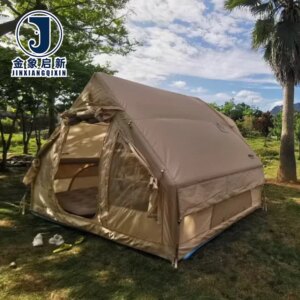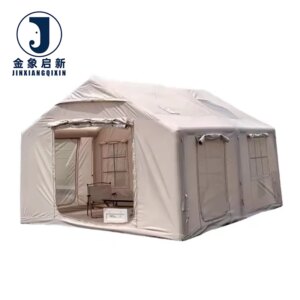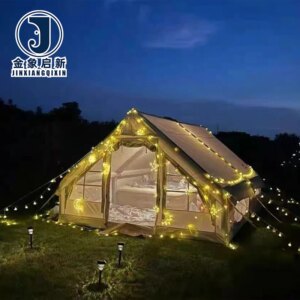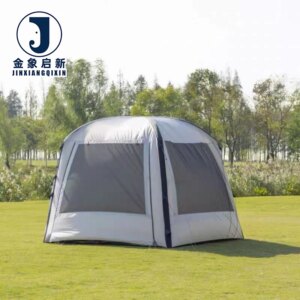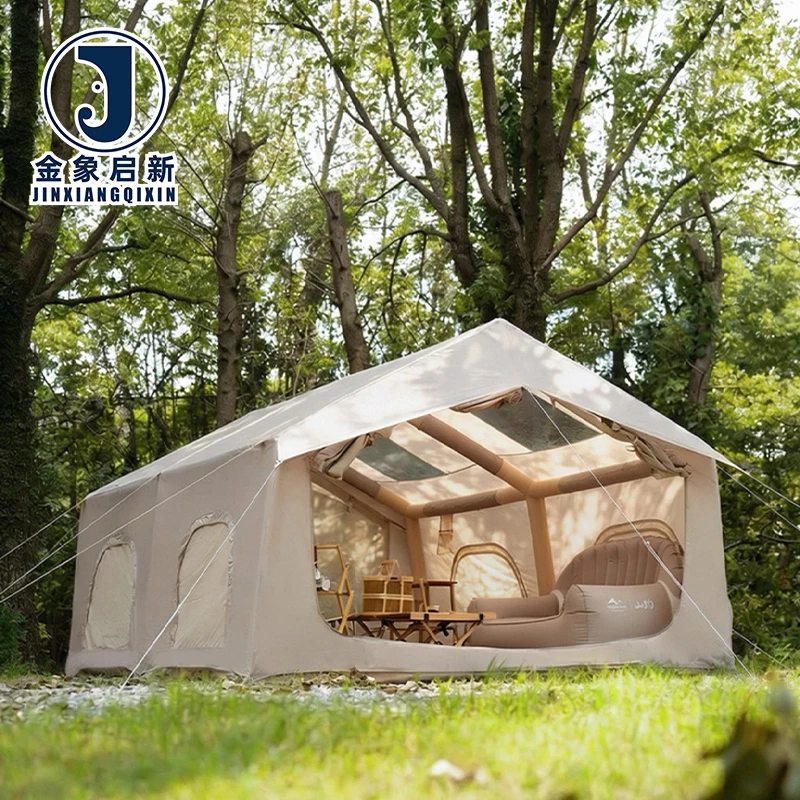
Precision-coated inflatable shelter fabric — Every roll undergoes full-process QA with 100% pre-shipment inspection, ensuring batch-to-batch consistency that fleet operators and site contractors depend on when deploying shelters across multiple locations.
Technical Specifications
| Parameter | Value |
|---|---|
| Product Type | Inflatable tent |
| Core Material | PVC waterproof fabric |
| Product Forms | Inflatable structure, single layer construction |
| Waterproof Performance | Fully waterproof coated construction (grade not stated in source) |
| UV Resistance | UV-resistant formulation available (test basis not stated in source) |
| Tear Resistance | Tear-resistant construction (test basis not stated in source) |
| Key Features | Quick setup, OEM & ODM sample customization, pattern printing |
| Customization | Custom sizing, sample development, pattern printing |
| Certifications | ISO9001, ISO14001, ISO45001, CE |
Application Suitability
| Application | Exposure & Requirement |
|---|---|
| Transport fleet driver shelters at loading yards | Constant assembly and teardown cycles, wind load on inflatable ribs, UV exposure during daytime staging |
| Outdoor equipment and cargo staging covers | Weather exposure, abrasion from equipment movement, requirement for rapid deployment under time pressure |
| Commercial camping ground infrastructure | Multi-season weather variation, guest safety requirements, repeated inflation and deflation cycles |
| Industrial site temporary accommodations | Dust, chemical exposure from site operations, requirement for structural integrity under wind and rain |
| Event facility temporary structures | High visibility demands, branding and print requirements, fast setup for tight event schedules |
Why Inflatable Tent Structures Fail Before the Fabric Does
The inflatable tent fabric for truck and transport shelter applications is only as reliable as its welded seams under cyclic inflation pressure. Generic PVC covers fail at the rib-to-body junction where flexing concentrates stress during inflation and wind gusts — the material itself survives while the seam splits open.
The seam is the structural weak point in every inflatable shelter, not the coated fabric.
When I review failed inflatable structures from transport yards and construction sites, the tear pattern almost always originates at the heat-welded junction between the air beam and the main body panel. The fabric retains its tensile strength, but the weld line degrades under repeated flex cycles. Purpose-built inflatable tent fabric must account for this stress concentration through controlled coating weight and consistent base fabric adhesion. [NEED_CITE: tensile and tear test methods for coated fabrics per ISO 1421]
Coating Adhesion and the Inflatable Rib Interface
The single-layer inflatable construction places unusual demands on the bond between the PVC coating and the base fabric scrim. During inflation, the air beam expands and the coating must flex without delaminating from the woven substrate. Inflatable tent fabric for truck and transport shelter must maintain coating adhesion through thousands of inflation cycles without blistering or separation at the rib curvature.
The precision coating process ensures uniform PVC application across the full fabric width, eliminating thin spots where delamination typically initiates under cyclic stress.
Deployment Speed Without Sacrificing Material Integrity
Rapid setup is a core operational requirement for transport fleet shelters and industrial site accommodations. The inflatable single-layer structure eliminates pole assembly and guy-line tensioning, but the fabric must still withstand the internal air pressure required to maintain structural shape in wind. Quick-deploy capability only matters if the shelter remains standing through a four-season weather cycle without seam degradation or coating failure.
Site operators need inflatable tent fabric that holds air pressure reliably across temperature variations — from summer heat softening the PVC to winter cold stiffening it. [NEED_CITE: temperature-dependent mechanical properties of PVC coated polyester fabrics]
Reading the Specifications That Actually Matter
Understanding inflatable shelter fabric requires looking beyond a single specification number. The base fabric denier and weave density determine how the material resists tear propagation when punctured or stressed at an inflation point. Coating weight contributes to waterproof barrier performance and abrasion resistance, but the relationship between coating thickness and base fabric strength is not linear — a heavy coating on a loose-weave base will crack before a moderate coating on a tight-weave substrate delivers its full tensile capacity.
UV-resistant formulation availability should be confirmed with test data before specifying for prolonged outdoor exposure, as claimed resistance without documented testing leaves buyers unable to verify performance against their project requirements. Waterproof performance in inflatable single-layer construction depends on both coating continuity and seam integrity — the fabric panel may be fully waterproof while a poorly welded junction allows moisture ingress. Tear resistance in inflatable structures is critical because a small puncture in an air beam can propagate rapidly under internal pressure, collapsing the entire shelter.
The Cost of Specifying Inflatable Shelter Fabric on Price Alone
When buyers prioritize the lowest quotation without verifying coating adhesion and seam weld quality, the consequences appear within the first season of deployment. Air beams that lose pressure overnight force crews to re-inflate shelters daily, consuming labor that erases any initial savings. Coating delamination at flex points creates visible blistering that compromises the waterproof barrier and signals premature structural decline.
Batch-to-batch inconsistency in fabric weight and coating thickness means the second container of inflatable tent fabric for truck and transport shelter may not perform like the first, creating unpredictable shelter reliability across a fleet’s staging network. [NEED_CITE: coating weight variation impact on PVC fabric performance]
Why Source Inflatable Shelter Fabric Through This Facility
Three full production lines with 36 sets of professional processing equipment support consistent output volume for commercial inflatable shelter projects without extended backorder delays.
A dedicated 10-person R&D team handles material selection, custom sizing, and pattern printing development — producing validation samples within days rather than weeks for inflatable tent prototypes.
Full-process quality inspection with dedicated QA and QC staff means every production stage from coating to cutting is monitored, with 100% pre-shipment inspection catching seam and coating defects before dispatch.
ISO9001, ISO14001, ISO45001, and CE certifications provide the compliance documentation that international procurement teams and site safety officers require for temporary structure approvals.
OEM and ODM customization capability allows fleet-branded inflatable shelters with pattern printing and dimensional adjustments matched to specific trailer configurations and staging area footprints.
Documentation & Verification
- Material specification sheet detailing PVC coating type, base fabric construction, and waterproof performance parameters per roll
- Batch-specific quality inspection report with tear strength metrics and dimensional verification before dispatch
- Test report for UV-resistant and waterproof grades where applicable to project specification requirements
- ISO and CE certificate copies aligned with inflatable shelter material procurement compliance needs
- Pre-shipment inspection record confirming seam weld integrity and coating consistency across the order
- Roll packing list with batch tracking numbers for traceability through installation and warranty periods
Fabrication, Handling & Storage
- Heat-weld seams at temperatures matched to PVC coating formulation to avoid burn-through on single-layer inflatable construction
- Reinforce inflation valve attachment points with additional PVC patches to distribute air pressure load across the base fabric
- Store rolls horizontally on pallets to prevent permanent creasing that weakens coating adhesion at fold lines
- Avoid deploying inflatable structures in sub-zero temperatures without confirming PVC low-temperature flexibility for the specified formulation
- Clean PVC surface with mild detergent only — solvent-based cleaners can degrade coating bond and compromise waterproof performance
- Repair field punctures with compatible PVC adhesive patches applied to clean, dry fabric surfaces before re-inflation
What We Need to Move Your Inquiry Forward
Provide the intended deployment environment and expected wind load conditions so we can confirm whether the standard inflatable tent fabric formulation meets your structural requirements or if a reinforced grade is necessary.
Share your target dimensions, inflation system specifications, and any pattern printing or branding requirements so our R&D team can develop a matched sample for dimensional and performance validation before you commit to production volume.
Specify your market’s fire safety or structural compliance standards for temporary shelters, along with your annual volume and required lead time, so we can confirm capacity allocation and documentation coverage.
Frequently Asked Questions
Q: How can I verify the waterproof rating and UV resistance claims before placing a bulk order?
A: Request batch-specific test reports covering waterproof performance and UV resistance for the exact production run. We provide documented test results alongside material specification sheets. For markets requiring independent third-party certification, confirm the testing standard your project specifies so we can align documentation before production begins.
Q: What custom sizing and pattern printing options are available for fleet-branded inflatable shelters?
A: Our R&D team develops custom-sized samples with pattern printing matched to your fleet branding requirements. Dimensional adjustments are based on your specific trailer configuration or staging area footprint. Sample approval is completed before mass production to ensure the printed design registers correctly on the PVC inflatable tent fabric surface.
Q: How do you ensure batch-to-batch color consistency across multiple container orders?
A: Dedicated QA and QC staff monitor coating formulation and pigment dispersion at every production stage. Each roll is inspected against the approved color reference before packing. Pre-shipment inspection records document color verification results, and batch tracking numbers allow full traceability if you need to match additional orders to a previous shipment.
Q: What quality control measures verify welded seam integrity on inflatable structures?
A: Full-process quality inspection covers seam welding parameters and adhesion testing throughout production. The 100% pre-shipment inspection specifically checks weld integrity at high-stress junctions including air beam connections and valve attachment points. Inspection records documenting seam performance are included in the dispatch documentation package.
Q: What is the typical lead time and minimum order for custom inflatable tent dimensions?
A: Lead times vary based on customization complexity and current production line allocation. Custom sizing with pattern printing requires sample development and approval before scheduling mass production. Share your required dimensions, annual volume, and delivery timeline in your inquiry so we can confirm feasibility and provide an accurate production schedule.