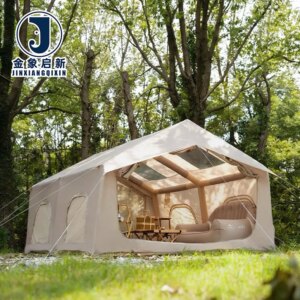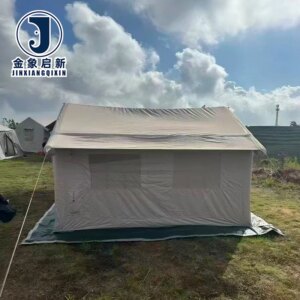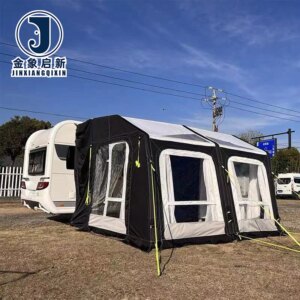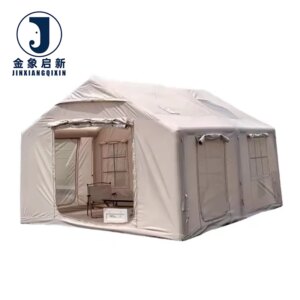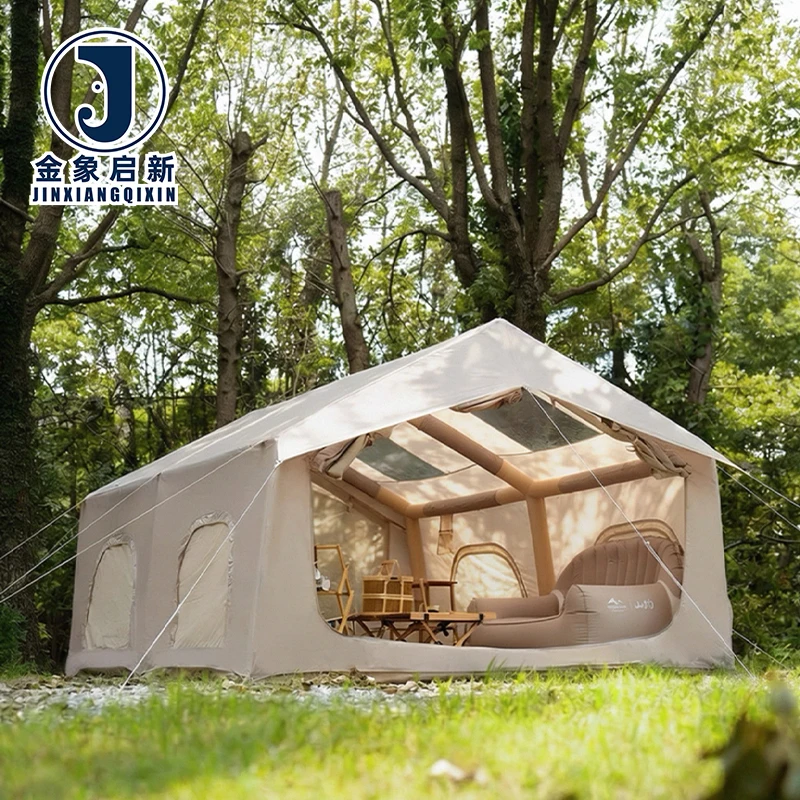
Proven PVC Coating Expertise — Nearly three decades of coated fabric process control applied to inflatable tent manufacturing, ensuring coating adhesion and material consistency across every production run.
Technical Specifications
| Parameter | Value |
|---|---|
| Product Type | Inflatable Tent |
| Core Material | PVC tarpaulin |
| Coating Material | PVC |
| Construction | Single layer |
| Product Forms | 2-3 Person Quick Automatic Opening |
| Key Performance | Waterproof, UV-resistant (test basis not stated in source), tear-resistant, fire-retardant (grade not stated in source), anti-static (standard not stated in source) |
| Customization Service | OEM & ODM (sample customization, pattern printing) |
| Standards | ISO9001, ISO14001, ISO45001, CE |
Application Suitability
| Application | Exposure & Requirement |
|---|---|
| Construction site temporary shelter | Daily rigging, wind load, abrasion from ground contact, UV exposure over extended deployment |
| Outdoor event logistics | Rapid deployment cycles, weather variability, foot traffic, public safety compliance |
| Emergency response base tent | Immediate field deployment, all-weather waterproofing, transport and storage durability |
| Mobile field operations | Multi-site relocation, folding and packing stress, temperature fluctuation |
| Industrial storage cover | Dust and moisture ingress prevention, long-term static loading, tear risk at anchor points |
Why "Fire-Retardant" Means Nothing Without a Grade Behind It
An Inflatable Tent manufacturer custom order specifying fire-retardant fabric without a named grade leaves procurement exposed to site rejection and regulatory non-compliance.
Buyer specifications must state the exact fire classification required for the target jurisdiction.
Purchasing teams frequently approve quotations listing "fire-retardant" as a blanket claim, only to discover at site inspection that the material lacks documentation matching the project’s safety code. On construction sites and public event venues, the fire marshal or safety officer requires a test certificate tied to a recognised standard — not a supplier declaration. [NEED_CITE: fire classification standards for temporary structures and tents]. When the delivered fabric cannot be traced to a specific grade, the entire installation may be shut down, forcing emergency replacement at significant cost and schedule disruption. I have seen entire event villages dismantled the night before opening because the tent fabric certificates did not reference the required standard.
Welded Seam Integrity Under Inflation Stress
Every inflatable tent relies on air-holding seams that must perform under constant internal pressure. The PVC tarpaulin construction allows heat-welded joints rather than stitched seams, eliminating needle holes that compromise waterproofing. For a quick-deploy 2-3 person unit, the weld lines at the tube junctions experience the highest stress during inflation and packing. The Inflatable Tent manufacturer custom process controls coating weight and adhesion at these critical junctions, ensuring the bond does not delaminate when the structure flexes during setup or wind loading. Coating adhesion between the PVC layer and the base fabric directly determines whether a weld holds or peels under field conditions.
Rapid Deployment Demands Material That Recovers
The automatic opening mechanism places specific demands on the PVC tarpaulin. The fabric must fold tightly for transport without developing permanent crease lines that weaken the coating over repeated cycles. Single-layer construction reduces pack weight and volume — critical for emergency response teams and field logistics operators carrying multiple units. [NEED_CITE: coated fabric fold recovery and low-temperature flexibility test methods]. When the PVC formulation is too rigid, the material cracks at fold points after a few deployment cycles. When it is too soft, the structure sags under its own weight once inflated. Balancing these characteristics requires process control at the coating stage, where the PVC compound formulation and application weight are set.
Reading the Specification Sheet Beyond Marketing Claims
GSM alone does not predict how an inflatable tent will perform in wind or rain. The base fabric denier and weave density work together with the coating weight to produce the final tensile and tear characteristics. A lighter base fabric with a heavy PVC coating may resist water effectively but tear easily if a sharp object catches the surface. Conversely, a dense base fabric with insufficient coating may be strong but allow moisture penetration at the yarn intersections. UV resistance, fire-retardant grades, and anti-static properties are achieved through specific additives introduced during the coating process — each must be verified by test documentation rather than assumed from the product family description. Fire-retardant grades available on request should be confirmed against the safety regulation applicable in your market before placing a bulk order. The surface finish affects both cleanability and print adhesion for branding applications, and should be selected based on whether the tent will serve as a branded event structure or a utilitarian field shelter.
The Hidden Cost of Specification Mismatches
When the delivered PVC tarpaulin does not match the quoted specification, failures appear in the field rather than at the loading dock. A material that arrives lighter than the agreed weight may lack the tear strength needed for repeated inflation cycles, splitting at stress points within weeks of deployment. Colour variation between rolls in the same order becomes visible once multiple tents are erected side by side at an event site, forcing partial rejection of the batch. [NEED_CITE: batch consistency standards for coated fabrics]. Anti-static or fire-retardant claims unsupported by test certificates create liability exposure if a safety incident occurs on site. Welded seams that fail before the fabric itself indicate that the coating adhesion was not validated for the specific heat-welding parameters used during fabrication.
Why Procurement Teams Source This Inflatable Tent From Jinan Jinxiang
Three full production lines and 36 sets of professional processing equipment support consistent output quality across Inflatable Tent manufacturer custom orders of varying volume. A dedicated 10-person R&D team handles material selection, sample development, and custom sizing — enabling specification validation before bulk commitment rather than after. The 9,180 m² production facility provides capacity for concurrent orders without compromising delivery schedules. Full OEM and ODM capability, including pattern printing and material specification adjustment, allows buyers to align the product precisely with project requirements. Every production stage includes dedicated QA and QC inspection, with 100% pre-shipment verification ensuring that waterproof integrity, structural stability, and material performance meet documented standards before dispatch.
Documentation & Verification
- Material specification sheet stating PVC base fabric, coating type, and treatment grades per order
- Test reports for UV resistance and fire-retardant grades where applicable to the specification
- Pre-shipment inspection record confirming waterproof integrity and structural performance
- ISO 9001, ISO 14001, ISO 45001, and CE certificates accompanying shipment documentation
- Roll packing list and certificate of origin for customs clearance support
- Batch-specific quality inspection report with GSM and coating weight verification
Fabrication, Handling & Storage
- Heat-weld PVC tarpaulin seams using temperature settings matched to the coating weight and formulation
- Reinforce inflation tube junctions and anchor points where stress concentrates during setup and wind loading
- Store folded tents in dry conditions to prevent moisture trapping between PVC layers
- Avoid dragging packed units across abrasive surfaces to protect the single-layer PVC coating
- Use mild cleaning agents compatible with PVC surfaces to preserve fire-retardant and anti-static treatments
- Inspect weld lines before each deployment cycle for early signs of coating delamination
What We Need to Quotation Your Inflatable Tent Project
Provide the intended application environment — whether construction site shelter, event logistics, or emergency response — along with the expected deployment duration and weather exposure conditions. Specify the fire-retardant or anti-static grade required by your local safety regulations so we can match the correct PVC formulation. Indicate the quantity range, any custom sizing or pattern printing requirements, and whether pre-production samples are needed for specification validation before the bulk order is released.
Frequently Asked Questions
Q: What fire-retardant and anti-static certifications are included with the inflatable tent?
A: Fire-retardant and anti-static grades are available on request and must be specified at the inquiry stage. The required grade depends on the target market’s safety regulations for temporary structures. We supply test documentation matched to the agreed standard once confirmed. Buyers should verify the applicable classification — such as local building code or event safety requirements — before finalising the order specification.
Q: Can the tent be customized in size, colour, and printed branding?
A: Full OEM and ODM customization is available, including custom sizing, colour selection, and pattern printing for branding purposes. The 10-person R&D team develops pre-production samples so buyers can validate material, dimensions, and print quality before committing to bulk production. Colour matching across multiple units within the same order is controlled through our batch consistency process.
Q: What documentation ships with each inflatable tent order?
A: Each shipment includes a material specification sheet, batch-specific quality inspection report, packing list, certificate of origin, and applicable ISO and CE certificates. Test reports for UV resistance and fire-retardant grades accompany the documentation when those treatments are part of the specification. Pre-shipment inspection records are available for buyer review before dispatch.
Q: How does the sample approval process work for custom orders?
A: Once the buyer confirms application requirements, sizing, material grade, and any printing needs, our R&D team produces a sample for evaluation. The sample allows verification of PVC tarpaulin weight, coating adhesion, colour accuracy, and fabrication quality. Production proceeds only after written sample approval, ensuring the bulk order matches the validated specification exactly.
Q: What is the lead time for OEM/ODM customized inflatable tents?
A: Lead time depends on customization scope, order volume, and material availability. Standard specifications move through production faster, while custom colours, printed branding, and non-standard sizes require additional setup. Buyers should confirm the target delivery date at inquiry stage so production scheduling can be aligned. Sample development typically precedes the bulk production timeline.