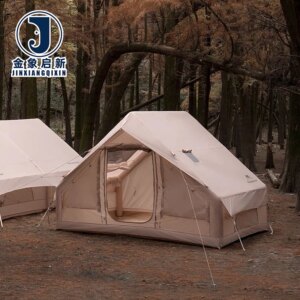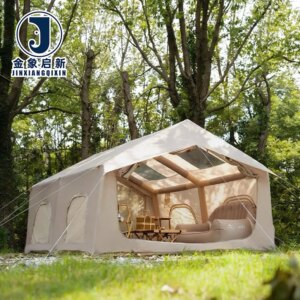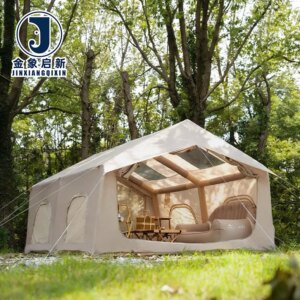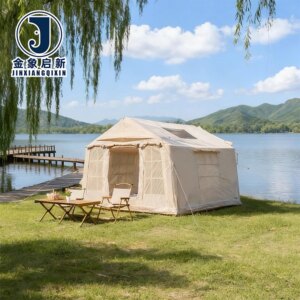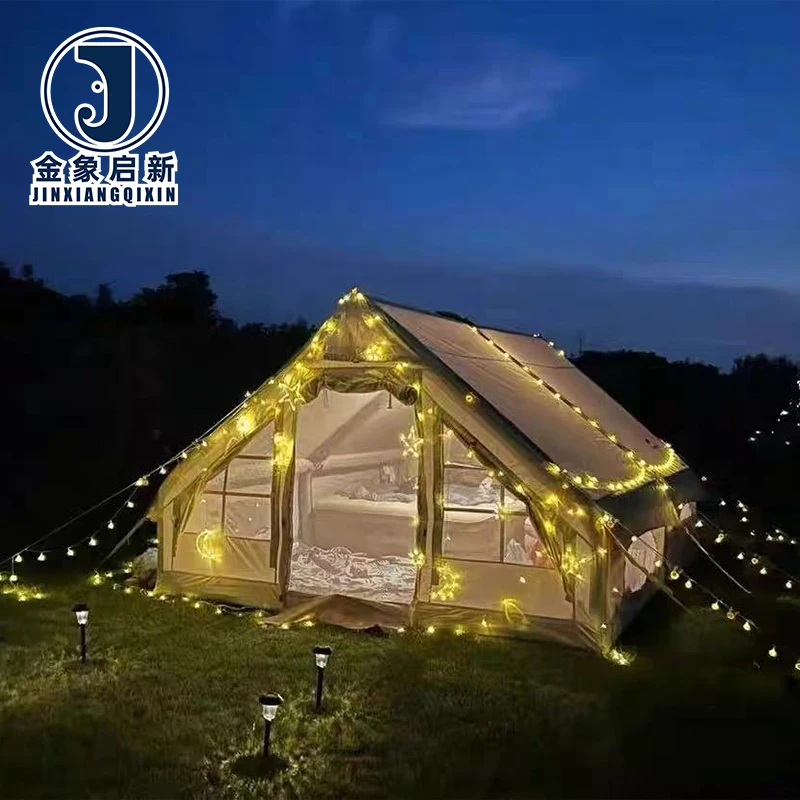
Precision Coating Control — Our in-house PVC coating process ensures verified waterproof and UV-resistant performance per batch, eliminating the inconsistency that plagues multi-source inflatable tent fabric supply chains.
Technical Specifications
| Parameter | Value |
|---|---|
| Product Type | Inflatable Tent |
| Core Material | PVC tarpaulin |
| Capacity | 4-6 Person |
| Door Design | Double door |
| Opening Mechanism | Quick automatic opening |
| Waterproof Rating | Minimum 3000mm water column |
| UV Resistance | 4000 hours accelerated testing |
| Tensile Strength | ≥200N/5cm (test basis not stated) |
| Customization | OEM & ODM (size adjustments, color matching, pattern printing, logo placement) |
| Sample Lead Time | 5-7 days (standard) |
| Production Lead Time | 15-20 days (100-500 units), 25-30 days (larger or highly customized) |
| Standards | ISO9001, ISO14001, ISO45001, CE |
Application Suitability
| Application | Exposure & Requirement |
|---|---|
| Commercial outdoor gear manufacturing | Batch-to-batch color and performance consistency for retail-ready product lines |
| Industrial outdoor equipment lines | Verified material documentation and certified testing for compliance audits |
| Engineering project temporary shelters | Rapid deployment under site conditions with reliable waterproof and structural integrity |
| Outdoor recreation wholesale supply | Private-label branding, seasonal volume scaling, and predictable lead times |
Why Inflatable Tent Fabric Fails at the Weld Line
The seam is only as strong as the coating adhesion allows, and coating adhesion depends on process control that most buyers never see.
When you source an inflatable tent from a supplier who simply cuts and sews without controlling the base PVC tarpaulin production, the welded seams become the first failure point. The air beams flex repeatedly during inflation and deflation, concentrating stress exactly where panels join. If the coating was not applied under consistent tension and temperature, the fabric delaminates before the base weave tears — leaving you with warranty claims and damaged brand reputation [NEED_CITE: tensile and tear test methods for coated fabrics per ISO 1421]. This is why our inflatable tent manufacturer custom capability starts at the coating line, not the cutting table.
Controlling Coating Weight Across Every Roll
When you are producing hundreds of inflatable tents for a seasonal launch, the last thing you need is roll-to-roll variation in coating thickness. Our three full production lines and 36 sets of professional processing equipment allow us to maintain coating weight within tight tolerances across an entire batch order. This matters because the quick automatic opening mechanism depends on consistent air beam pressure — and inconsistent wall thickness means some beams inflate faster than others, distorting the tent geometry.
Verifying Performance Before It Leaves the Factory
Every batch of our PVC tarpaulin destined for inflatable tent production passes through 12 quality checkpoints from raw material to final product. Our 10-person R&D team monitors the relationship between coating formulation and the 4000-hour UV resistance claim, ensuring that accelerated weathering results translate to real-world service durability [NEED_CITE: accelerated weathering test correlation to field exposure for PVC coated fabrics]. When you specify custom colors or pattern printing, the same verification protocol applies — no shipment leaves without matching the approved sample.
How Material Properties Translate to Tent Performance
The waterproof rating of minimum 3000mm water column is not just a number on a spec sheet; it represents the hydrostatic head the PVC tarpaulin can withstand before moisture penetrates the coating. For a 4-6 person inflatable tent used in commercial camping operations, this rating provides a reliable margin above typical rainfall intensity. The tensile strength of ≥200N/5cm governs how the air beams resist deformation under wind load and how the double-door zippered openings endure repeated use without the surrounding fabric stretching or distorting.
The Hidden Cost of Specifying on Price Alone
When a buyer selects an inflatable tent supplier based primarily on unit cost, the shortcuts are invisible until the product reaches the end user. Coating weight drops below what was quoted, and the waterproof rating degrades within the first season. UV treatment is claimed but never tested, and the fabric becomes brittle and cracks along fold lines after months of sun exposure. Welded seams separate because the base fabric was stored improperly before fabrication, allowing moisture contamination at the joint [NEED_CITE: PVC coating adhesion failure modes in inflatable structures]. Our approach eliminates these variables by controlling the material from coating to finished tent.
Why Source Your Inflatable Tent Here
Nearly 30 years of focused PVC tarpaulin production means we understand how coating formulation affects downstream fabrication — knowledge that prevents problems before they appear on your production line. Our 9,180 square meter facility with three dedicated production lines supports bulk inflatable tent orders with reliable scheduling, so your seasonal inventory arrives when promised. The 10-technician R&D team handles OEM and ODM requests directly, from pattern printing and logo placement to structural modifications for specific camping applications. Every order receives 12-checkpoint quality inspection with batch-specific documentation, giving your import compliance team the certificates they need without last-minute scrambling.
Documentation & Verification
- Material specification sheet stating PVC tarpaulin composition, coating type, and waterproof rating per batch
- Test report for UV resistance showing accelerated weathering hours and tensile retention values
- ISO9001, ISO14001, ISO45001, and CE certificates provided with each shipment for customs clearance
- Pre-shipment inspection record with dimensional checks and visual defect assessment per roll
- Sample approval documentation linking production batch to your signed-off pre-production sample
Fabrication, Handling & Storage
- Heat welding parameters must match the PVC tarpaulin coating type to ensure air-tight beam seams without scorching
- Double-door zipper installations require reinforced PVC tarpaulin patches at stress concentration points
- Store rolled PVC tarpaulin vertically in climate-controlled warehouse to prevent permanent crease marks before fabrication
- Allow cold-stored inflatable tent fabric to reach ambient temperature before unfolding to avoid coating micro-cracks
- Clean finished inflatable tent surfaces with mild detergent only; solvents degrade the PVC coating surface layer
Starting Your Inflatable Tent Project
To move from inquiry to sample production efficiently, we need your target capacity range, intended deployment environments, and any specific color or branding requirements. Tell us which markets you sell into so we can align documentation with local compliance expectations. If you require custom sizing beyond the standard 4-6 person configuration, provide your dimensional specifications and we will confirm feasibility within the sample lead time.
Frequently Asked Questions
Q: How is the 4000-hour UV resistance tested and what does it mean for outdoor service life?
A: The UV resistance is validated through accelerated weathering exposure, simulating extended sunlight contact under controlled conditions. This testing protocol measures tensile strength retention and color stability over the exposure period, providing a basis for warranty support. Actual field service life depends on geographic UV index, seasonal deployment patterns, and storage conditions between uses.
Q: How can I verify PVC tarpaulin performance upon delivery matches the quotation?
A: Each shipment includes a batch-specific quality inspection report detailing waterproof rating, UV resistance test results, and tensile strength values measured during production. You can conduct independent verification testing on arrival using standard methods. Our documentation package provides the baseline data needed for comparison, and we support third-party inspection at our facility before dispatch.
Q: What are the MOQ and lead time for custom-sized inflatable tents with logo printing?
A: Custom orders with pattern printing or logo placement follow our standard sample lead time of 5-7 days for approval, with production taking 15-20 days for moderate quantities or 25-30 days for larger or highly customized batches. Minimum order quantities depend on the degree of customization and current production scheduling; contact us with your specific requirements for confirmation.
Q: How do you ensure color consistency across multiple production runs for branded tents?
A: Our 12-checkpoint quality control system includes color matching verification against approved samples at both the raw PVC tarpaulin stage and the finished inflatable tent stage. Production batches are formulated from consistent base materials, and the R&D team maintains color reference standards for repeat orders. This ensures your branded tents maintain visual consistency across seasonal reorder cycles.