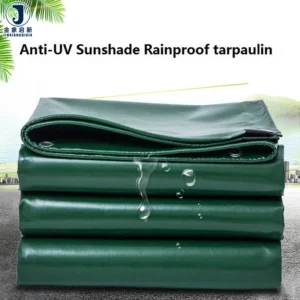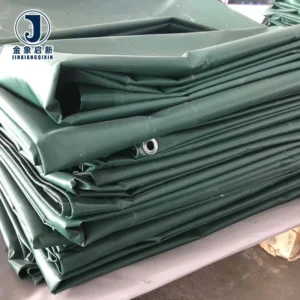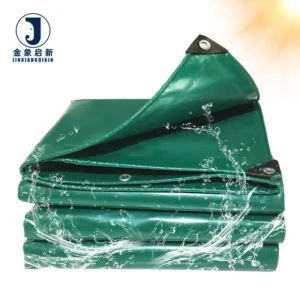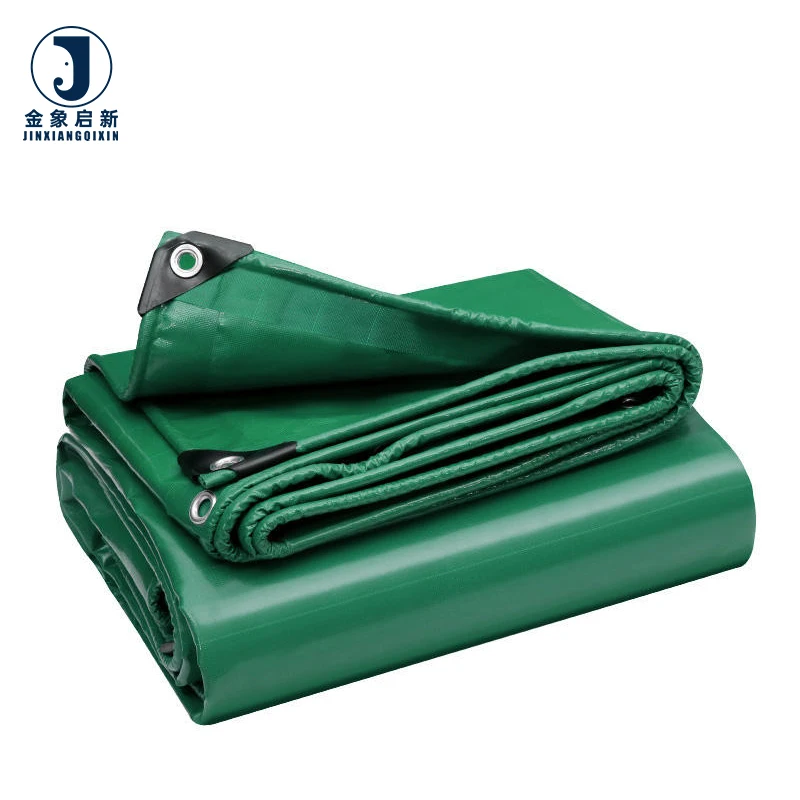
Cut-to-Fit Precision — Every dump trailer and transport cover is sized from your exact vehicle dimensions, eliminating the gaps and overhangs that generic tarps leave at tailgates and tie-down rails.
Technical Specifications
| Parameter | Value |
|---|---|
| Product Type | PVC Coated Tarpaulin |
| Base Fabric Denier | 200DX300D / 500DX500D / 840DX840D / 1000DX1000D |
| Weight | 250gsm–1500gsm (confirm the grade for this item) |
| Coating Material | PVC |
| Surface Finish | Available in glossy or matte finish |
| Temperature Range | -15ºC to 70ºC |
| UV Treatment | Customized (test basis not stated in source — confirm the standard required) |
| Flame Retardant | FR treated (grade not stated in source — confirm the grade for your market) |
| Anti-Mildew | Anti-fungal treated |
| Waterproof Rating | Waterproof, rain-resistant |
| Color Options | Blue, yellow, black, green, white, etc. |
| Working Life | 3–10 years depending on usage environment |
| Standards | ISO, CE |
Application Suitability
| Application | Exposure & Requirement |
|---|---|
| Dump trailer cover | Constant load shifting, tie-down strap abrasion, road spray, UV exposure during haulage |
| Boat and marine transport | Highway wind loading, salt and road spray, prolonged sun exposure on open trailers |
| Firewood and cargo cover | Open-bed fleets, rain ingress prevention, repeated removal and refitting by hand |
| Roof and patio cover | Extended static UV exposure, thermal expansion and contraction, pooling water resistance |
| Camping and pool cover | Seasonal deployment, ground contact, chlorinated or treated water exposure |
Why a Generic-Size Tarp Fails Your Trailer Within Weeks
A cover cut to your exact trailer dimensions stops water pooling at the tailgate and eliminates the flapping that destroys hems on the highway.
Generic-size tarps leave excess fabric that catches wind at speed, creating a sail effect that tears eyelets free and fatigues welded seams at the points where the load flexes most. A fitted PVC Tarpaulin for truck and trailer cover removes this slack, distributing tie-down forces evenly across reinforced hems. When covers are ordered by a generic dimension rather than the specific trailer model, the misalignment is often invisible until the first long haul exposes the stress. [NEED_CITE: tensile and tear test methods for coated fabrics per ISO 1421]
Trailer-Specific Sizing That Matches Your Tie-Down Rails
Fleet operators replacing worn dump trailer covers know that a centimetre of misalignment at the eyelet row means the strap rubs against bare metal instead of fabric. Our cut-to-fit approach starts from your vehicle bed dimensions, not a standard size chart. The PVC Tarpaulin for truck and trailer cover is shaped to sit flush against the load, with eyelet spacing matched to the tie-down rail pattern on your specific trailer model.
Reinforced Seams at the Flex Points That Matter
Welded seams on a dump trailer cover face repeated stress every time the bed is raised or the load shifts under braking. High-frequency welding bonds the PVC coating layers together rather than relying on thread, which can cut through the base fabric under tension. This construction method keeps the seam strength aligned with the body of the fabric, reducing the chance that the cover fails at the join before the main panel shows wear. [NEED_CITE: DIN 4102 fire classification for building materials]
Reading the Specs Beyond the GSM Number
The base fabric denier options — from 200DX300D to 1000DX1000D — determine how the load is distributed across individual yarns when the fabric is pulled taut over an uneven surface. A higher denier yarn resists abrasion at contact points with cargo edges, while the weave density controls how a tear propagates once a single yarn breaks. The PVC coating weight then seals this structure against water ingress and adds surface abrasion resistance. Weight alone, measured in GSM, reflects the combined mass of base fabric and coating but does not distinguish between a heavy coating on a light base and a balanced construction — two covers with identical GSM can behave very differently under tie-down tension.
The Hidden Cost of Specifying the Wrong Cover Grade
Ordering a dump trailer cover at a GSM that looks correct on paper but lacks the base fabric denier to support it leads to early failure at the hem line, where concentrated strap forces exceed what the lighter yarns can hold. Similarly, specifying a flame-retardant treatment without confirming the test grade against your route compliance requirements can result in a load being turned away at a checkpoint or a construction site. [NEED_CITE: flame retardant classification standards for transport covers] Batch colour variation across covers in a single fleet order also becomes visible once installed side by side on adjacent trailers, prompting rework that delays deployment.
Why Transport Fleets Source Covers Here
Three full production lines with 36 sets of professional equipment support bulk capacity for fleet-scale orders without extending lead times beyond what route schedules allow. A 10-person R&D team handles pattern development and custom sizing, producing samples within days so you can verify fit before committing to a full production run. Every roll and finished cover passes through dedicated QA/QC at each production stage, with 100% pre-shipment inspection confirming dimensions, eyelet placement and seam integrity before dispatch.
Documentation & Verification
- Material specification sheet stating exact GSM, base fabric denier and coating weight for your ordered grade
- Test report for UV and flame-retardant treatment where applicable, matched to your route compliance needs
- Pre-shipment inspection record with photos of welded seams and eyelet reinforcement on your covers
- Roll packing list with individual cover dimensions and weight for container loading verification
- Certificate of origin and customs documentation for cross-border fleet procurement
Fabrication, Handling & Storage
- Weld seams on heavy-denier base fabrics require adjusted temperature and dwell time to achieve full coating penetration
- Store rolled covers vertically on pallets to prevent flat-spot creases across the PVC coating surface
- Avoid dragging matte-finish covers over abrasive surfaces during deployment to preserve the surface texture
- Clean glossy-finish covers with mild detergent only to prevent softening the plasticiser in the PVC layer
- Allow cold-stored covers to reach ambient temperature before unfolding to prevent low-temperature coating fracture
What We Need to Quote Your Covers Accurately
Send your trailer bed dimensions, tie-down rail spacing and the specific dump trailer or truck model so we can confirm eyelet positioning and hem reinforcement layout. Let us know the exposure conditions — highway haulage, static storage or site covering — and any compliance requirements for flame retardancy or UV treatment your market demands.
Frequently Asked Questions
Q: How do you cut covers to fit specific trailer models rather than generic sizes?
A: We take the exact bed length, width and side depth of your trailer model, including the position of tie-down rails and tailgate hinges. The PVC Tarpaulin for truck and trailer cover is then cut and welded to sit flush against those reference points, with eyelets spaced to match your strap pattern.
Q: How is GSM verified on arrival to ensure the material matches the quotation?
A: Each production batch includes a material specification sheet stating the confirmed GSM, base fabric denier and coating weight. Pre-shipment inspection records document these values against the agreed specification before dispatch, so you can verify on arrival.
Q: What eyelet spacing and hem reinforcement options are available?
A: Eyelet spacing is set to match your tie-down rail pattern, and hems are reinforced with additional PVC welding or webbing at high-stress corners. The reinforcement method depends on the base fabric denier selected for your cover.
Q: Can you match colour consistently across multiple covers in a fleet order?
A: Covers within a single production run are coated from the same batch of PVC compound, maintaining colour consistency across the fleet. We recommend ordering your full fleet requirement together to avoid inter-batch shade variation.