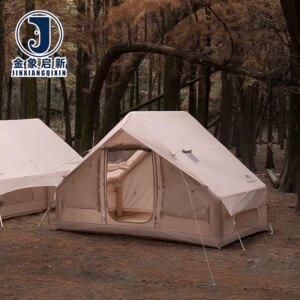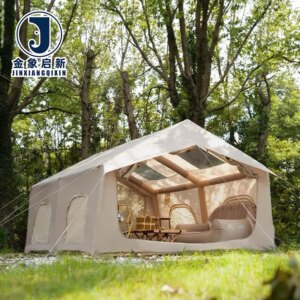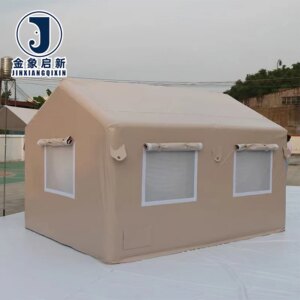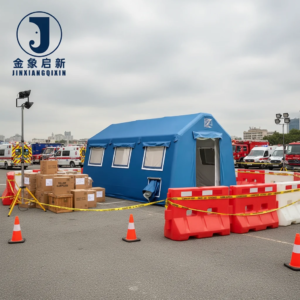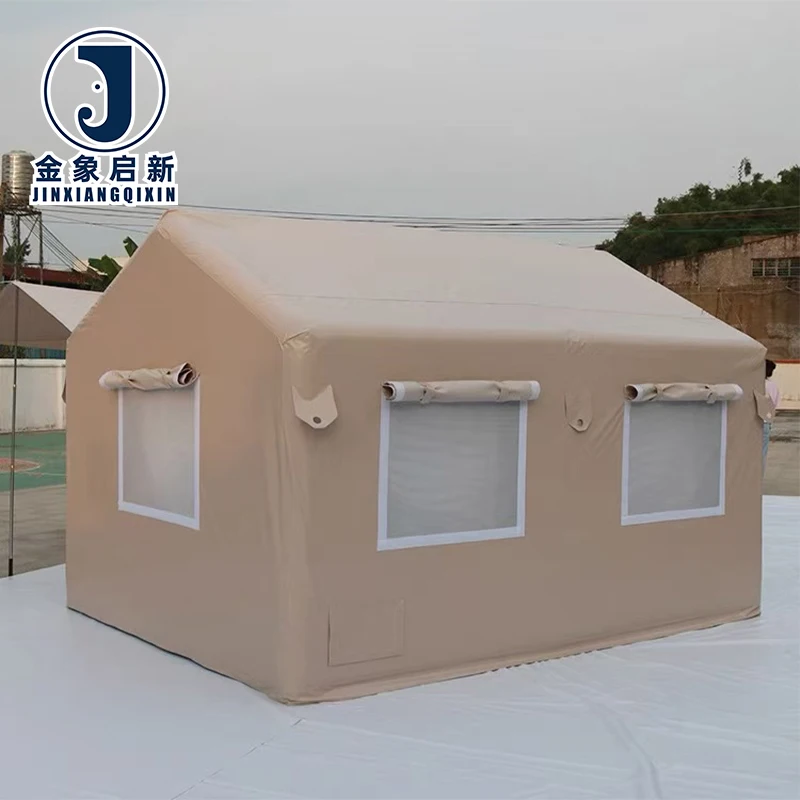
Technical Specifications
| Parameter | Value |
|---|---|
| Product Type | Inflatable Fabric / Inflatable Tent |
| Core Material | PVC tarpaulin |
| Construction | Single layer |
| Capacity | 3-4 Person |
| Season Rating | Four-season |
| Key Features | Waterproof, UV-resistant (test basis not stated in source), tear-resistant, fire-retardant (grade not stated in source), anti-static (standard not stated in source), quick automatic opening |
| Customization Service | OEM & ODM (sample customization, pattern printing, material selection, product design) |
| Production Lines | 3 full production lines |
| Processing Equipment | 36 sets of professional processing equipment |
| R&D Team Scale | 10 technicians |
| Standards | ISO9001, ISO14001, ISO45001, CE |
Application Suitability
| Application | Exposure & Requirement |
|---|---|
| Temporary site offices | Prolonged outdoor exposure, wind load on inflatable frame, UV degradation over deployment cycles |
| Equipment storage shelters | Moisture ingress prevention, abrasion from loaded gear, puncture risk from sharp tools |
| Mobile field operations | Rapid deployment and deflation, repeated inflation cycles, transport vibration |
| Construction sites | Dust and debris exposure, foot traffic around shelter base, variable ground conditions |
| Outdoor event management | Aesthetic presentation, weather variability across seasons, quick turnover between events |
| Industrial project bases | Compliance with fire-retardant and anti-static site safety requirements, extended static deployment |
What "Flame Retardant" Means Without a Test Report Behind It
A fire-retardant claim without a documented grade is a compliance gap waiting to surface during a site audit.
Procurement teams for construction and tunnelling projects routinely receive inflatable structure quotations listing fire-retardant treatment as a standard feature, yet the supporting test classification is absent. When the site safety officer requests documentation, the shipment cannot be accepted, and the project timeline absorbs delays that no amount of fabric quality can recover. Fire-retardant performance is defined by specific grading systems — DIN 4102, NFPA 701, EN 13501 — each targeting different deployment environments, and a blanket claim without a referenced standard leaves the buyer exposed. [NEED_CITE: fire classification systems for inflatable structures across international markets]
Frame Integrity Under Repeated Inflation Cycles
An inflatable tent deployed for industrial field operations undergoes inflation and deflation far more frequently than a recreational camping unit. Each cycle stresses the welded seams at the tube junctions, where the PVC coating must maintain adhesion through flex, temperature shift, and internal pressure variance. The single-layer PVC tarpaulin construction used in this Custom Inflatable Tent is engineered with coating adhesion controlled across the full production run, reducing the risk of seam delamination after repeated field use. [NEED_CITE: weld seam durability testing methods for inflatable PVC structures]
Compliance Documentation for Regulated Deployment Zones
Industrial and mining sites often mandate that any temporary structure — including inflatable shelters — carry verifiable fire-retardant and anti-static certification before deployment is approved. Our manufacturing process produces these treatments in controlled batches, with test documentation generated per order rather than applied retroactively. Buyers specifying a Custom Inflatable Tent for regulated environments receive material specification sheets and applicable test reports alongside the shipment, enabling site compliance officers to verify without additional back-and-forth.
Reading the Specification Beyond the Surface Claim
PVC tarpaulin as a core material delivers inherent waterproof performance through its coated construction, but the functional lifespan of an inflatable structure depends on parameters that extend beyond the base fabric. The coating method determines how the PVC layer bonds to the base weave — knife-coated fabrics typically achieve higher peel strength and more consistent coating thickness than calendered alternatives, which directly affects weld seam reliability when the inflatable frame is pressurized. [NEED_CITE: coating adhesion test methods per ISO 1421 for PVC laminated and coated fabrics]
Tear resistance in an inflatable structure is governed by the interaction between base fabric denier, weave density, and coating penetration. A high-denier warp yarn provides tensile backbone, while the weft density controls how a puncture propagates under internal air pressure. For four-season deployment, the material must also resist embrittlement at low temperatures and softening under sustained solar load — properties that are a function of both the PVC compound formulation and any surface treatment applied. UV-resistant treatment extends the material’s resistance to photodegradation, though the specific test basis should be confirmed against the deployment region’s solar intensity.
When Treatment Claims Outpace the Documentation
A recurring failure pattern in inflatable structure procurement is the discovery — after delivery — that fire-retardant or anti-static treatment was specified on the purchase order but not verified against the actual batch. The inflatable tent arrives, passes visual inspection, and is deployed; weeks later, a site audit flags the missing certification, and the structure must be removed or retested at the buyer’s cost. Similarly, anti-static treatment without a referenced standard may satisfy a casual visual check but fail under the specific resistance thresholds required for mining or volatile atmosphere environments. [NEED_CITE: anti-static performance standards for inflatable structures in hazardous atmospheres]
Why This Manufacturing Source Reduces Procurement Risk
Three full production lines dedicated to coated fabric manufacturing provide batch-level capacity control, meaning a Custom Inflatable Tent order is produced on equipment calibrated for consistent coating weight and weld parameters across the entire run. A 10-person R&D team handles material selection and sample development before bulk production begins, allowing buyers to validate coating adhesion, treatment response, and dimensional accuracy against a physical sample. Dedicated QA/QC staff conduct 100% pre-shipment inspection with batch-specific documentation, ensuring that the fire-retardant and anti-static properties documented in the specification sheet correspond to the physical product dispatched.
Documentation & Verification
- Material specification sheet stating PVC base fabric, coating weight, and treatment parameters per batch
- Fire-retardant test report referencing the applicable grading standard for the target market
- Anti-static test documentation where treatment is specified for the order
- 100% pre-shipment inspection record with batch-level quality traceability
- ISO9001, ISO14001, ISO45001, and CE certificates available for compliance audit
Fabrication, Handling & Storage
- Store inflatable tent fabric rolls upright on a flat surface to prevent coating creasing at the fold line
- Avoid prolonged compression at fold points during transport, as single-layer PVC construction is susceptible to permanent crease marks under sustained pressure
- Weld seam parameters should be validated against the specific coating weight before production-scale joining
- Clean deployed surfaces with mild detergent only; solvent-based cleaners may compromise the PVC coating integrity
- Deflate and dry the structure fully before long-term storage to prevent microbial growth on the inner coating surface
Specifying Your Custom Inflatable Tent Inquiry
When requesting a quotation for a Custom Inflatable Tent, provide the intended deployment environment and any site-specific compliance requirements, including fire-retardant grading standards and anti-static thresholds applicable to your market. Specify the required dimensions, inflation mechanism preference, and whether pattern printing or branding integration is needed on the exterior surface. Indicate whether a physical sample is required before bulk commitment, and confirm the target deployment season to align material treatment selection with expected environmental exposure.
Frequently Asked Questions
Q: What fire-retardant grading standards can be provided for inflatable tents deployed in regulated environments?
A: Fire-retardant treatment is available for inflatable tent production, with the specific grade determined by the target market’s compliance requirements. Test reports referencing applicable standards such as DIN 4102 or NFPA 701 are generated per batch and supplied with shipment documentation. Buyers should confirm the required classification during the inquiry stage to ensure material selection aligns with site safety audit expectations.
Q: Can the inflatable tent be produced in custom dimensions with printed branding on the exterior?
A: Yes. The OEM and ODM customization scope includes dimension modification, pattern printing, and material selection tailored to the buyer’s deployment requirements. Sample development is completed before bulk production to validate sizing accuracy and print registration. The 10-person R&D team coordinates directly with buyers to translate design specifications into production-ready formats.
Q: How is batch quality consistency maintained across multiple inflatable tent units in a single order?
A: Each production batch undergoes dedicated QA/QC inspection at every manufacturing stage, with 100% pre-shipment inspection documented per order. Material specification sheets and test reports are generated at the batch level, providing traceability from raw material input through to finished product dispatch. This documentation enables buyers to verify that coating weight, treatment performance, and dimensional accuracy remain consistent across all units.
Q: What documentation is supplied to support site compliance verification for fire-retardant and anti-static treatments?
A: Shipments include material specification sheets detailing PVC base fabric, coating parameters, and treatment grades. Fire-retardant and anti-static test reports are provided where applicable to the order specification. ISO9001, ISO14001, ISO45001, and CE certificates are available for compliance audit. All documentation is batch-specific, enabling site safety officers to cross-reference the physical product against the certified performance data.