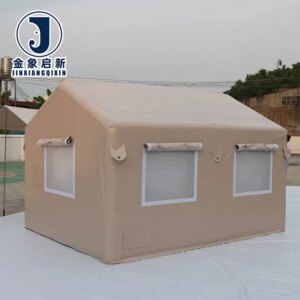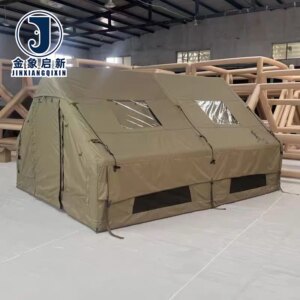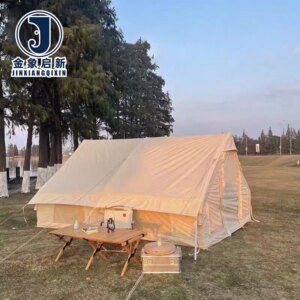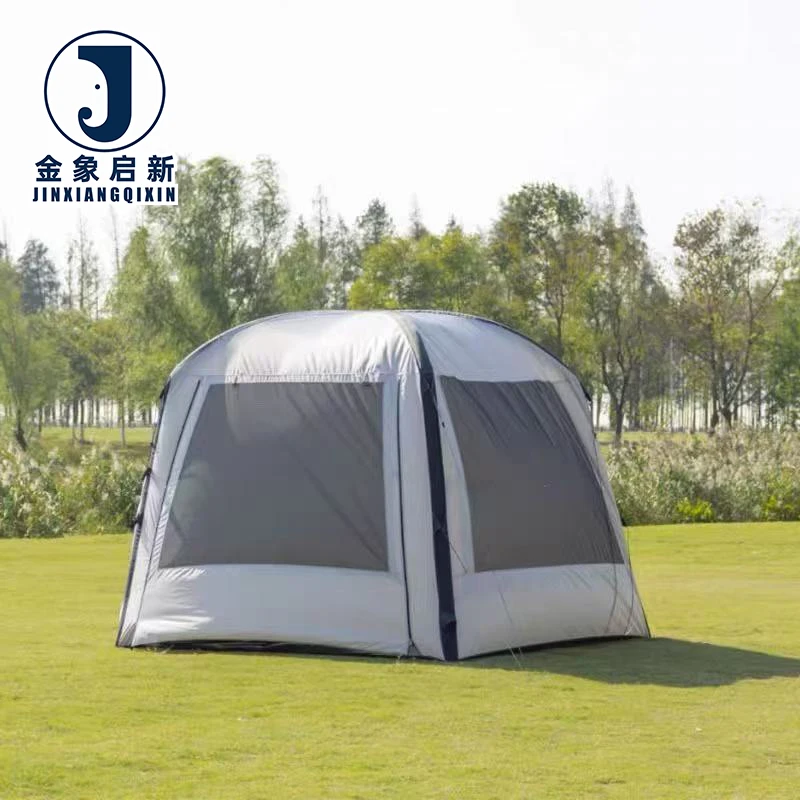
Custom Fitment Precision — every inflatable tent panel is pattern-cut and heat-welded to match the exact deployment footprint your fleet or site requires, eliminating generic sizing gaps.
Technical Specifications
| Parameter | Value |
|---|---|
| Product Type | Inflatable Tent |
| Core Material | PVC tarpaulin |
| Key Performance | Waterproof, UV-resistant, tear-resistant |
| Product Forms | Inflatable structure with automatic opening mechanism |
| Material Thickness Range | 0.3mm to 1.2mm |
| Customization Service | OEM & ODM (sample customization, pattern printing) |
| Quality Control System | Full-process quality inspection with dedicated QA & QC staff |
| Standards | ISO 9001, ISO 14001, ISO 45001, CE |
Application Suitability
| Application | Exposure & Requirement |
|---|---|
| Transport fleet roadside rest and dispatch stations | Constant relocation, rapid deploy and pack-down cycles, wind and rain exposure |
| Construction site field offices and equipment shelters | UV exposure, dust and debris impact, repeated anchoring and un-anchoring |
| Outdoor event and exhibition temporary spaces | Crowd proximity, branding visibility, multi-day weather resistance |
| Beach and open-air hospitality facilities | Salt air, sand abrasion, sustained sun exposure |
| Four-season outdoor camping operations | Temperature fluctuation, snow load potential, ground moisture contact |
Why Generic Tent Sizing Costs Fleet Operators Downtime
Off-the-shelf shelters rarely match the footprint between a parked trailer and the site boundary.
Transport and logistics teams often arrive at a laydown area only to find the temporary shelter they ordered does not clear the outriggers, or leaves a gap where rain tracks in beside the trailer. The PVC inflatable tent eliminates that mismatch by being cut to your deployment dimensions rather than a catalog number. [NEED_CITE: site shelter fitment challenges in fleet operations]
Rapid Deployment Without a Crew
An automatic opening mechanism inflates the PVC inflatable tent structure in minutes, which matters when your convoy stops at an unprepared site and the operations manager needs a weatherproof command point immediately. No pole assembly, no tensioning ropes in the wind. One operator with a pump can have the shelter standing while the crew offloads.
Abrasion at the Contact Points
Where the inflatable wall meets the ground, where tie-down lines pass through the anchor loops, where two units zip together in a compound — these flex and rub zones see concentrated wear. The PVC tarpaulin base material is selected for tear resistance at those junctions, so the seam does not split open after a week of use on gravel or compacted soil. [NEED_CITE: abrasion failure modes in temporary structures]
Custom Printing for Site Identification
Pattern printing allows each PVC inflatable tent to carry fleet livery, safety signage, or project branding directly on the fabric. This is not a decal that peels; the ink bonds to the PVC coating surface, staying legible through repeated inflation cycles and UV exposure.
Seam Integrity Under Inflation Pressure
The heat-welded joints in an inflatable structure carry internal air pressure continuously. A weld that is cooler or narrower than the fabric’s coating thickness will hold in calm conditions but delaminate when the structure flexes in a gust. Our welding parameters are set against the specific PVC tarpaulin thickness being used — whether that is 0.3mm for a lightweight event unit or 1.2mm for a construction site shelter — so the bond strength matches the material, not a default machine setting.
Material Thickness as a Design Variable
Thickness range from 0.3mm to 1.2mm is not arbitrary. Thinner gauges reduce packed weight and allow faster inflation, suited to hospitality units that deploy daily. Thicker gauges resist puncture from ground debris and withstand higher internal pressures needed for larger clear-span structures. Selecting the wrong gauge means either an overweight shelter that is slow to deploy or an underbuilt one that fails at the first contact with sharp aggregate. The relationship between gauge and tensile behaviour must be matched to the actual site conditions, not assumed from a product brochure. [NEED_CITE: coated fabric thickness and tensile strength correlation per ISO 1421]
What Thickness and Coating Weight Actually Govern
In PVC-coated fabrics, the base fabric denier and weave density determine how far a tear propagates once initiated, while the coating weight governs waterproofing and surface abrasion resistance. A high GSM reading alone does not guarantee tear performance if the base scrim is loosely woven; conversely, a tight scrim with insufficient coating will wick moisture at the yarn intersections. For an inflatable tent, both layers must be specified together because the structure relies on air retention and panel rigidity simultaneously. Surface finish — whether the outer face presents a smooth or textured profile — affects how easily sand, dust, and biological growth release during cleaning, which directly influences how the material ages in four-season outdoor camping use.
When Specification Gaps Surface on Site
A common scenario: the inflatable shelter arrives and the fabric feels noticeably lighter than the sample that was approved. The packed unit is easier to carry, which seems like a benefit until the first strong wind loads the panels and the seams begin to creep apart. Without batch-level weight verification against the stated material thickness, there is no way to catch this before the unit is deployed in front of a client. Colour variation between units ordered in the same batch creates a visible mismatch when two shelters stand side by side at an event or along a transport corridor. Welded joints that were run at incorrect temperatures will hold air during factory testing but fail at the flex point once the structure is anchored in uneven terrain. [NEED_CITE: pre-shipment inspection protocols for coated fabric products]
Production Capability Matched to Your Deployment Schedule
Three full production lines and 36 sets of processing equipment mean a custom PVC inflatable tent order moves from sample approval to bulk cutting without queueing behind unrelated product runs. The 10-person R&D team handles pattern development for non-standard footprints, working from your site dimensions rather than forcing your layout into a standard module. Full-process quality inspection with dedicated QA and QC staff ensures every heat-welded seam is checked against the specified material thickness, not just visually but for bond integrity. ISO 9001, ISO 14001, ISO 45001, and CE certifications frame the management systems behind that inspection. OEM and ODM sample customization lets you verify the structure’s inflation behaviour and anchoring method before committing to a production run.
Documentation & Verification
- Material specification sheet stating thickness, base fabric type, and coating composition per batch
- UV resistance and flame retardant test reports provided where applicable to your market requirements
- Pre-shipment inspection record documenting seam checks and dimensional verification for each unit
- ISO and CE certificates accompanying dispatch documentation
- Roll and unit packing list with weight and dimension confirmation
Fabrication, Handling & Storage
- Heat-weld seams at temperatures matched to the selected PVC tarpaulin thickness between 0.3mm and 1.2mm for full bond depth
- Avoid folding inflatable panels at the same crease line repeatedly; rotate fold points to prevent coating fatigue
- Store deflated units dry and shaded, away from direct contact with solvents that can soften the PVC surface
- Clean with mild detergent and soft brush; abrasive pads will score the coating and compromise waterproofing
- Field repairs require PVC-compatible adhesive and patch material cut from the same thickness range as the original panel
- During cold-weather transport, allow folded units to warm gradually before inflation to prevent low-temperature coating crack
Start Your Specification
Provide the intended deployment surface, typical wind and weather conditions at your sites, and the internal dimensions required between anchoring points. If your market mandates a specific flame retardant grade for temporary structures, state the standard so we can confirm material compliance before sampling. Indicate whether you need finished units with pattern printing or blank stock for your own fabrication line.
Frequently Asked Questions
Q: What material thickness options are available for the inflatable tent?
A: The PVC tarpaulin used in our inflatable structures is available in a thickness range from 0.3mm to 1.2mm. Thinner gauges suit lightweight hospitality and event units requiring fast deployment, while thicker gauges are specified for construction site shelters and four-season camping operations where ground abrasion and higher wind loads are expected. We recommend sample testing at your chosen thickness before bulk ordering.
Q: What is the minimum order quantity for custom sizes and printed patterns?
A: Minimum quantities depend on the degree of customization — standard sizes with pattern printing carry different thresholds than fully bespoke dimensions. We develop a custom sample first so you can verify the inflation performance, seam layout, and print registration before production begins. Contact our team with your required dimensions and print artwork to receive a specific minimum and lead time for your PVC inflatable tent order.
Q: How can I verify the UV resistance and flame retardant claims?
A: UV-resistant treatment and flame retardant grades are available, but the specific grade must match your local regulatory requirements. We supply test reports for the applicable standard — confirm the test basis required for your market at the inquiry stage so we can select the correct material formulation and include the corresponding documentation with your shipment.
Q: Does the automatic inflation mechanism work in cold conditions?
A: The PVC tarpaulin retains flexibility across a range of outdoor temperatures, but very low temperatures can stiffen any coated fabric. The automatic opening mechanism operates effectively within the material’s rated temperature envelope. For deployment in freezing conditions, we recommend discussing your specific climate profile so we can confirm the appropriate material thickness and advise on cold-weather inflation procedures for the PVC inflatable tent.
Q: How is batch-to-batch colour consistency controlled across multiple units?
A: Colour matching is managed through controlled coating formulation and verified during the full-process quality inspection. When multiple PVC inflatable tent units are ordered in the same batch, pre-shipment inspection includes a side-by-side colour check so any variation is caught before dispatch. For multi-phase orders spanning separate production runs, we retain colour reference records to maintain consistency.