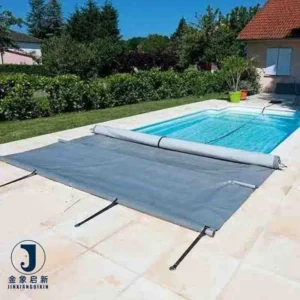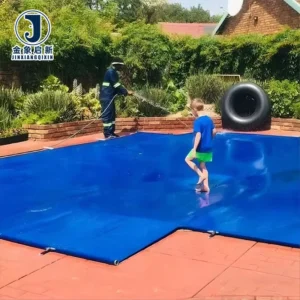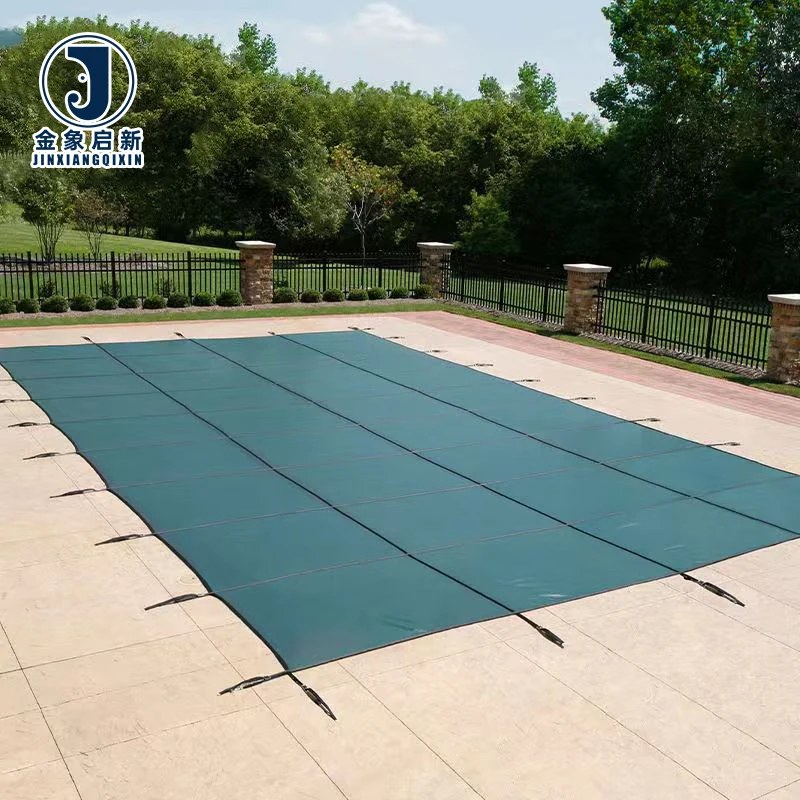
Integrated Hot-Press Seams — eliminating stitch lines that fail under sustained pool-edge tension, built on three full production lines with dedicated QA at every stage.
Technical Specifications
| Parameter | Value |
|---|---|
| Product Type | PVC Coated Tarpaulin Pool Cover |
| Base Fabric | 500D×500D Polyester |
| Coating Material | PVC |
| Construction Method | Integrated pressing (no stitching) |
| Water Resistance | Fully waterproof coated construction |
| Flame Retardant | Available in flame retardant grades — confirm the grade required for your market |
| UV Resistance | Anti-UV treatment available — request test documentation before order |
| Anchoring Options | Brass anchoring system / Aluminium battens with stainless steel hook and plate / Heavy-duty water tube loops every 4 ft |
| Color | Customizable |
| Printing | Custom brand printing available |
| Standards | ISO, CE |
Application Suitability
| Application | Exposure & Requirement |
|---|---|
| Residential in-ground pool winter cover | Sustained snow load, leaf and debris accumulation, freeze-thaw cycles, UV exposure during off-season storage |
| Commercial pool safety barrier | Code-compliant safety requirements, high foot traffic around edges, frequent removal and reinstallation |
| Pool construction and maintenance contractor projects | Varied pool shapes and dimensions, fitted cover demand, on-site measurement accuracy |
| Aquaculture and reservoir pond covers | Permanent water contact, evaporation reduction, algae control, chemical exposure from water treatment |
Why a Pool Cover Fails at the Seam Before the Fabric Does
Stitched seams are the first failure point on any PVC pool cover exposed to sustained edge tension and winter moisture.
A safety pool cover that splits along a stitch line leaves the pool exposed and defeats the purpose of the installation entirely. Most fabric failures we investigate do not start in the middle of the panel — they begin where needle holes have created a perforation line through the coated fabric, allowing water ingress that separates the PVC coating from the polyester base over repeated freeze-thaw cycles. [NEED_CITE: coated fabric seam failure mechanisms under cyclic loading per ISO 1421 test methods]. When the PVC Safety Pool Cover is specified for in-ground winter protection, the construction method matters as much as the material weight itself.
How Integrated Pressing Replaces Stitched Construction on Pool Covers
Traditional stitched pool covers rely on thread that degrades under UV exposure and moisture long before the PVC coated fabric itself reaches end of life. Our PVC Safety Pool Cover uses integrated hot-press construction, fusing overlapping panels at the molecular level so that the seam carries the same tensile load as the body of the fabric. This means no needle perforations, no thread to rot, and no separation between coating layers at the highest stress points around the pool perimeter.
Anchoring System Selection for Different Pool Deck Surfaces
The anchoring method determines how well the PVC Safety Pool Cover holds under wind uplift and snow accumulation. Brass anchors suit concrete decks with drilled recesses, aluminium battens with stainless steel ratchets work for timber or composite surrounds where surface mounting is preferred, and water tube loops at 4 ft intervals provide perimeter weight on pools where drilling is not an option. Each system must match both the deck material and the expected seasonal load to keep the cover tensioned correctly across the span. [NEED_CITE: anchoring load requirements for pool safety covers in residential and commercial settings].
Reading the Base Fabric Specification Beyond Yarn Count
The 500D×500D polyester base provides the structural skeleton of this PVC coated tarpaulin pool cover. Denier indicates the linear mass density of each yarn — higher denier means thicker individual filaments that resist tearing once a puncture starts. However, denier alone does not determine overall strength; the weave density and PVC coating adhesion together define how the fabric performs under sustained tension across a pool span. The integrated pressing construction ensures that the coating bond at seam overlaps matches the peel strength of the body fabric, which is critical when the cover bears snow load or standing water over weeks at a time.
The Hidden Cost of Specifying Pool Covers on Material Weight Alone
Buyers who specify a PVC pool cover based solely on quoted weight often discover on delivery that the actual fabric is lighter than agreed — a gap that becomes visible only when the cover sags under the first snowfall or fails to hold tension across the pool. Coating weight verification should happen at pre-shipment inspection, not after the container arrives. Similarly, flame retardant or anti-UV claims without supporting test reports leave commercial pool operators exposed when local inspectors request compliance documentation that was never supplied. Batch colour variation between panels is another recurring issue when covers are installed side by side on adjacent pools or large commercial facilities. [NEED_CITE: pre-shipment inspection standards for coated fabric weight verification and colour consistency].
Why Source PVC Pool Covers Through This Facility
Three full production lines and 36 sets of professional equipment support bulk capacity with consistent output across large orders, reducing the risk of batch variation that affects colour matching on installed covers. A 10-person R&D team handles custom pool shape cutting, anchoring system integration, and sample development within days — not weeks — so buyers can verify fit and finish before committing to production. Dedicated QA and QC at every production stage with 100% pre-shipment inspection means seam integrity, dimensional accuracy, and anchoring placement are confirmed before dispatch, not left to chance on arrival.
Documentation & Verification
- Material specification sheet stating 500D×500D base fabric denier, PVC coating type, and colour reference
- Test reports for UV resistance and flame retardancy provided with grade clearly stated where applicable
- Pre-shipment inspection record confirming integrated press seam integrity, anchoring placement, and dimensional accuracy
- Roll packing list with per-roll identification for batch traceability across multi-panel pool cover orders
- Certificate of origin and customs documentation prepared for international pool cover shipments
Fabrication, Handling & Storage
- Integrated hot-press seams require no post-fabrication sealing, reducing on-site rework for custom-shaped pool covers
- Brass anchors and aluminium battens must be tensioned evenly to avoid concentrated load on any single pressed seam
- Store PVC coated rolls flat or on cores to prevent permanent creasing in the 500D×500D base fabric before cutting
- Avoid dragging cut pool cover panels across rough concrete decks to protect the PVC coating surface from abrasion
- Clean with mild detergent only — solvent-based cleaners can degrade the PVC coating bond on the polyester base
What We Need to Quote Your Pool Cover Project
Provide the pool shape — rectangular, round, or freeform — along with overall length, width, and any step-out or recess dimensions so we can prepare an accurate cutting pattern. Specify your preferred anchoring method and deck surface type so we can confirm compatible hardware. Indicate your target market and any local flame retardant or safety compliance requirements so we can supply the correct test documentation with your shipment.
Frequently Asked Questions
Q: How do I measure my pool to order a correctly sized safety cover?
A: Measure the pool at the waterline edge, not the coping, recording length and width at the widest points for rectangular pools. For freeform shapes, provide a scaled diagram with measurements at each change of direction. Include step-out areas and raised features separately. Our R&D team reviews every measurement set before cutting to confirm the pattern matches the pool profile and anchoring layout.
Q: What anchoring methods are available and which suits my pool type?
A: Brass anchors require drilled recesses in concrete or stone decks and provide the cleanest finish. Aluminium battens with stainless steel ratchets mount to timber or composite surrounds without core drilling. Water tube loops every 4 ft offer a non-invasive perimeter weight solution where deck modification is restricted. Your deck material and local wind load requirements determine the best option.
Q: How is the flame retardant grade verified — can you provide a test report?
A: Flame retardant grades are available and each is supported by a third-party test report stating the specific classification achieved. Before ordering, confirm the grade required by your local building code or commercial pool regulation so we can match the correct material specification and include the documentation with your shipment.
Q: What is the UV resistance basis for your PVC pool cover fabric?
A: Anti-UV treatment is applied during the PVC coating process and is available for pool covers expected to face extended sun exposure. We provide test documentation on request — specify your market and expected exposure conditions during inquiry so we can confirm the treatment level and supply supporting data before production begins.
Q: Can you produce custom colors and print our branding on the pool cover?
A: Custom colours are produced to your reference, with batch consistency verified across all panels before dispatch. Brand printing is available for commercial and hospitality pool operators who require logo or facility identification on the cover surface. Request a printed sample for approval before full production to confirm colour accuracy and print resolution on the PVC coated fabric.