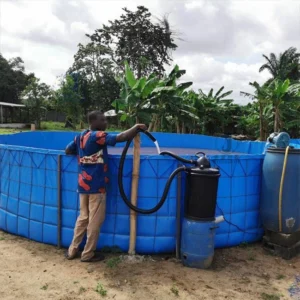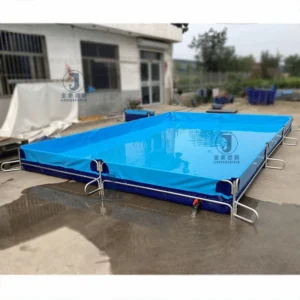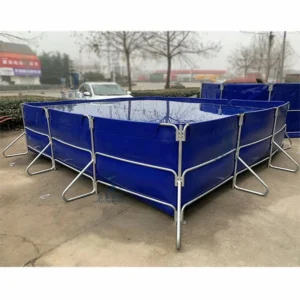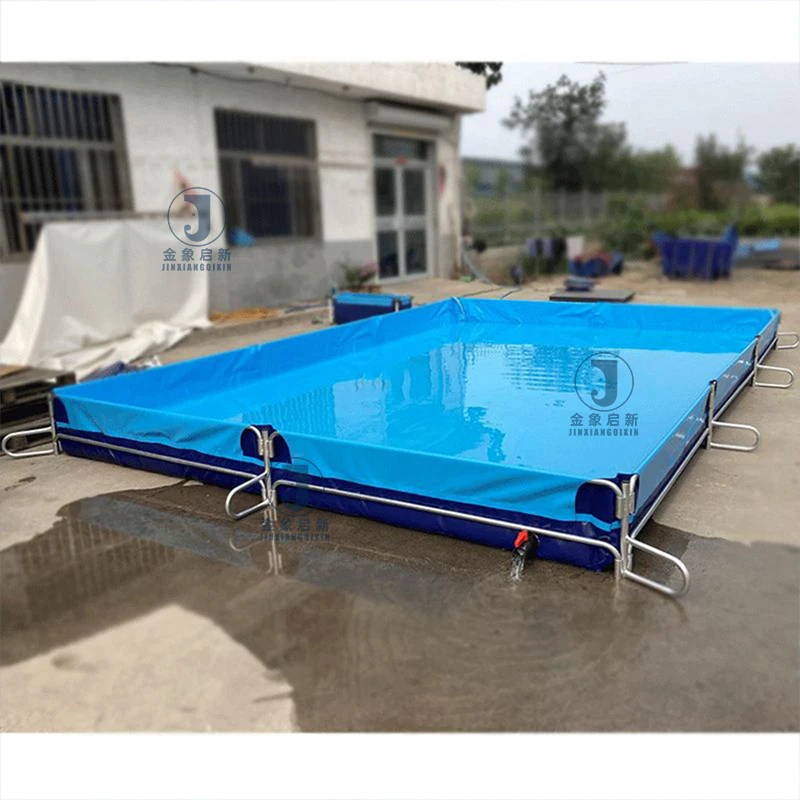
Proven Seam Engineering — Our PVC pond liners use hot-air welding at every joint, creating bonds that outlast the base fabric under continuous hydrostatic pressure.
Technical Specifications
| Parameter | Value |
|---|---|
| Product Type | PVC Tarpaulin Fish Pond Liner |
| Coating Material | PVC |
| Base Fabric | Polyester |
| Yarn Count | 500D×500D |
| Coating Method | Double-sided PVC coating |
| Weight Range | 450–900 g/m² (confirm the grade for your project) |
| Surface Characteristics | Smooth, leather-like texture |
| Flame Retardancy | Available in flame retardant grades — confirm the grade required for your market |
| UV Resistance | Anti-UV treatment available — test basis to be confirmed per order |
| Shape Options | Rectangular, square, round (custom to pond dimensions) |
| Seaming Method | Integrated hot-air welding (non-stitched) |
| Repairability | Field-repairable by hot air welding |
| Certifications | ISO, CE |
Application Suitability
| Application | Exposure & Requirement |
|---|---|
| Commercial aquaculture ponds | Permanent water contact, flex during drainage and refill, abrasion against substrate |
| Foldable aquaculture tank systems | Repeated folding and unfolding, seam stress at fold lines, UV exposure outdoors |
| Agricultural irrigation reservoirs | Continuous sun exposure, soil chemistry contact, long-term water containment |
| Hatchery and nursery containment | Custom-shaped basins, controlled breeding environments, biosecurity cleaning |
| Safety and winter pool covers | Tensioned anchoring, debris load, seasonal UV and weather cycling |
Why Stitched Seams Fail First in Aquaculture Pond Liners
A PVC pond liner fails not in the centre of the panel — it fails at the seam, at the hem, where water pressure meets a fold.
Generic pond liners assembled from stitched panels develop leak paths through needle perforations within a single growing season. The thread degrades faster than the coated fabric, and once water finds a stitch hole, the damage spreads under hydrostatic load [NEED_CITE: tensile and tear test methods for coated fabrics per ISO 1421]. Buyers who specify PVC pond liner for aquaculture based on GSM alone often discover that seam construction — not fabric weight — determines whether the liner survives its first harvest cycle. The question is whether your liner was pressed as one continuous membrane or pieced together from panels with vulnerable overlaps.
Containing Water Under Load: What Separates a Pond Liner from a Generic Tarp
A PVC pond liner for aquaculture operates under constant hydrostatic pressure that increases with water depth. The 500D×500D polyester base fabric provides dimensional stability so the liner does not stretch or sag as water volume builds. Double-sided PVC coating ensures full water containment without leakage paths through coating gaps on either face. Unlike single-coated materials, the dual-surface construction resists abrasion from both the substrate below and stock movement above.
Seam Integrity at Flex Points: Where Harvest Cycles Test the Liner
Every drainage and refill cycle concentrates stress at the folds and corners of a pond. Integrated hot-air welding fuses the PVC coating into a continuous bond, eliminating the needle holes and thread degradation that stitched seams introduce. When the liner flexes during harvest, the welded joint behaves as a single membrane rather than two panels pulling apart. On-site damage from tools, substrate, or stock can be repaired with a hot air welder without removing the liner, extending service life without the downtime of a full replacement [NEED_CITE: DIN 4102 fire classification for building materials].
Reading Beyond the GSM Number on Your Pond Liner Quote
The stated weight in grams per square metre tells you how much material is present, but not how that weight is distributed between base fabric and coating. A 650 g/m² liner with a heavy coating over a light base may resist puncture but lack the tensile strength to hold shape under water load. The 500D×500D yarn count in this liner indicates a balanced weave that resists tear propagation in both warp and weft directions. Double-sided PVC coating adds weight through material, not filler, and the integrated pressing construction means no extra mass from seam tape or overlap patches. Surface smoothness with a leather-like texture reduces biofilm adhesion, making cleaning between cycles faster and less damaging to the coating.
The Hidden Cost of Specifying Liners Without Verifying Seam Construction
Buyers who approve a PVC pond liner for aquaculture based on sample swatches often overlook how the full-size liner is assembled. Panels stitched and taped at the edges separate under the weight of thousands of litres of water, and the failure appears only after installation and filling [NEED_CITE: field failure modes of stitched versus welded coated fabric seams]. Batch-to-batch GSM variation can mean that one liner in a multi-pond facility performs differently from the next, creating uneven service intervals across the same site. Without a pre-shipment inspection record that confirms seam weld integrity and dimensional accuracy against your pond drawing, you are accepting the liner on trust rather than evidence.
Why Aquaculture Operators Source Pond Liners Here
Three full production lines and 36 sets of professional equipment support bulk orders of custom-sized pond liners with consistent lead times. A dedicated ten-person R&D team handles pattern layout, custom shaping, and sample development — producing samples within days so you can verify material feel, weld behaviour, and dimensional fit before committing to full production. Every liner undergoes 100% inspection before shipment, with dedicated QA/QC checks at each production stage rather than only at final packing. Deep process control over coating weight and adhesion, built across nearly 30 years of coated fabric manufacturing, means the GSM on your quotation is the GSM on your delivered liner.
Documentation & Verification
- Material specification sheet stating GSM, base fabric denier, and coating type for each liner order
- Test report for UV and flame-retardant grades where applicable, referenced to your production batch
- Pre-shipment inspection record confirming weld integrity and dimensional accuracy against your pond drawing
- Roll or bale packing list with liner count and individual dimensions for site receiving
- Certificate of origin and customs documentation for cross-border aquaculture projects
Fabrication, Handling & Storage
- Hot-air welding at 450–900 g/m² requires adjusted temperature and speed settings per liner grade
- Integrated pressed seams eliminate needle holes, so no additional seam sealing is needed after fabrication
- Store rolled liners on pallets away from direct ground contact to prevent coating deformation at pressure points
- Unfold liners at ambient temperature; cold-stored PVC-coated fabric becomes stiff and resists flat deployment
- Clean between cycles with mild detergent; the smooth leather-like surface resists aggressive scrubbing damage
- Field punctures can be patched by hot air welding using offcuts from the same liner batch
Preparing Your Pond Liner Enquiry
Share your pond dimensions — length, width, and depth or diameter — along with the intended water volume and whether the liner will sit on compacted soil, sand, or a concrete base. Confirm whether your local regulations require flame retardant certification for aquaculture containment structures. Specify if you need the liner supplied flat-cut with hem allowance for anchoring, or as a pre-welded three-dimensional tank shape ready for site installation.
Frequently Asked Questions
Q: How can I verify the GSM of the PVC pond liner on arrival matches my quotation?
A: Request a pre-shipment sample swatch with measured weight from the same production batch. On delivery, cut a measured square from the liner edge and weigh it on a calibrated scale. Compare the result against the material specification sheet that ships with your order. Any discrepancy beyond normal tolerance should be flagged before installation.
Q: Can the liner be cut and welded on-site to fit irregular pond shapes?
A: Yes. The PVC-coated polyester construction is compatible with standard hot air welding equipment used for coated fabrics. Cut the liner to your pond profile with a clean straight edge, overlap the joint by the recommended width, and weld at the temperature suited to your liner grade. The integrated pressing method means no seam tape or adhesive is required.
Q: What UV treatment documentation supports the outdoor lifespan claim?
A: Anti-UV treatment is available as an option on this liner range. Before placing your order, request the specific test basis that supports the UV claim for your batch. A test report referenced to your production run — not a generic data sheet — confirms that the liner you receive carries the treatment stated on your quotation.
Q: How do you control colour consistency across multiple liners for the same facility?
A: All liners in a single order are produced from the same coating batch with dedicated QA/QC checks at each production stage. The pre-shipment inspection record documents colour consistency across the order. If you are phasing liner installation over multiple deliveries, request a retained sample from your first batch to match against subsequent orders.
Q: What documentation ships with the liner to confirm material grade and weld inspection?
A: Each shipment includes a material specification sheet stating GSM and base fabric denier, a test report for any claimed treatments such as anti-UV or flame retardant grades, and a pre-shipment inspection record covering weld integrity and dimensional accuracy. Certificates of origin and customs support documents are provided for international aquaculture projects.