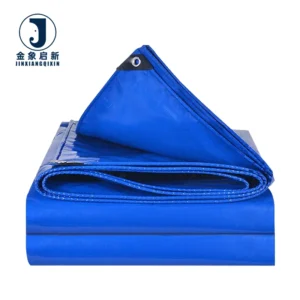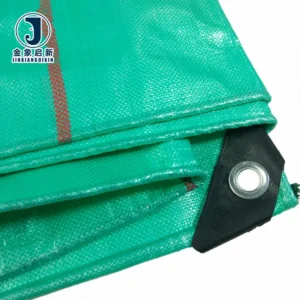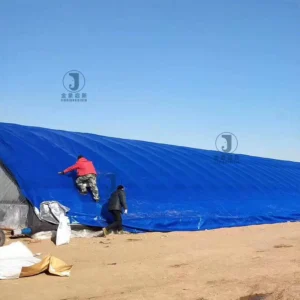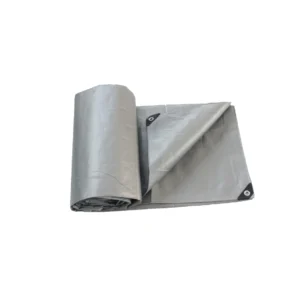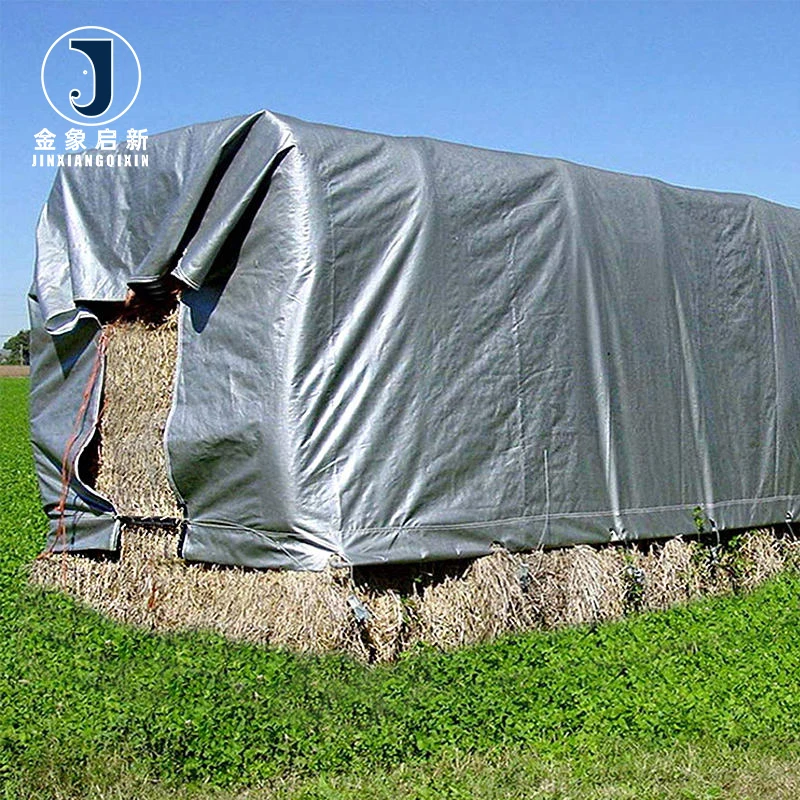
Coated fabric process control — three full production lines with 36 equipment sets manage coating weight and lamination consistency across every PE tarpaulin roll shipped.
Technical Specifications
| Parameter | Value |
|---|---|
| Product Type | PE Tarpaulin Roll |
| Fabric Weight | 45gsm ~ 400gsm |
| Weave Count | 6×6, 8×8, 10×10, 12×12, 14×14 |
| Coating Material | HDPE weaving with LDPE lamination on both sides |
| Thickness | 0.2-0.4mm / 8 mil-16 mil / Custom |
| Roll Width | 6ft, 8ft, 10ft, 12ft or 2m, 4m, 6m |
| Roll Length | 100 yards, 100 meters, or as per buyer’s wish |
| Color | Blue, Blue/Orange, Green, Grey, Black, Clear, Grey/Green, Orange, or any pantone color |
| Flame Retardant | NFPA701 (grade not stated in source) |
| UV Treatment | Available (test basis not stated in source) |
| Hemming Margin | 4cm unless specified |
| Roping | All four sides |
| Eyelets | PC, brass, aluminum; every 3ft or 1 meter interval |
| Corner Guards | PP or PE |
| Gussets | Available for heavy duty tarps |
| Key Features | Waterproof, washable, tear resistant, weather proof, mildew proof, anti-aging |
Application Suitability
| Application | Exposure & Requirement |
|---|---|
| Truck and trailer top covers | Continuous road vibration, wind flex at high speed, rain and grit abrasion |
| Flatbed load protection | Tie-down strap pressure at eyelet points, UV exposure during multi-day transit |
| Side curtain fabric for transport | Repeated rolling and unrolling, flex cracking resistance, colour consistency across panels |
| Oversized or irregular load wrapping | Custom cut dimensions, reinforced stress points at load edges, weather sealing |
Why Generic-Size PE Tarpaulin for Truck and Transport Cover Fails on the Road
A cover cut to a standard rectangle leaves cargo exposed at the exact points where wind and rain enter most.
Fleet operators often order PE tarpaulin for truck and transport cover in generic dimensions that do not match the trailer profile. The result is excess material that flaps at speed, creating drag and accelerating edge wear, while the areas that need full coverage remain open. Welded seams and eyelet lines bear the highest dynamic load during transit, yet generic covers place these stress points in the wrong locations. [NEED_CITE: dynamic load distribution across truck tarpaulin tie-down points during highway transit]
Fitting the Cover to the Trailer Profile
Every trailer model has a distinct roof radius, side rail height, and rear door configuration. A PE tarpaulin for truck and transport cover specified by exact vehicle dimensions eliminates the overhang that catches crosswinds and the gaps that allow spray ingress. Hem lines and eyelet intervals are positioned to align with the trailer’s built-in tie-down rails, so the load is secured at structurally sound points rather than at arbitrary intervals.
Edge Reinforcement Where the Load Flexes Most
The perimeter of a truck cover absorbs the majority of road-induced stress. All four edges of this PE tarpaulin are roped with PP cord inside a 4cm hemming margin, distributing tie-down tension across the full edge rather than concentrating it at individual eyelets. PC, brass, or aluminum eyelets are set at 3ft or 1 meter intervals, and PP or PE corner guards are added at the four corners where strap tension peaks. For heavier loads, gussets reinforce the stress zones that experience the greatest flex cycle during transit. [NEED_CITE: hem and eyelet failure patterns in transport tarpaulins under cyclic wind load]
Reading GSM and Weave Count Together
A 400gsm PE tarpaulin with a 6×6 weave behaves very differently from a 400gsm fabric woven at 14×14. The mesh count defines the number of HDPE yarns per unit area, which governs how the lamination bonds to the base fabric and how the material resists tear propagation. Higher mesh counts produce a tighter weave that limits LDPE strike-through variation and delivers more uniform tear resistance across both warp and weft directions. Thickness from 0.2mm to 0.4mm interacts with weave density to determine how the cover handles abrasion against sharp-edged cargo. Selecting the correct combination of GSM, mesh count, and thickness ensures the PE tarpaulin for truck and transport cover performs under the specific flex and abrasion regime of your fleet’s routes.
What Happens When the Specification Does Not Match the Journey
A transport cover ordered solely on GSM without checking the weave count can delaminate at the edges where the strap tension cycles are most aggressive. Colour drift between rolls becomes visible the moment two panels are installed side by side on the same trailer. If flame retardant treatment is required on site but the grade is not confirmed against the local fire code, the cover fails inspection and the load sits uncovered until a compliant replacement arrives. [NEED_CITE: batch colour consistency tolerance for PE tarpaulin rolls in fleet livery applications]
Why Jinxiang Supplies the Fabric Behind Your Fleet Covers
Three full production lines and 36 sets of professional equipment provide the capacity to fulfil bulk roll orders with consistent lead times. A 10-person R&D team handles custom width, pantone colour matching, and finished cover sizing against specific truck and trailer model drawings. Every production stage includes dedicated QA/QC, culminating in 100% inspection before dispatch so roll count, width, colour, and edge finishing are verified. Nearly 30 years of focused coated fabric production means the lamination adhesion and weave tension parameters are refined from long process history, not trial and error. ISO and CE certified production supports compliance documentation for cross-border fleet operations.
Documentation & Verification
- Material specification sheet stating GSM, mesh count, and HDPE/LDPE coating reference for each roll
- Colour match record against pantone reference with batch-to-batch consistency notation
- NFPA701 flame retardant test documentation where treatment is specified on the order
- Pre-shipment inspection record covering roll width, length, eyelet spacing, and hem finishing
- Roll packing list with individual roll identification for traceability on receipt
Fabrication, Handling & Storage
- Heat-seal HDPE/LDPE lamination at manufacturer-recommended temperature to avoid delamination at seams
- Position eyelets at 3ft or 1m intervals to match trailer tie-down rail spacing before cutting
- Store PE tarpaulin rolls upright on pallets to prevent edge creasing across the 6m width
- Avoid dragging rolls on abrasive surfaces that score the LDPE coating before deployment
- Use mild detergent for cleaning to preserve the LDPE lamination surface integrity
Planning Your Fleet Cover Specification
To move from inquiry to sample, provide the truck or trailer model designation, the operating environment including typical weather and road exposure, and any site-specific fire compliance requirements. Confirm whether roll stock for in-house fabrication or finished cut covers with hemming, roping, and eyelets are needed. Specify the target pantone colour and annual volume so batch consistency and production scheduling can be aligned to your fleet maintenance cycle.
Frequently Asked Questions
Q: How do I verify the GSM of a PE tarpaulin roll on arrival?
A: Request the material specification sheet that states GSM, base fabric weave count, and coating material for your specific order. On receipt, cut a measured sample from the roll and weigh it to confirm the stated GSM. Our pre-shipment inspection records include weight verification per roll before dispatch.
Q: What does the NFPA701 flame retardant option cover for truck tarpaulins?
A: NFPA701 addresses flame propagation for textiles used in public and occupational settings. Confirm the specific grade and test edition required by your local fire safety authority before ordering. We supply NFPA701 test documentation with the roll when this treatment is specified on the purchase order.
Q: How do I provide vehicle dimensions for a custom-fitted truck cover?
A: Send the trailer model designation or a dimensional drawing showing roof radius, side drop, and rear profile. Include tie-down rail positions so eyelet spacing and hem lines are aligned correctly. Our R&D team reviews the drawing and confirms sizing before production begins.
Q: What eyelet and hem reinforcement options are available for high-stress tie-down points?
A: Standard configuration includes PP rope inside a 4cm hem with PC, brass, or aluminum eyelets at 3ft or 1m intervals. Corner guards in PP or PE reinforce the four corners. For heavy duty covers, gussets add material at zones where strap tension and load flex concentrate the highest stress.