Proven process control — nearly 30 years focused on coated fabric production, with dedicated QA at every stage ensuring the 900gsm PVC wash bay containment mat meets its quoted weight before dispatch.
Technical Specifications
| Parameter | Value |
|---|---|
| Product Type | PVC Tarpaulin Wash Bay Containment Mat |
| Material | PVC coated tarpaulin |
| Weight | 900gsm |
| Base Fabric | Plain Woven Warp |
| Edge Design | Foam barriers |
| Surface | Anti-slip |
| Water Resistance | Waterproof |
| UV Treatment | UV Stabilized (test basis not stated — confirm grade for your exposure conditions) |
| Assembly | Custom size available |
| Certification | ISO, CE (verify against manufacturer catalog) |
Application Suitability
| Application | Exposure & Requirement |
|---|---|
| Fleet operator wash bays for trucks and trailers | Constant water exposure, chemical runoff, heavy vehicle traffic, abrasion from tire contact |
| Dealership service garages | Frequent wash-down cycles, detailing chemicals, personnel foot traffic on wet surfaces |
| Industrial maintenance facilities | Spill containment compliance, degreaser exposure, equipment drag across mat surface |
| Mobile detailing operations | Repeated roll-out and roll-up, UV exposure in outdoor settings, portability demands |
Why Generic Tarps Fail Where Containment Mats Must Hold
A PVC Wash Bay Containment Mat for truck and vehicle wash must match the bay footprint precisely, or contaminated runoff escapes at every gap.
Generic tarpaulins shift and puddle under wash-down pressure. Without raised perimeter barriers, water migrates across the shop floor, carrying oils, heavy metals and cleaning chemicals into drains that are not rated for contaminated discharge. I have reviewed wash bay layouts where a standard flat tarp left gaps at the edges, and the resulting cleanup cost exceeded the mat investment within the first quarter. [NEED_CITE: EPA guidelines on wash water runoff containment for fleet maintenance facilities]
Perimeter Foam Barriers That Keep Runoff Contained
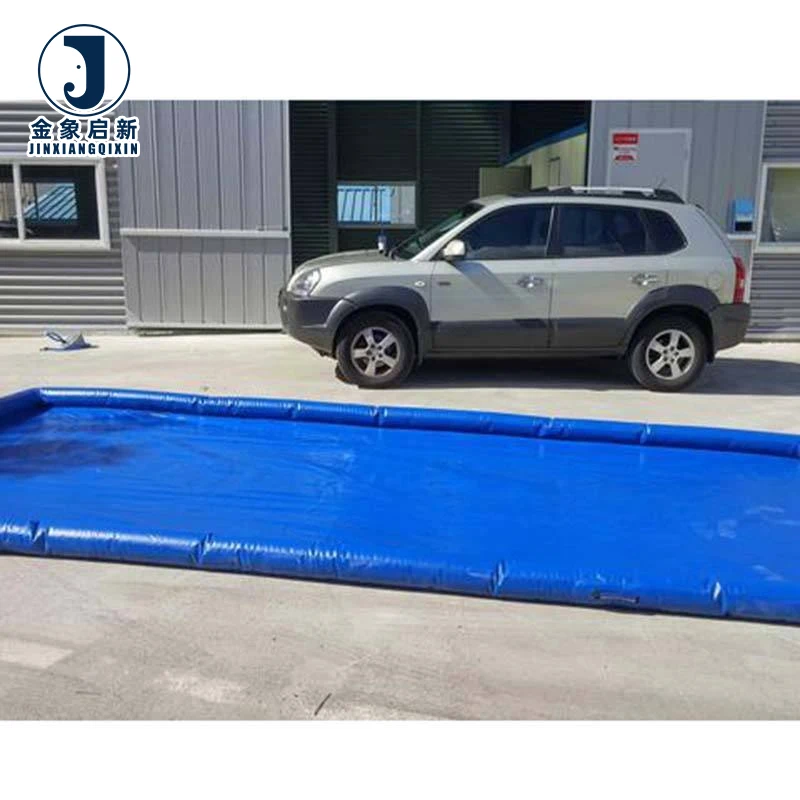
The foam edge barriers on this PVC wash bay containment mat form a raised perimeter that captures wash water and chemical runoff before it reaches the surrounding floor. Unlike flat tarps that rely on gravity and floor slope, the integrated barriers create a defined containment volume across the entire mat surface. This design is critical for truck and trailer wash bays where the volume of runoff from a single vehicle can fill several square metres of floor space.
Anti-Slip Surface for Wet Working Conditions
Personnel handling high-pressure hoses and moving around heavy vehicles need reliable traction. The anti-slip surface texture on this PVC wash bay containment mat maintains grip under continuous water flow and chemical film. This is especially relevant for fleet wash bays where operators work around articulated trailers with limited clearance and heavy equipment that cannot be easily repositioned if a slip occurs. [NEED_CITE: OSHA requirements for slip resistance in vehicle maintenance areas]
Understanding the 900gsm PVC Construction
The 900gsm weight reflects the combined mass of the plain woven warp base fabric and the PVC coating applied to both sides. This GSM level places the mat in the heavy-duty range, suited to withstanding puncture from tools, abrasion from tire contact, and drag from equipment being moved across the surface. The plain woven warp construction provides balanced tensile properties in both machine and cross directions, which matters when the mat is subjected to uneven loads from parked vehicles. The PVC coating delivers full waterproof containment and, where UV stabilization is specified, preserves material integrity in semi-exposed or outdoor wash bay installations. Foam barrier adhesion to the PVC base is a critical junction — if the bond fails, containment is compromised at the perimeter where stress concentrates.
What Happens When Containment Mat Specs Are Wrong
A mat that is too light for daily truck wash traffic will show puncture damage and surface wear within the first season. Foam barriers that lack sufficient height for the bay’s runoff volume will overflow at the edges during peak wash cycles. I have seen operators replace containment mats repeatedly because the quoted GSM did not match the material that arrived on site — the lighter fabric simply could not handle the mechanical stress from heavy vehicle wheels. Batch inconsistency across multiple mats covering a large bay leads to visible surface variation and uneven wear patterns that compromise both safety and professional appearance. [NEED_CITE: common failure modes in industrial PVC containment mats under vehicle traffic]
Why Source This PVC Wash Bay Containment Mat Here
Deep process control over PVC coating weight and adhesion comes from nearly 30 years of focused coated fabric production, ensuring the 900gsm specification is met consistently across every mat produced.
Three full production lines and 36 sets of professional equipment support bulk orders for fleet operators outfitting multiple wash bays without extended waiting periods.
A 10-person R&D team handles custom sizing to match specific wash bay dimensions or trailer footprints, developing samples within days so buyers can verify fit before committing to a full order.
Dedicated QA and QC inspection at every production stage, with 100% pre-shipment inspection, means each PVC wash bay containment mat is checked for barrier adhesion, surface integrity, and dimensional accuracy before dispatch.
ISO and CE certified production processes, with exports to over 20 countries across North America, Europe and Asia, demonstrate compliance familiarity with varied market requirements.
Documentation & Verification
- Weight verification per mat against the stated 900gsm before dispatch
- Material specification sheet stating base fabric type, coating weight, and UV treatment basis
- Pre-shipment inspection record covering barrier adhesion, surface texture, and dimensional accuracy
- Roll and mat packing list with piece count and gross weight for logistics planning
- Certificate of origin and customs documentation for international shipment
Fabrication, Handling & Storage
- Weld seams at foam barrier junctions require calibrated heat settings to bond with the 900gsm PVC coating without scorching
- Custom-cut mats should be unrolled flat before installation to release curl from storage tension
- Store rolls and folded mats upright on pallets to prevent permanent creasing in the PVC coating
- Use mild detergents for cleaning — strong solvents may degrade the anti-slip surface texture over time
- Field repairs on minor punctures can be made with compatible PVC adhesive patches matched to the coating weight
Request a Specification Match for Your Wash Bay
To ensure the PVC wash bay containment mat fits your facility, provide the exact bay dimensions, the heaviest vehicle class washed, and whether the installation is indoor, covered, or fully exposed. If your operation requires multiple mats to cover a large area, include a layout sketch so overlap and seam placement can be planned before production.
Frequently Asked Questions
Q: How is the mat sized to fit a specific wash bay or trailer model?
A: Custom sizing is cut to your exact bay dimensions or vehicle footprint. Provide length, width, and any cut-outs for drains or equipment mounts. For bays requiring multiple mats, we plan overlap zones during the cutting stage so seams align properly and containment continuity is maintained across the entire wash area.
Q: What foam barrier height options are available for different containment volumes?
A: Barrier height is selected based on the expected runoff volume per wash cycle and the mat surface area. Heavier vehicle classes and longer wash routines generate more water, requiring taller barriers. Request a sample section with the proposed barrier height to verify containment capacity matches your operational flow rate before placing a full order.
Q: How do I verify the 900gsm weight claim on delivery?
A: Request a pre-shipment weight inspection record documenting GSM measurement per mat. On arrival, you can independently verify by cutting a measured sample and weighing it on a calibrated scale. Discrepancies between quoted and actual GSM are a common industry issue, which is why we include weight verification documentation as standard with every shipment.
Q: How are seams welded to prevent leakage at high-wear flex points?
A: Seams at foam barrier junctions and mat overlaps are heat-welded using calibrated temperature and pressure settings matched to the 900gsm PVC coating. This creates a continuous bond that resists separation under vehicle traffic and repeated flexing. Inspect weld lines on receipt to confirm full adhesion across the entire seam length before installation.