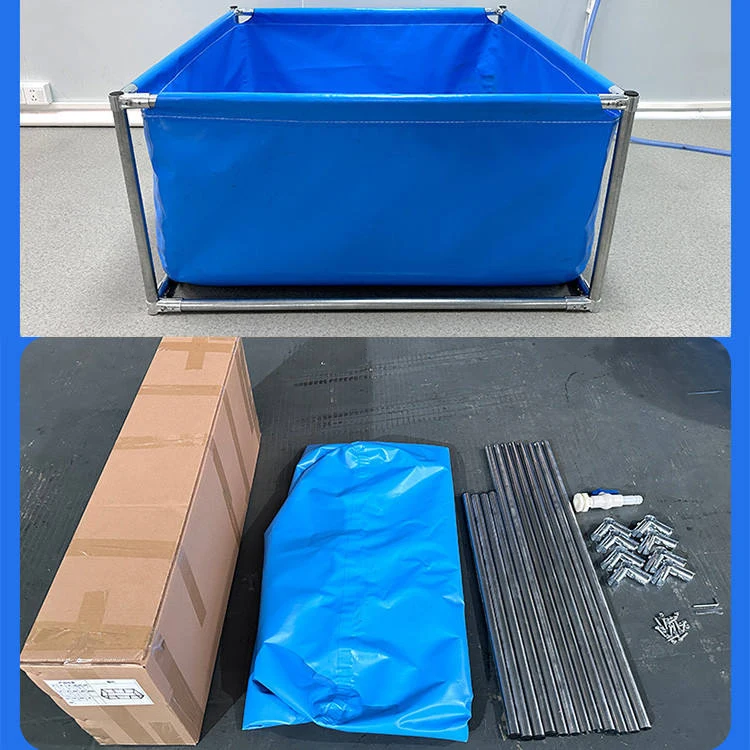
[Deep Process Control Over Coating] — Nearly 30 years focused on coated fabric ensures consistent PVC coating weight and adhesion across every cut panel and roll destined for aquaculture water containment.
Technical Specifications
| Parameter | Value |
|---|---|
| Product Type | PVC Fish Pond Liner |
| Shape Options | Circular / Rectangular |
| Material | PVC Tarpaulin |
| Feature | Foldable |
| Custom Size | Available |
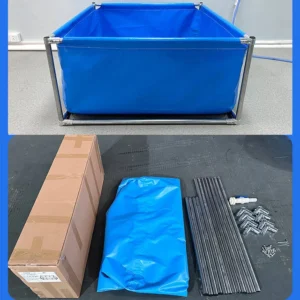
| Color | Blue (as shown) |
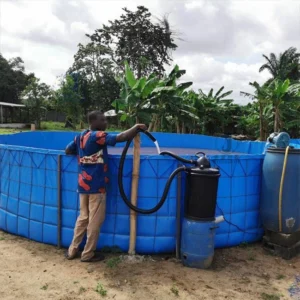
| Application | Fish Tank / Aquaculture Pond |
| Standards | ISO, CE |
| Flame Retardant | Available in flame retardant grades — confirm the grade required for your market |
| Anti-UV | Available with UV treatment — confirm test basis for your region |
Application Suitability
| Application | Exposure & Requirement |
|---|---|
| Aquaculture grow-out ponds | Permanent water contact, biological load, soil chemistry, puncture risk from substrate |
| Hatchery and nursery tanks | Precise dimensional fit, cleanable surface, foldable transport to remote sites |
| Shrimp and prawn ponds | Saline water exposure, high UV in tropical climates, abrasive sediment |
| Agricultural water reservoirs | Long-term water retention, weather cycling, mechanical damage from equipment |
| Live-fish hauling tanks on trucks | Constant flexing during transport, road vibration, rapid deployment and breakdown |
Why Generic Pond Liners Fail at the Seams Before the Fabric Does
Reinforced welded seams are engineered to outlast the base fabric under continuous water pressure and flex load.
When sourcing a PVC fish pond tarpaulin aftermarket supplier, buyers often focus on base fabric weight and overlook the weakest link: the seam. I have seen heavy-grade coated rolls fail at the weld line, precisely where water pressure and load flex concentrate the most stress. A liner might hold water perfectly in the field centre but split along a poorly heat-welded joint within the first filling cycle. The PVC Tarpaulin Fish Pond for Aquaculture must survive not just static water head pressure but the dynamic stress introduced when stock moves, when water levels fluctuate, and when the liner flexes against uneven ground [NEED_CITE: tensile and tear test methods for coated fabrics per ISO 1421].
Foldable Design for Remote Aquaculture Deployment
Transporting rigid tanks to remote fish farming sites adds cost and limits scalability. The foldable PVC tarpaulin fish pond liner in circular and rectangular shapes compresses into compact bundles for container shipping and overland transport to hatchery locations. Once on site, the material unfolds without permanent creasing, allowing crews to position and secure the liner into prepared earthworks or frame structures. This PVC Tarpaulin Fish Pond for Aquaculture configuration reduces freight volume and enables rapid deployment across multiple pond sites within a single farming season.
Circular and Rectangular Configurations for Diverse Pond Layouts
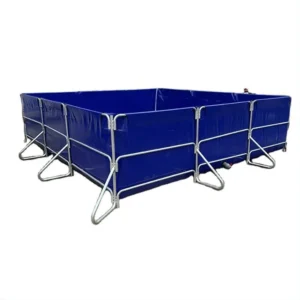
Different aquaculture systems demand different geometries. Circular ponds promote centralised water circulation and waste collection, while rectangular configurations maximise land use in greenhouse or tunnel setups. Each PVC fish pond tarpaulin aftermarket order can mix both shapes within the same shipment, with dimensions confirmed by cut-sheet before production begins. The PVC Tarpaulin Fish Pond for Aquaculture is cut and welded to exact measurements rather than offered in generic stock sizes that leave excess material bunched at the edges or fall short of the bank-to-bank distance.
How Coating Weight and Base Fabric Interact in Water Containment
A liner’s ability to resist puncture and hold water long-term depends on the relationship between base fabric denier, weave density, and PVC coating weight. The base fabric provides tensile and tear strength — higher denier yarns and tighter weaves resist tear propagation when a sharp stone or tool contacts the liner. The PVC coating adds waterproofing, chemical resistance to saline or biologically active water, and protects the yarns from abrasion against the substrate. Coating adhesion to the base fabric determines whether the layers separate under flex stress or remain bonded through repeated filling and draining cycles [NEED_CITE: coating adhesion test methods for PVC coated fabrics]. Heat welding performance also depends on coating formulation — some PVC compounds weld at lower temperatures with stronger peel strength at the joint. Specifying GSM alone without understanding the base fabric construction gives an incomplete picture of how the liner will perform under real aquaculture conditions.
The Hidden Cost of Specifying on Price Per Square Metre Alone
Buyers who select pond liners based on the lowest quoted GSM often discover the material arrives lighter than stated, with coating weight reduced to hit the price point. Batch colour variation between rolls in the same order becomes visible once ponds are installed side by side across a farm — an aesthetic issue that also signals inconsistent coating thickness. More critically, underspecified liners develop pinhole leaks within the first season as the thin coating abrades against the pond substrate. The cost of draining, removing, and replacing a failed liner far exceeds the saving on the initial purchase, not counting the loss of stock if a pond drains unexpectedly [NEED_CITE: common failure modes of PVC pond liners in aquaculture].
Why Aquaculture Operators Source This Liner Here
Deep process control over PVC coating weight and adhesion means the GSM stated on the quotation is the GSM verified on arrival — every roll and cut panel is checked against the material specification sheet before dispatch. Three full production lines and 36 sets of professional equipment support bulk capacity, so a multi-pond aquaculture project receives consistent material across the entire order without batch-to-batch variation. The 10-person R&D team handles custom sizing, developing cut-sheets and samples within days for circular and rectangular pond configurations. Dedicated QA/QC runs at every production stage with 100% inspection before shipment, covering weld integrity, dimensional accuracy, and surface quality. ISO and CE certified production provides the documentation trail that importers and project contractors need for compliance and customs clearance.
Documentation & Verification
- Material specification sheet stating base fabric denier, coating weight, and colour reference for each pond liner
- Pre-shipment inspection record confirming pond dimensions, weld integrity, and surface quality before dispatch
- Test report for UV and flame-retardant grades where applicable, matched to the batch supplied
- Roll packing list with individual liner identification for container loading and site distribution
- Certificate of origin and customs documentation supporting international aquaculture project shipments
Fabrication, Handling & Storage
- Heat-weld seams using temperature and dwell time matched to the PVC coating formulation for maximum peel strength
- Reinforce corners and high-stress points on rectangular ponds with additional PVC patches before filling
- Store folded liners on pallets away from direct sunlight and sharp objects to prevent surface creasing or puncture
- Unfold in ambient temperatures above the material’s cold-flex threshold to avoid coating crack at fold lines
- Clean biological fouling with mild detergent compatible with PVC coating — avoid solvents that degrade the plasticiser
- Field-repair minor punctures with PVC-compatible adhesive patches applied to dry, clean surfaces
Before You Request a Quotation
Provide the exact pond dimensions — diameter and depth for circular ponds, length, width, and depth for rectangular — along with the substrate type the liner will sit on. Specify whether the installation is permanent or seasonal, and whether the site experiences high UV exposure or saline water conditions. Indicate the quantity of each pond size required and whether you need the liners shipped folded for container loading or rolled for wider formats. If your market requires specific flame-retardant or anti-UV certification, state the standard your local authority recognises so the correct grade is quoted from the outset.
Frequently Asked Questions
Q: How is pond size confirmed before cutting to avoid misfit on delivery?
A: Every custom PVC fish pond tarpaulin order is confirmed with a detailed cut-sheet showing all dimensions, seam allowances, and hem details before production begins. The buyer reviews and approves this drawing, ensuring the circular diameter or rectangular length and width matches the prepared earthworks exactly.
Q: What weld and seam reinforcement is applied at high-flex points?
A: Corners on rectangular ponds and the base-to-wall junction on all configurations receive reinforced heat-welded seams designed to handle concentrated stress. Additional PVC patches are applied at points where water pressure and substrate irregularity create the highest flex demand.
Q: How is batch colour consistency maintained across multiple ponds in one order?
A: All liners within a single project order are produced from the same coating batch using the same colour reference. Pre-shipment inspection includes a visual colour comparison across rolls and cut panels to confirm consistency before the PVC Tarpaulin Fish Pond for Aquaculture shipment leaves the facility.
Q: What is the lead time and minimum order for custom pond dimensions?
A: Lead time depends on the quantity and complexity of custom sizes requested. Sample development for new pond dimensions is completed within days. Contact the sales team with your cut-sheet and project timeline for a specific production schedule and minimum order confirmation.
Q: How should the PVC tarpaulin pond be cleaned and repaired in the field?
A: Drain the pond and clean biological buildup with a mild detergent safe for PVC coatings. Rinse thoroughly before refilling. Minor punctures are repaired with PVC-compatible adhesive patches applied to a dry, clean surface — carry a field repair kit for immediate fixes during the farming season.