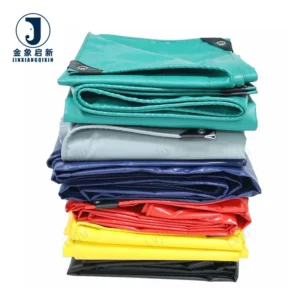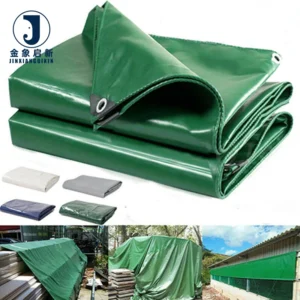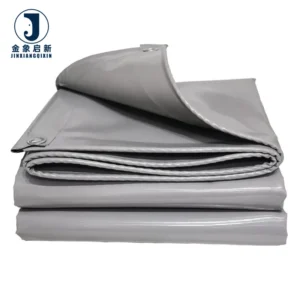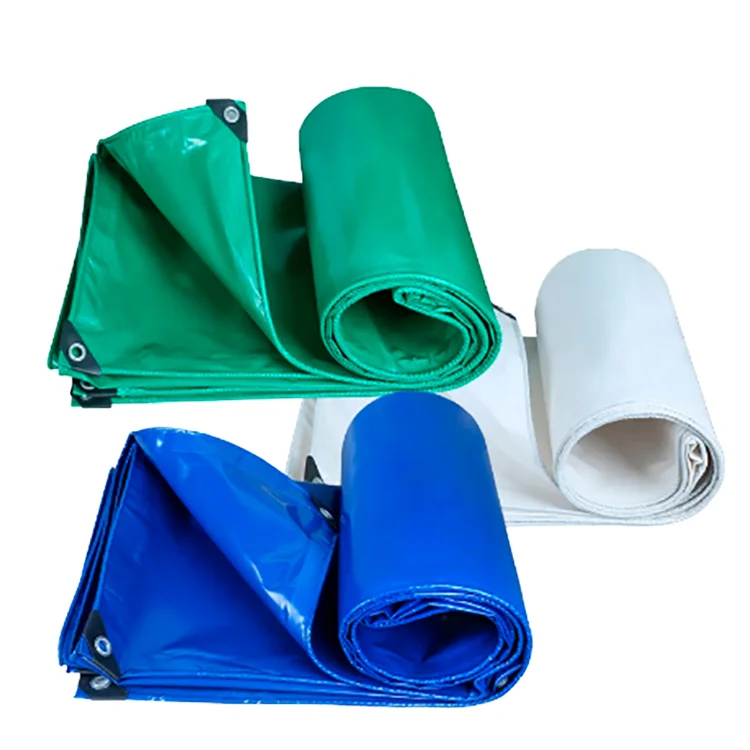
Tricot Base Consistency — Every roll of PVC knife-coated tarpaulin undergoes stage-by-stage coating weight and adhesion control, ensuring the base fabric and PVC bond withstand the flex fatigue and abrasion of daily transport use.
Technical Specifications
| Parameter | Value |
|---|---|
| Product Type | PVC Coated Tarpaulin Fabric |
| Coating Material | PVC |
| Coating Method | Knife Coated |
| Base Fabric | Tricot |
| Weight Reference | 500GSM |
| Surface Style | Plain |
| Waterproof Rating | ≥ 20KPa |
| Flame Retardancy | ≤ 10 seconds (grade not stated in source) |
| Low-Temperature Flexibility | Not fractured at -30°C |
| Anti-Mildew | Mildew proofing stated (test basis not stated in source) |
| Treatment Options | Anti-UV, flame retardant, anti-corrosion (acid, alkali, brine) |
| Standards | ISO, CE |
Application Suitability
| Application | Exposure & Requirement |
|---|---|
| Truck and Trailer Load Covers | Constant flexing at load points, road spray, tie-down abrasion, wind uplift |
| Side Curtain Fabric | Repeated rolling and unrolling, lateral stress, UV and weather exposure |
| Flatbed and Open-Bed Cargo Protection | Direct rainfall, debris impact, extended outdoor staging |
| Transport Equipment Builder Stock | Model-specific cutting, weld seam integrity, batch colour consistency |
Why Generic Sizing Fails Where the Load Flexes Most
PVC knife coated tarpaulin for truck and trailer covers must be cut and reinforced to match the trailer, not the catalogue.
Generic-size covers fail at the exact points where the load shifts during transit — the rear corners, the tie-down contact zones and the flex lines over uneven cargo. When a cover is trimmed from a standard dimension rather than a vehicle-specific pattern, the stress concentrates at the nearest seam or eyelet. Operators running regional and long-haul routes report that weld failures and hem tears appear within the first months of use, almost always at these high-movement zones rather than across the main fabric body. [NEED_CITE: flex fatigue and seam failure patterns in heavy-duty transport covers per ISO 1421]
Cut to the Trailer, Not the Average
A fleet running three different trailer models needs three different cover patterns. The wheel arch clearance, the rear door fold-back radius and the side curtain track profile all vary between manufacturers. Our PVC knife coated tarpaulin is cut from verified patterns matched to your specific trailer dimensions, with hem reinforcement placed at the actual stress points identified during fitment trials rather than at standard intervals.
Reinforcement Where the Road Decides
Tie-down straps cut into fabric that lacks local reinforcement, and the abrasion from road debris concentrates along the lower edge. The tricot base fabric used in this PVC knife coated tarpaulin provides a dense weave structure that resists tear propagation from nicked edges, while the plain surface style allows welded seams to bond with consistent adhesion across the full panel width.
How Coating Weight and Base Fabric Work Together
The relationship between the 500GSM reference weight and the tricot base fabric determines how the material behaves under real transport loads. GSM alone describes the total mass per square metre — both the PVC coating and the polyester base combined — but it does not isolate the base fabric denier or weave density that actually resists tearing. [NEED_CITE: relationship between base fabric denier and tear strength in coated technical textiles per DIN 53354] A knife-coated construction drives the PVC into the interstices of the tricot weave under blade pressure, creating a mechanical lock between coating and yarn rather than a surface lamination. This bond integrity is what prevents delamination at the flex points where a truck cover bends over a shifting load every time the vehicle brakes or corners.
The low-temperature flexibility rating of -30°C means the PVC formulation retains plasticiser stability in cold-climate transit, so the fabric will not become brittle and fracture when flexed below freezing. The waterproof rating of ≥ 20KPa provides a measured barrier against driven rain and road spray, relevant for loads that sit exposed on staging yards before final delivery.
What Happens When Batch Colour Drifts Between Rolls
A fleet replacing covers across twenty trailers will notice immediately if the shade varies from roll to roll once the panels are installed side by side on adjacent vehicles. Colour inconsistency within a single order signals insufficient pigment dosing control during the coating stage and can force a buyer to reject an entire shipment at the destination port. [NEED_CITE: batch colour consistency standards for coated fabrics in transport applications] This is a quality control failure, not a material specification problem, and it is preventable with in-process pigment verification before each roll is wound.
Why Procurement Teams Verify Before Dispatch
Nearly 30 years of coated fabric process control means the coating weight and adhesion on every roll of PVC knife coated tarpaulin is measured at multiple production stages, not just sampled from the first metre of a run. Three full production lines and 36 sets of professional equipment support bulk volume without compressing lead times by skipping QA checkpoints. The 10-person R&D team develops vehicle-specific cutting patterns and reinforcement layouts for fleet clients, producing samples within days so that fitment can be confirmed before the production run begins. A dedicated QA/QC function inspects every roll before it is packed, catching GSM drift, colour shift and seam adhesion issues while the material is still in the facility.
Documentation & Verification
- Weight verification per roll against the stated 500GSM before dispatch
- UV and flame retardant test reports matched to specific production batch
- Material specification sheet confirming tricot base, coating weight and plain surface
- Pre-shipment inspection record covering waterproof rating and flex performance
- Roll packing list with individual roll weight and linear metre count
- Certificate of origin and customs documentation for cross-border transport
Fabrication, Handling & Storage
- Weld temperature profiles must be matched to the 500GSM knife-coated construction to avoid seam delamination at flex points
- Eyelet reinforcement plates distribute tie-down load across the tricot base weave to prevent tear-out under tension
- Rolls stored on pallets in upright position to prevent flat-spot creasing across the full width
- Cold-weather unfolding requires gradual acclimatisation to avoid surface cracking near the -30°C flexibility threshold
- Mild cleaning agents preserve the anti-UV and flame retardant surface treatments on the plain-finish PVC face
What to Include With Your Next Enquiry
Specify the trailer model and year so that cutting patterns can be matched to the actual vehicle geometry rather than a generic size chart. State the operating climate and whether low-temperature flexibility or high UV exposure is the primary concern for your routes. Indicate whether you require rolls of fabric for your own fabrication facility or finished covers with eyelets, hems and reinforcement already applied.
Frequently Asked Questions
Q: How do you verify GSM on arrival matches the quotation for truck tarpaulin orders?
A: Every roll is weighed and measured at multiple stages during production. A pre-shipment inspection record is generated for each order, documenting the actual GSM against the stated specification. This record accompanies the shipment documentation, giving your receiving team a baseline to verify on arrival before the container is unpacked.
Q: Can truck covers be cut and reinforced to fit specific trailer models rather than generic sizes?
A: Yes. Our R&D team develops cutting patterns matched to individual trailer models, including wheel arch clearance, door fold-back radius and side curtain track profiles. Samples are produced within days for fitment trials before the full production run, ensuring reinforcement is placed at the actual stress points.
Q: What eyelet spacing and hem reinforcement options are available for tie-down and flex-point stress?
A: Eyelet spacing and hem reinforcement are specified based on the trailer model and tie-down method used. The tricot base fabric provides a dense weave structure for eyelet retention, and reinforcement patches are welded at identified high-stress zones rather than applied at standard intervals.
Q: How is batch colour consistency maintained across multiple rolls for fleet-wide cover replacement?
A: Pigment dosing is verified in-process before each roll is wound, not only at the start of a production run. A colour reference standard is established for each order and compared against every roll during the pre-shipment inspection, preventing shade variation between rolls in the same shipment.
Q: What flame retardant test documentation is provided for transport covers crossing regional compliance borders?
A: Where flame retardant grades are specified, test reports are provided with the standard cited for that grade. Buyers should confirm the specific grade and test standard required by their operating region at the enquiry stage, so the correct formulation and documentation can be matched to the order.