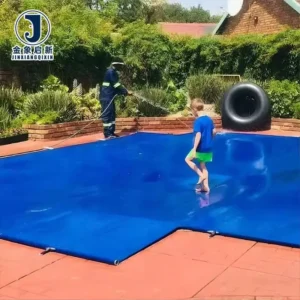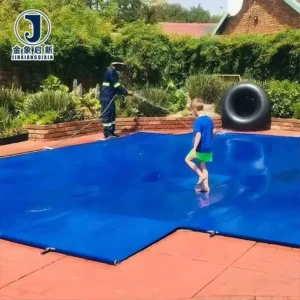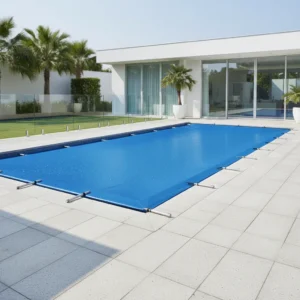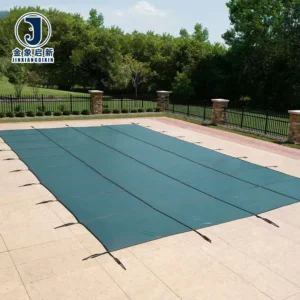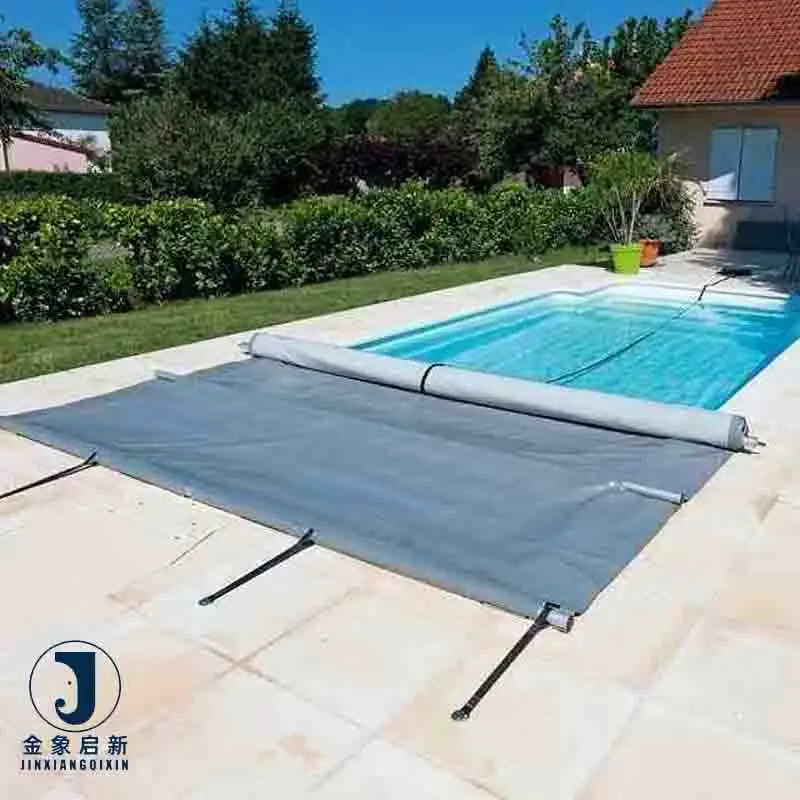
Fabric Integrity Under Load — Knife-coated PVC construction with controlled coating adhesion prevents delamination when pool covers flex under wind uplift and water pooling.
Technical Specifications
| Parameter | Value |
|---|---|
| Product Type | PVC Tarpaulin Pool Cover |
| Material | PVC coated fabric |
| Coating Method | Knife coated |
| Waterproof Rating | Fully waterproof coated construction |
| UV Resistance | UV resistant and anti-aging treatment (test basis not stated) |
| Anti-Mildew | Anti-mildew surface treatment |
| Tear Resistance | High strength and tear resistant structure |
| Weather Resistance | Rain, wind, snow, extreme temperature resistant |
| Custom Size | Available for different pool dimensions |
| Custom Color | Flexible color customization |
| Standards | ISO, CE |
Application Suitability
| Application | Exposure & Requirement |
|---|---|
| Residential outdoor pools | Seasonal debris accumulation, direct UV exposure, standing rainwater on cover surface |
| Hotel and commercial pool facilities | Continuous weather exposure, frequent removal and reinstallation, aesthetic consistency across multiple pools |
| Non-standard pool shapes | Custom-fabricated dimensions, reinforced edge tie-down points, wind uplift resistance |
Why PVC Pool Cover Tarpaulin Weight Verification Matters at Delivery
Stated GSM and actual delivered weight must match — pool covers that arrive lighter than quoted compromise long-term weather resistance.
Buyers sourcing PVC pool cover tarpaulin frequently discover discrepancies between the material specification sheet and the fabric that arrives on site. A cover specified for year-round outdoor exposure requires consistent coating weight to maintain waterproof integrity and structural stability under wind load. When the delivered material falls short of the quoted GSM, the cover becomes more susceptible to tearing at tie-down points and accelerated degradation under UV exposure. This issue surfaces most often with large-format covers for commercial pools, where a marginal weight reduction across a large surface area translates into noticeable performance loss [NEED_CITE: tensile and tear test methods for coated fabrics per ISO 1421].
Covering a Pool Is Like Covering a Moving Load
A pool cover endures a similar stress profile to a transport tarpaulin — except the load is water, wind, and accumulated debris rather than freight. The PVC pool cover tarpaulin must span an open void without underlying support, bearing the weight of pooled rainwater while resisting uplift from crosswinds. Knife-coated PVC fabric provides the tensile continuity needed to handle these multidirectional forces without separating at the coating-to-base-fabric interface. The waterproof barrier must remain intact across the entire surface, because even a small coating defect allows water ingress that accelerates biological growth beneath the cover.
Tie-Down Points and Edge Stress Concentration
The perimeter of any pool cover experiences concentrated mechanical stress at every anchor point. When wind lifts the centre of the cover, the entire load transfers to the edges and tie-down locations. Knife-coated PVC construction supports heat-welded reinforcement patches at these high-stress zones, creating a bonded joint that distributes load across a wider fabric area rather than concentrating it at a single grommet. Covers that fail prematurely almost always fail at these edge attachment points, not across the main field of fabric [NEED_CITE: coated fabric weld strength versus base fabric tensile capacity].
Coating Weight, Base Fabric Density, and Tear Propagation
Understanding how coating weight interacts with base fabric density clarifies why GSM alone does not predict pool cover durability. The base fabric — defined by yarn denier and weave density — provides the structural skeleton that resists tensile and tear forces. The PVC coating adds waterproof protection, UV screening, and surface abrasion resistance, but it cannot compensate for an underweight base fabric. A knife-coated construction method allows precise control over coating thickness on both faces, ensuring consistent weight distribution. High-density base weaves limit tear propagation by forcing any tear to navigate a tighter yarn matrix, while the coating locks the weave in place and prevents individual yarns from pulling out under stress.
The Hidden Cost of Specifying Pool Covers by Price Per Square Metre
Procurement decisions based primarily on unit cost often lead to material substitutions that only become apparent after installation. A PVC pool cover tarpaulin that arrives below the quoted coating weight will show reduced stiffness and increased flexibility — signs that the structural margin has been eroded. In commercial pool installations where multiple covers are deployed across identical pool dimensions, even slight roll-to-roll variation in coating weight produces visible differences in drape and surface tension. Welded seams on lighter material are more prone to peeling under repeated flex cycles, and UV-resistant treatments applied at reduced concentration offer diminished protection against surface cracking [NEED_CITE: coating weight variation effects on welded seam integrity in PVC tarpaulins]. Colour consistency across a multi-cover order also suffers when production runs are split across different coating batches to meet cost targets.
Why Fabrication Expertise Matters for Pool Cover Performance
Ninety-six months of continuous production focus on coated fabric has produced process controls that directly affect pool cover reliability. Three dedicated production lines with specialised knife-coating heads maintain consistent coating weight across wide-format rolls, eliminating the thin spots that cause premature waterproof failure. The ten-member R&D team develops custom-sized pool covers with application-specific edge reinforcement configurations, addressing the exact tie-down geometry of each installation rather than applying a generic hem detail. Pre-shipment inspection covers every cover at completion, with documented weight verification and visual checks for coating defects before packing. Custom colour matching is validated across the entire production run, ensuring that covers installed side by side on adjacent pools present a uniform appearance.
Documentation & Verification
- Material specification sheet confirming coating method, base fabric type, and stated GSM for each pool cover order
- UV and anti-aging test documentation provided where applicable to support weathering performance claims
- Pre-shipment inspection record with weight verification and visual defect check for every cover
- ISO and CE certificates confirming quality management system compliance
- Roll packing list with cover dimensions, colour reference, and quantity for customs and receiving
- Certificate of origin documentation supporting international shipment requirements
Fabrication, Handling & Storage
- Heat-weld seams using temperature settings calibrated for knife-coated PVC to maintain coating adhesion at joints
- Reinforce tie-down points with welded patches sized to distribute load across the PVC-coated base fabric
- Store rolled covers upright on end caps to prevent flat-spot creasing in the coated surface
- Deploy covers at ambient temperature to avoid stress cracking in cold-stiffened PVC material
- Clean with mild detergent solutions compatible with anti-mildew surface treatment to preserve biological resistance
- Repair minor punctures using PVC-compatible adhesive patches bonded to the knife-coated surface
What to Include in Your Pool Cover Enquiry
Provide the exact pool dimensions, including any irregular geometry, so that the cover can be fabricated with appropriate overlap and anchor point placement. Specify the local climate conditions — particularly peak UV exposure and wind load expectations — to guide material weight selection. Confirm whether you require finished covers with welded hems and reinforcement, or roll stock for on-site fabrication. Indicate your colour requirements and whether multiple covers must match across a single installation [NEED_CITE: colour consistency standards for batch-produced PVC coated fabrics].
Frequently Asked Questions
Q: How is the GSM of pool cover fabric verified upon delivery?
A: Every PVC pool cover tarpaulin order is accompanied by a material specification sheet stating the quoted GSM. Pre-shipment inspection includes weight sampling against this documented value. Upon delivery, buyers can conduct independent weight verification by cutting a measured sample from the cover edge and calculating grams per square metre to confirm the received material matches the order specification.
Q: What UV test basis supports the anti-aging claim for prolonged outdoor exposure?
A: UV-resistant and anti-aging treatments are applied during the coating process to protect the PVC surface from solar degradation. The specific test basis for UV resistance should be confirmed at enquiry stage, as different markets require different validation standards. Request documented test results that correspond to your regional compliance requirements before finalising material selection.
Q: Can pool covers be custom-sized for irregular pool shapes?
A: Custom fabrication accommodates non-standard pool dimensions and irregular geometries. Provide accurate pool measurements including any curved edges, step zones, or protruding features. The PVC pool cover tarpaulin is cut and welded to the specified shape with reinforced edge details appropriate for the anchor system being used on site.
Q: How is colour consistency maintained across multiple covers in one batch?
A: Production runs for multiple PVC pool cover tarpaulin units within a single order are scheduled on the same coating line using matched pigment batches. Roll-to-roll colour verification is conducted during pre-shipment inspection, ensuring that covers installed side by side present uniform colour under natural and artificial lighting conditions.
Q: What edge reinforcement options are available for securing pool covers against wind?
A: Edge details are configured based on the tie-down system specified for each installation. The knife-coated PVC fabric supports heat-welded hem reinforcement, welded D-ring patches, and lacing rail attachment configurations. The reinforcement approach is selected based on expected wind uplift loads and the anchor spacing used around the pool perimeter.