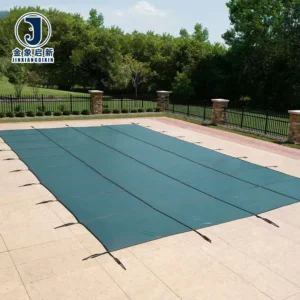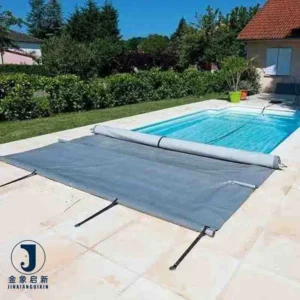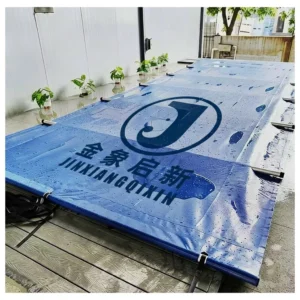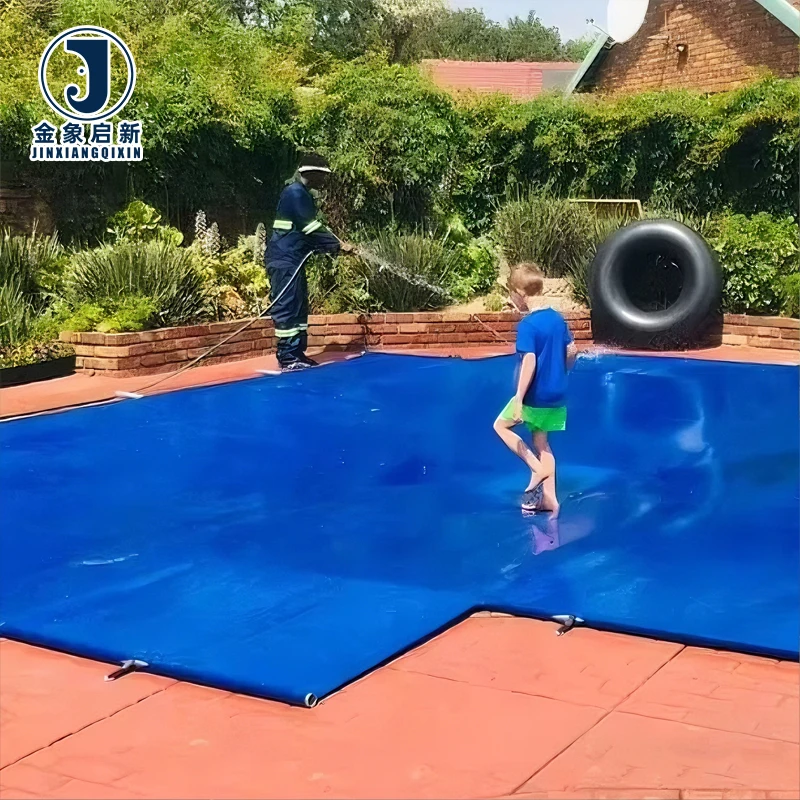
Deep process control over coating weight — verified through dedicated QA/QC at every production stage, ensuring each roll of PVC laminated pool cover tarpaulin meets the stated GSM before it leaves the factory.
Technical Specifications
| Parameter | Value |
|---|---|
| Product Type | PVC Swimming Pool Cover Tarpaulin |
| Base Fabric | High-strength polyester mesh |
| Coating Material | PVC |
| Coating Method | Laminated technology & Hot-melt Coating technology |
| Weight Options | 350 gsm / 420 gsm / 500 gsm / 550 gsm / 600 gsm / 750 gsm |
| Thickness Options | 0.32 mm / 0.35 mm / 0.4 mm / 0.45 mm / 0.5 mm / 0.65 mm |
| Roll Width | 2 m / 2.1 m |
| Roll Length | 75 m / 50 m |
| Color Options | Blue / Red / Yellow / Light blue / Grey (Customized) |
| Waterproof | Yes |
| Key Features | Anti-UV (test basis not stated), Anti-mildew, Anti-static (surface resistance not stated), Cold crack resistance (temperature not specified) |
Application Suitability
| Application | Exposure & Requirement |
|---|---|
| Swimming pool safety cover | Continuous sun exposure, UV degradation, water evaporation control, wind load tension |
| Truck awning and side curtain | Road vibration, constant flexing at load points, weather and moisture exposure |
| Cargo ship and trailer cover | Salt-laden air, heavy rain, tie-down abrasion at hems and eyelets |
| Fish tank and pond liner | Permanent water contact, submersion pressure, aquatic chemistry |
Why Generic Pool Covers Fail Where the Load Flexes Most
A cover that fits loose will fail fast, regardless of how strong the fabric is.
Generic-size covers leave gaps at the edges where debris enters and wind gets underneath, creating a parachute effect that tears the fabric at stress points. For transport applications, the same problem appears when a truck awning or side curtain is cut to a generic dimension rather than the specific trailer model. The PVC laminated pool cover tarpaulin material addresses this through custom sizing, but the real failure point is usually where the cover meets the tie-down hardware. [NEED_CITE: tensile and tear test methods for coated fabrics per ISO 1421]
Fitment Hardware That Matches the Cover to the Structure
Securing a PVC laminated pool cover tarpaulin requires tensioning hardware suited to the pool or trailer geometry. Hook-and-eye systems work for irregular contours where the edge follows a curved or stepped profile. For rectangular pools and flatbed trailers, an aluminium bar encased in a PVC sleeve with a ratchet tensioner pulls the cover taut, distributing the load across the full hem rather than concentrating it at individual eyelets.
Seam Integrity Under Road Vibration and Wind Load
Welded seams on a moving load are tested by constant flexing, not static weight. The hot-melt coating technology used in this PVC laminated fabric creates adhesion between the PVC coating and the polyester mesh base that survives repeated bending. When a truck awning flaps in crosswind or a pool cover lifts under thermal expansion, the weld line absorbs that energy. [NEED_CITE: hot-melt lamination adhesion strength testing for PVC coated polyester]
Reading GSM and Thickness Without Guessing
The weight range from 350 gsm to 750 gsm covers the full product family, and each grade corresponds to a specific thickness from 0.32 mm to 0.65 mm. GSM alone does not determine tear resistance — the denier and weave density of the polyester mesh base contribute equally. A 500 gsm fabric with a high-density base may outperform a 600 gsm fabric with a looser weave when a tear starts at an eyelet. Thickness influences abrasion resistance at contact points where the cover rubs against the pool coping or trailer rail. Coating method matters here: laminated construction typically delivers higher peel strength than simple calendering, meaning the coating resists separating from the base fabric when the material is folded repeatedly. Available in flame retardant grades — confirm the grade required for your market.
The Cost of Overlooking Colour Consistency Across Rolls
When outfitting a fleet of trailers or covering multiple pools at a single resort, colour variation between rolls becomes visible once installed side by side. This is not a cosmetic issue — it signals inconsistent coating thickness across the batch, which often correlates with uneven UV treatment distribution. Covers that fade at different rates require piecemeal replacement rather than a single batch swap, increasing long-term procurement costs. [NEED_CITE: colour fastness testing standards for PVC coated textiles]
Why Sourcing PVC Laminated Fabric Here Reduces Specification Risk
Three full production lines and dedicated equipment handle bulk orders with on-time delivery, whether you need roll stock or finished covers cut to dimension. A 10-person R&D team manages material selection, custom sizing, and sample development, delivering samples within days for transport and pool cover applications. QA/QC inspection at every stage catches GSM deviation and colour drift before the roll ships, not after. Material specification sheets accompany every order, stating exact GSM, base fabric, and coating weight per roll for arrival verification.
Documentation & Verification
- Material specification sheet stating exact GSM, base fabric type, and coating weight per roll
- Colour reference documentation to prevent shade variation across rolls in a single order
- Pre-shipment inspection record confirming roll count, dimensions, and visual consistency
- Certificate of origin and customs support documentation for cross-border shipment
- UV and flame retardant test reports available — confirm the grade required for your market
Fabrication, Handling & Storage
- Hot-air welding at temperatures suited to the laminated PVC coating ensures seam peel strength matches the base fabric tear resistance
- Reinforced hems with double-fold construction distribute tie-down load across a wider area of the 500 gsm and heavier grades
- Store rolls upright on pallets to prevent flat-spot creases that weaken the coating at the fold line
- Cold crack resistant grades maintain flexibility during low-temperature transit — confirm the temperature rating for your route
- Clean with mild detergent; avoid solvent-based cleaners that degrade the anti-mildew treatment on the PVC surface
Specifying Your PVC Laminated Pool Cover Tarpaulin Order
Provide your pool dimensions or trailer model reference, the tensioning system preference, and the GSM grade that matches your exposure conditions. If your market requires specific fire classification or UV stability documentation, state the standard at inquiry stage. Confirm whether you need roll stock or finished covers with hemming and hardware, and request a sample for fitment verification before bulk production.
Frequently Asked Questions
Q: How do I verify the GSM on arrival matches the quoted specification?
A: Request the material specification sheet with your order, which states the exact GSM, base fabric denier, and coating weight for each roll. On delivery, cut a measured sample from the roll and weigh it against the stated value. Dedicated pre-shipment inspection records are provided to confirm weight verification before dispatch.
Q: Can the cover be cut to fit irregularly shaped pools with steps and ledges?
A: Custom contour cutting is available for pools with complex geometry, including steps, ledges, and non-rectangular profiles. Provide detailed dimensions or a site plan at inquiry stage. The hook-and-eye tensioning system is recommended for irregular contours where a straight aluminium bar cannot follow the pool edge.
Q: What is the difference between hook tensioning and aluminium bar systems?
A: Hook-and-eye systems suit irregular pool shapes where the cover edge follows a curved profile. Aluminium bar systems encase a rigid bar in a PVC sleeve, tensioned with a ratchet for rectangular pools and flatbed trailers. The bar distributes load across the full hem, while hooks concentrate force at individual attachment points.
Q: Do you supply UV test reports with the shipment?
A: UV and flame retardant treatments are available across the product family, and test reports can be provided — confirm the specific grade and test standard required for your market at inquiry stage. Stating your compliance requirement upfront ensures the correct treatment is applied and documented before production begins.