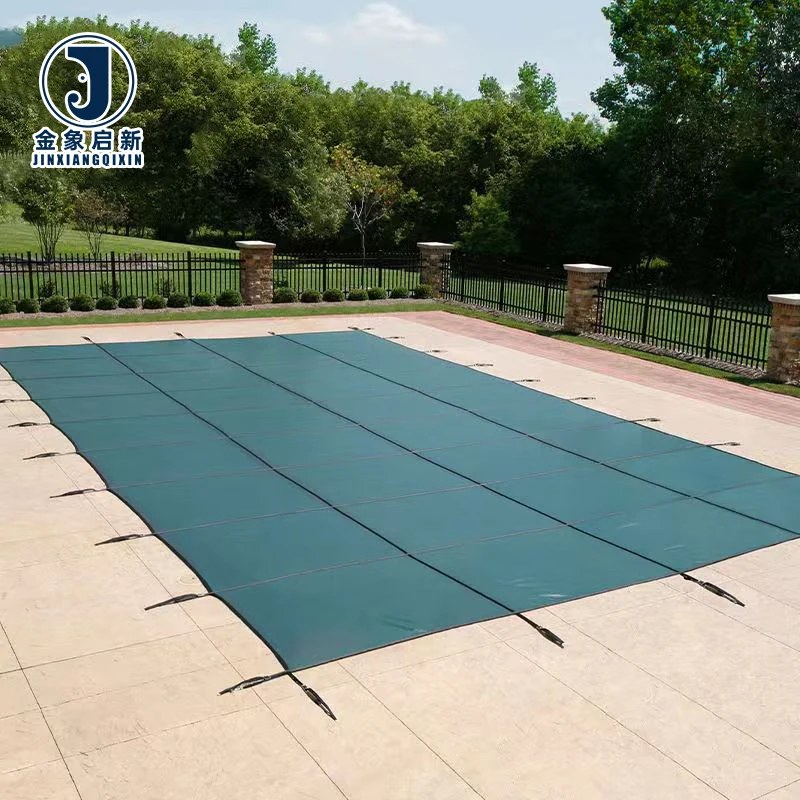
Integrated Pressing Construction — eliminating stitched seams that fail at flex points, this PVC pool cover uses heat-welded joints engineered for sustained tension and weather exposure across seasonal cycles.
Technical Specifications
| Parameter | Value |
|---|---|
| Product Type | PVC Coated Tarpaulin Pool Cover |
| Material | PVC & Polyester |
| Yarn Count | 500D-500D |
| Construction | Integrated pressing (not stitched) |
| Thickness Range | 450-900 g/m² |
| Surface | Smooth and soft with leather-like texture |
| Flame Retardancy | Available in flame retardant grades — confirm the grade required for your market |
| UV Resistance | Available with anti-UV treatment — confirm test basis required for your market |
| Water Resistance | Waterproof, water resistant |
| Repairability | Repairable by hot air welding |
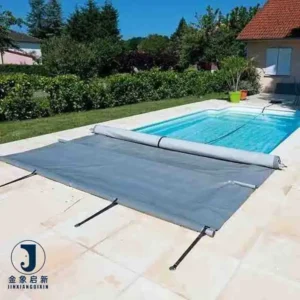
| Installation Option 1 | Brass anchoring system |
| Installation Option 2 | Aluminium battens with stainless steel hook, plate and ratchets |
| Installation Option 3 | Heavy-duty water tube loops every 4 ft |
| Package | Roll packing, bale packing, carton |
Application Suitability
| Application | Exposure & Requirement |
|---|---|
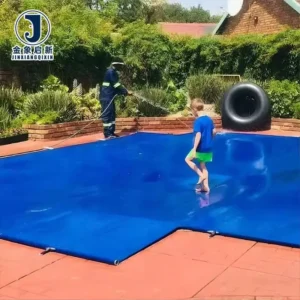
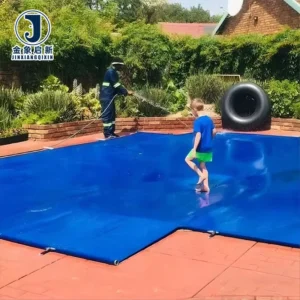
| Residential in-ground pool winterization | Prolonged UV and weather exposure, debris and leaf load, snow accumulation, child and pet safety barrier |
| Commercial and hospitality pool facilities | High-frequency seasonal deployment, rapid tensioning and removal, abrasion from repeated handling |
| Custom-shaped pool covers | Dimensional precision for rectangular, round, and freeform pools, secure perimeter anchoring under wind uplift |
| Pool construction and maintenance contractors | Professional-grade material matching site specifications, consistent batch quality across multiple installations |
Why Coated Fabric Seam Integrity Matters More Than Stated GSM
The weakest point on any pool cover is not the fabric face — it is where the panels join.
Buyers specifying PVC pool cover for truck and transport grade applications know that a cover rated at a certain GSM can still fail prematurely when stitched seams separate under sustained tension or flex load. Integrated pressing replaces needle holes and thread lines with a continuous welded bond, removing the primary failure path that appears after repeated seasonal loading [NEED_CITE: tensile and tear test methods for coated fabrics per ISO 1421]. When the seam outlasts the base fabric, the entire cover performs as a single engineered unit rather than a collection of joined panels.
Eliminating Stitch-Line Failure at High-Stress Zones
Pool safety covers bear concentrated load at perimeter anchor points and across mid-span where wind uplift creates cyclic flexing. Stitched seams introduce needle perforations through the base fabric, creating micro-tear initiation sites that propagate under repeated stress. This PVC pool cover uses integrated pressing to fuse panel joints without penetrating the 500D-500D polyester base, maintaining continuous tensile strength across the entire welded zone. The result is a cover that resists seam separation even when ratcheted tight against winter wind loads.
Three Anchoring Methods for Different Deck Conditions
Secure tie-down is critical for any safety-rated pool cover exposed to seasonal wind and snow load. This PVC pool cover supports brass anchoring systems embedded into concrete or stone surrounds, aluminium battens with stainless steel hooks and ratchets for adjustable tension, and heavy-duty water tube loops positioned every 4 ft for ballast-based restraint. Each method addresses different deck materials and exposure conditions, and the reinforced perimeter construction is designed to distribute anchor loads across the coated fabric without localized tearing [NEED_CITE: anchoring load distribution for tensioned membrane structures].
Reading the Specification Sheet Beyond Weight Alone
GSM indicates total coated weight but does not independently define tensile or tear performance. The 500D-500D polyester base fabric provides the structural skeleton, and the PVC coating on both sides locks the yarn intersections while adding puncture and abrasion resistance. A heavier coating on a lower-denier base may weigh more but tear more easily than a lighter coating on a high-denier weave. The integrated pressing construction further ensures that the panel joints do not become the limiting factor — a cover specified at 450 g/m² with a welded seam can outperform a heavier stitched alternative at the seams where load concentrates. The leather-like surface finish also affects how the cover handles during installation, reducing friction against pool coping and making single-operator deployment practical for residential-scale covers.
The Hidden Cost of Specifying on Weight Without Verification
When GSM stated on a quotation does not match the material arriving on site, the cover may be lighter and thinner than engineered for, compromising both safety rating and service life. A pool cover that is underweight will sag under snow load, pool standing water, and accelerate UV degradation as the coating thins at tension points. Similarly, flame retardant or anti-UV treatments claimed without a supporting test report leave the buyer exposed if local building codes or insurance requirements demand documented compliance. These discrepancies typically surface only after the cover is installed and the first seasonal stress event occurs [NEED_CITE: field failure analysis of coated fabric covers under environmental load]. Batch-to-batch colour variation is another risk when sourcing from suppliers without stage-by-stage QA, producing visible differences when multiple covers are installed across a commercial facility.
Why Fabrication Capability Determines Cover Performance
Deep process control over coating weight and adhesion, developed across nearly 30 years of focused coated fabric production, ensures that the PVC layer bonds consistently to the 500D polyester base at every point across the roll. Three full production lines and 36 sets of professional equipment support volume capacity without compressing lead times on custom-sized pool covers. A 10-person R&D team handles material selection, custom shaping, and sample development, enabling rapid turnaround on non-standard pool geometries. Dedicated QA/QC at every production stage with 100% pre-shipment inspection catches GSM deviation, colour inconsistency, and weld integrity issues before dispatch. The hot air welding repairability of this material means field damage can be addressed on site without full cover replacement, extending practical service life significantly.
Documentation & Verification
- Material specification sheet confirming GSM, base fabric denier, and coating type per roll
- Anti-UV and flame retardant test reports matched to the delivered batch where applicable
- Pre-shipment inspection record documenting weld integrity and dimensional accuracy
- Roll packing list with individual cover identification for multi-unit orders
- Certificate of origin and customs documentation for international shipment
Fabrication, Handling & Storage
- Hot air welding at perimeter seams requires calibrated temperature to avoid coating scorch on the smooth leather-like surface
- Brass anchor points should be reinforced with additional PVC patches welded over the 500D base fabric
- Store rolls horizontally on padded racks to prevent permanent creasing in the 450-900 g/m² coated material
- Deploy at ambient temperature to avoid low-temperature stiffness that increases crease-mark risk during unrolling
- Clean with mild detergent only — solvent-based cleaners may degrade the PVC coating surface
- Field puncture repair by hot air welding with matching PVC scrap, maintaining waterproof integrity
What to Include in Your Enquiry
Provide pool dimensions, shape profile, and surrounding deck material so the correct anchoring method and cover sizing can be specified. Confirm whether anti-UV treatment or a specific flame retardant grade is required for your market or local building code. Indicate annual volume and whether covers are needed as finished cut-to-size units or as roll stock for in-house fabrication.
Frequently Asked Questions
Q: How do I measure my pool accurately for a custom-fit cover?
A: Measure the internal water-line dimensions for rectangular pools, or the maximum diameter for round pools, and add the overlap allowance required by your chosen anchoring system. For freeform shapes, provide a scaled drawing with key radii and straight-run lengths. The fabrication team uses these measurements to cut the 500D-500D base fabric with precision before integrated pressing and perimeter finishing.
Q: What anchoring system works best for high-wind exposure areas?
A: Brass anchors embedded into concrete decking provide the highest pull-out resistance for sustained wind uplift. Aluminium battens with ratchets allow seasonal re-tensioning as the PVC coated fabric relaxes and contracts with temperature cycles. Water tube loops every 4 ft suit locations where deck penetration is not permitted, though they offer lower uplift resistance than mechanical anchors.
Q: How is GSM verified on arrival to ensure material matches specification?
A: Request the pre-shipment inspection record, which documents weight per square metre measured at multiple points across each roll or finished cover. On receipt, cross-check by cutting a measured sample from the roll edge and weighing it against the stated GSM on your material specification sheet.
Q: Can the pool cover be custom printed with branding for commercial facilities?
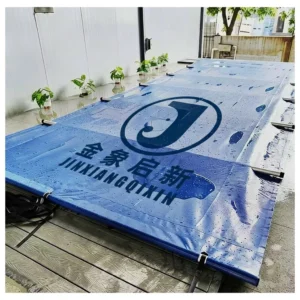
A: Pattern printing and branding are available on the PVC coated surface. Confirm colour references and print area dimensions at enquiry stage so the R&D team can develop a sample showing print adhesion and colour accuracy on the leather-like finish before bulk production proceeds.
Q: What is the procedure for repair if the cover is damaged during use?
A: Punctures and tears in the PVC coated tarpaulin can be repaired on site using hot air welding with a matching PVC patch. Clean the damaged area, apply the patch over the 500D polyester base, and weld at calibrated temperature to restore waterproof integrity without returning the cover to the factory.