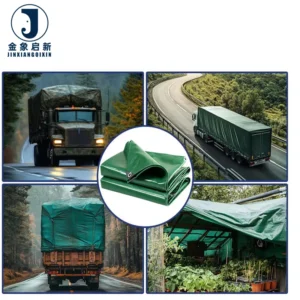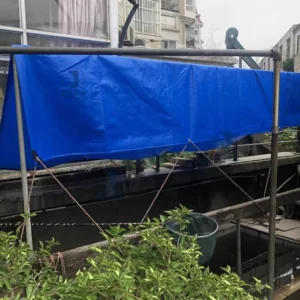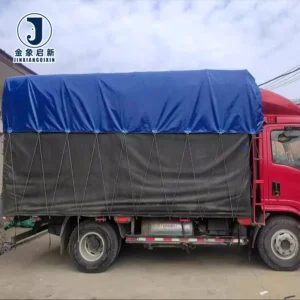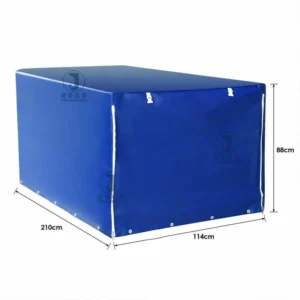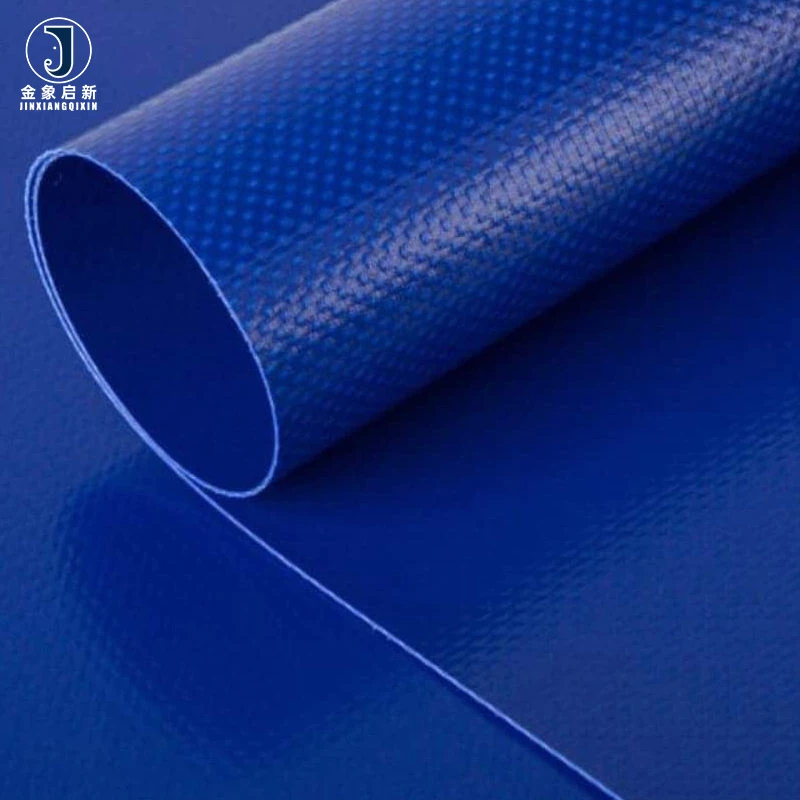
Hot-Melt Coating Adhesion — PVC fusion to high-tenacity polyester mesh prevents delamination when side curtains flex under highway wind load.
Technical Specifications
| Parameter | Value |
|---|---|
| Product Type | PVC Truck Cover |
| Material | PVC + High-strength polyester mesh fabric |
| Weight (GSM) | 350gsm / 420gsm / 500gsm / 550gsm / 600gsm / 750gsm |
| Thickness | 0.32mm / 0.35mm / 0.4mm / 0.45mm / 0.5mm / 0.65mm |
| Roll Size | 2m × 75m / 2.1m × 50m |
| Finish Product Size | Custom items as per customer’s needs or sold by inventory |
| Coating Method | Laminated technology & Hot-melt Coating technology |
| Key Features | Waterproof, Anti-Mildew, Cold Crack Resistance, Sunproof, Color fastness |
| Special Treatments Available | Flame retardant (grade not stated), Anti-Static (resistance not stated), Anti-cold, Anti-mildew, 3P |
| Standards | ISO, CE |
Application Suitability
| Application | Exposure & Requirement |
|---|---|
| Truck side curtain | Constant flexing at load shifts, road debris abrasion, daily tie-down tension cycles |
| Flatbed top cover | Direct weather exposure, pooling water, UV loading across large unsupported spans |
| Tipper trailer enclosure | Abrasive contact with bulk cargo, repeated hydraulic folding stress at hinge lines |
| Fleet branding panel | Consistent colour across multiple vehicles, surface receptivity to pattern printing and graphics |
| Curtain-side trailer OEM build | Roll-to-roll batch consistency, predictable weld behaviour during fabrication |
Why a Generic-Size PVC Truck Tarpaulin Cover for Fleet & Trailer Costs More Than the Fabric
A cover that does not follow the trailer’s actual panel geometry fails first at the seams, not the field.
When a PVC truck tarpaulin cover for fleet & trailer use is cut from a standard rectangle, the excess material flaps in the slipstream. That flapping concentrates cyclic stress at the weld lines and eyelet zones. Within months, the operator is patching or replacing covers that were supposed to last years. The root cause is not the fabric — it is the dimensional mismatch between a generic panel and a trailer that was never perfectly rectangular. Transport equipment builders who specify by trailer model drawing, not by catalogue size, avoid this failure mode entirely [NEED_CITE: seam failure distribution across curtain-side fleets per field inspection records].
Trailer-Specific Pattern Cutting Eliminates the Gap-Overlap Problem
Every trailer model has a distinct opening dimension, radius at the corner posts, and buckle rail height. A PVC truck tarpaulin cover for fleet & trailer cut to that exact pattern seals the load without the slack that causes wind-induced fatigue. The hot-melt coating technology used on this fabric provides strong adhesion between the PVC layer and the high-strength polyester mesh base, which matters because the fabric must survive the tension cycles of a fitted panel without coating separation.
Reinforced Zones Where the Load Moves Most
The stress map of a loaded trailer is not uniform. The zones above the axle line and near the tailgate experience the highest flex amplitude. This PVC coated fabric is available in grades from 350gsm to 750gsm, allowing operators to select a weight that matches the flex demand at each zone without over-specifying the entire panel. Welded seams on this material deliver strong tearing strength at the weld line, which is critical where the fabric folds under ratchet strap tension [NEED_CITE: tearing strength for welding of hot-melt coated fabrics].
How Weight and Weave Interact Beyond the GSM Number
The GSM figure alone does not determine how a truck cover performs under road vibration. The base fabric — high-strength polyester mesh — provides the structural backbone. Its yarn denier and weave density govern tensile load distribution across the panel. A 500gsm fabric with a dense base weave will resist tearing better than a 600gsm fabric where the extra weight comes entirely from heavier coating. The laminated and hot-melt coating technologies each produce different levels of coating-to-yarn adhesion, which directly influences how the panel behaves when it is heat-welded during fabrication. Hot-melt coating typically yields higher peel strength at the weld interface, reducing the risk of delamination along seam lines. Thickness, ranging from 0.32mm to 0.65mm across the available grades, correlates with stiffness and puncture resistance but also affects how easily the fabric folds and drapes around cargo profiles. Choosing a grade means balancing these interacting variables against the specific trailer type and cargo exposure [NEED_CITE: relationship between base fabric density and tear propagation in coated polyester fabrics].
What Happens When the Specification Is Chosen on Price Per Kilogram
Selecting fabric based on the lowest cost per kilogram usually means accepting a lighter coating weight or a looser base weave. The consequence does not appear on the invoice — it appears on the road. Loosely woven base fabric allows tears to propagate rapidly once a puncture starts, often at a tie-down point where the strap edge cuts into the panel. Insufficient coating adhesion causes the PVC layer to separate from the mesh at flex zones after repeated thermal cycling. Fleet operators who have replaced covers prematurely often discover that the replacement cost and vehicle downtime far exceeded the savings on the original material purchase [NEED_CITE: coated fabric replacement frequency versus initial specification grade].
Why Transport Equipment Builders Source This Fabric
Three full production lines and 36 sets of professional equipment provide the bulk capacity to supply an entire fleet build programme from a single production run, maintaining roll-to-roll consistency. The 10-person R&D team handles pattern development, colour matching, and sample fabrication, so custom width and finish product sizing can be confirmed before full production. Dedicated QA and QC at every production stage, with 100% inspection before shipment, catches dimensional deviation and coating defects before the rolls leave the facility. Nearly 30 years of focused coated fabric production gives the team process control over coating weight and adhesion that is difficult to replicate in a generalist operation. Samples for custom colour, size, or treatment requirements are developed within days, allowing fleet operators and OEM builders to validate the material before committing to volume.
Documentation & Verification
- Material specification sheet stating verified GSM, base fabric type and coating weight for each roll
- Pre-shipment inspection record confirming finish product dimensions match the trailer model drawing
- Colour consistency report across rolls within the same production batch
- Test documentation for flame retardant or anti-static treatments where specified for the order
- ISO and CE certificates covering the production facility and management systems
- Certificate of origin and customs documentation for cross-border shipment
Fabrication, Handling & Storage
- Heat-weld parameters must match the selected GSM and coating method — hot-melt coated grades require different temperature settings than laminated grades
- Reinforce tie-down zones with additional PVC patches before welding eyelets into 600gsm or 750gsm panels
- Store rolls upright on pallets to prevent creasing that becomes permanent on 0.5mm and thicker grades
- Allow cold-stored rolls to reach ambient temperature before unrolling to avoid cold crack damage
- Use mild detergent only on anti-mildew treated surfaces to preserve the treatment’s effectiveness
- Cut panels from the same roll batch for one trailer to maintain colour uniformity across adjacent panels
What to Include in Your Enquiry
Provide the specific trailer model designation, panel dimensions, and the number of vehicles in the fleet or build batch. Specify any fire-retardant or anti-static compliance requirements for your operating region. Indicate colour preference, whether finished covers or roll stock is required, and whether sample panels are needed for fitment verification before full production.
Frequently Asked Questions
Q: How do you ensure the cover fits my specific trailer model and not just a generic size?
A: We work from the trailer model drawing or physical measurements you provide. Each PVC truck tarpaulin cover for fleet & trailer is cut to those exact dimensions, including corner radii and buckle rail positions. Pre-shipment inspection verifies the finished panel against the agreed drawing before dispatch, so the cover seals the load without excess slack or short-fall at the edges.
Q: GSM stated on the quotation versus actual weight on arrival — how is this verified?
A: Every roll undergoes weight verification against the stated GSM during pre-shipment inspection. The inspection record accompanies the shipment, documenting the actual measured weight per square metre. This eliminates the common problem where the material arriving on site is lighter than what was quoted, a frequent complaint across the coated fabric supply chain.
Q: How do you maintain colour consistency across multiple truck covers for one fleet?
A: Rolls for a single fleet order are produced in one batch run, and colour consistency is checked roll-to-roll before packing. This prevents the visible colour variation that appears when covers from different production runs are installed side by side on adjacent vehicles. A colour report is included in the shipment documentation.
Q: What prevents welded seams from failing at high-flex points during transit?
A: The high-strength polyester mesh base fabric combined with hot-melt coating technology produces welds with strong tearing resistance at the seam. Flex-point zones are identified from the trailer model layout, and weld parameters are adjusted for the specific GSM grade. Welded seam samples can be provided for your testing before full production begins.
Q: What lead time should I expect for custom sizing, colour, and reinforcement?
A: Custom orders require sample approval before bulk production. Lead time depends on the number of distinct panel sizes, colour requirements, and whether flame retardant or anti-static treatments are specified. Confirming these details at enquiry stage allows us to provide an accurate production schedule for your fleet delivery timeline.