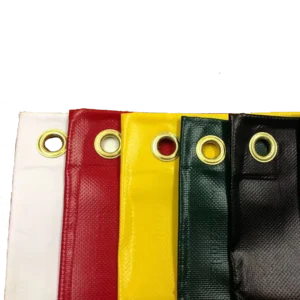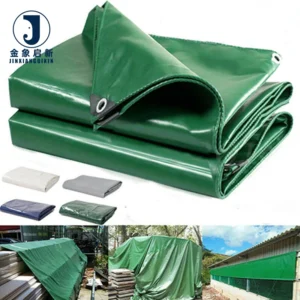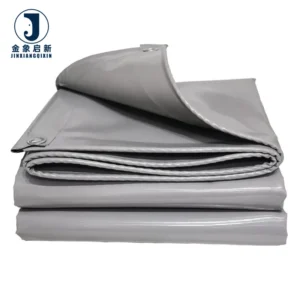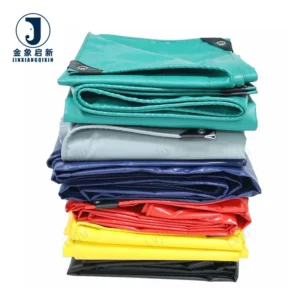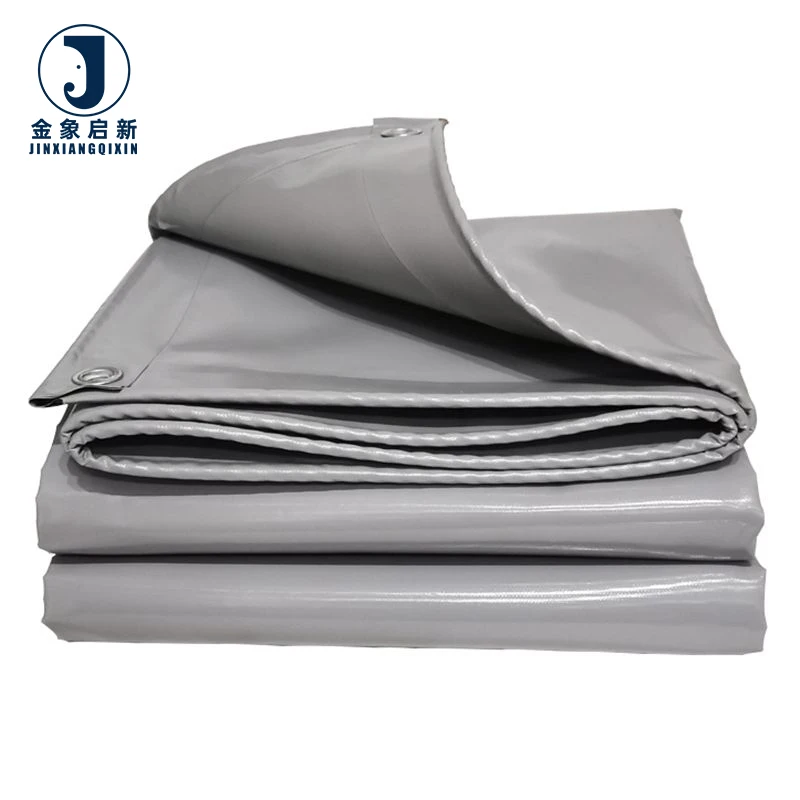
Precision Coating Control — Every roll of PVC knife-coated tarpaulin is verified against the stated GSM before dispatch, ensuring the material arriving at your dock matches the specification on your purchase order.
Technical Specifications
| Parameter | Value |
|---|---|
| Product Type | PVC Knife-Coated Tarpaulin |
| Weight (GSM) | 500 to 800 g/m² (confirm the grade for your application) |
| Coating Method | Knife coated |
| Coating Material | PVC |
| Waterproof Rating | Anti-permeable ≥ 20 KPa |
| Flame Retardant Grade | ≤ 10 seconds (grade not stated — confirm the standard required for your market) |
| Low-Temperature Flexibility | Will not fracture by pliers at -30 °C |
| Anti-Corrosion | Acid, alkali and brine corrosion resistance |
| Mildew Resistance | Mildew proofing properties stated (test basis not stated) |
| UV Treatment | Anti-UV (test basis not stated — request test report where required) |
| Seaming Method | High-frequency heat combined welding |
| Tensile Strength | High tensile strength (test basis not stated) |
| Water Absorption | Almost no absorbable water, dries quickly after rain |
Application Suitability
| Application | Exposure & Requirement |
|---|---|
| Flatbed and curtain-side trailer covers | Road vibration, driving rain, tie-down abrasion at flex points, daily UV exposure |
| Truck tarpaulin replacement fabric | Constant mechanical stress from load movement, highway wind load, repeated folding and unfolding |
| Heavy machinery and oversized load covers | Point loading from sharp edges, prolonged outdoor storage, requirement for reinforced hems and tie-down points |
| Side curtain fabric for transport equipment builders | High-frequency welding compatibility, colour consistency across fleet orders, dimensional stability under tension |
Why Generic-Size Truck Covers Fail on Specific Trailer Models
A cover cut to a generic rectangle will never seal properly against a trailer built to a specific chassis dimension.
Fleet operators who order off-the-shelf truck tarpaulins frequently discover gaps at the corners, excess material that flaps in highway wind, and edge hems that bear the full load of tie-down straps without adequate reinforcement. The PVC knife-coated tarpaulin you specify must be cut and welded to the exact vehicle dimensions of your trailer model. When covers do not fit, the resulting stress concentration at poorly positioned eyelets causes premature tearing, and cargo is left exposed to road spray and weather. [NEED_CITE: fleet tarpaulin replacement frequency tied to fitment accuracy]
Seaming Integrity Where the Load Flexes Most
The weakest point on any truck cover is not the fabric itself but the joint where two panels meet. High-frequency heat combined welding produces a seam that is water-tight and will not crack under the repeated flexing that occurs when a loaded trailer moves over uneven road surfaces. This PVC knife-coated tarpaulin uses welded seams rather than stitched-and-taped joints, eliminating the needle holes that become leak paths after sustained highway driving in wet conditions.
Waterproof Performance Under Road Spray Conditions
Driving rain and road spray hit a moving truck cover at angles and pressures that static installations never experience. The anti-permeable rating of ≥ 20 KPa means the PVC knife-coated tarpaulin resists water penetration under sustained pressure, keeping cargo dry across long-haul routes in wet climates. Combined with the near-zero water absorption characteristic, the fabric sheds water quickly and dries rapidly, reducing the weight penalty and mould risk that plague absorbent cover materials during multi-day transit.
Reading the Specification Sheet Beyond GSM
GSM alone does not determine how a truck cover performs under tie-down tension. The base fabric denier and weave density work together with the PVC coating weight to produce the final tensile and tear values. A knife-coated construction locks the coating into the base fabric structure, delivering higher peel strength than laminated alternatives — a critical factor when welded seams are subjected to repeated flex cycles. [NEED_CITE: tensile and tear test methods for coated fabrics per ISO 1421] The low-temperature flexibility rating of -30 °C ensures the fabric remains pliable in cold-chain transport and winter routes, preventing the brittle cracking that rigid-coated materials suffer when folded in freezing conditions. Corrosion resistance to acid, alkali, and brine further extends service suitability for routes through industrial zones and coastal environments where salt spray is constant.
The Hidden Cost of Specifying on Price Per Kilogram Alone
When procurement decisions focus solely on unit cost, the material that arrives is often lighter than what was quoted — a lower GSM than agreed, with thinner coating that compromises waterproof integrity and seam weldability. Colour variation between rolls in the same fleet order becomes visible once covers are installed side by side on adjacent trailers, forcing a full replacement cycle. Welded seams that fail before the fabric does leave cargo exposed at the exact point where road vibration concentrates the most stress. [NEED_CITE: coating weight variance and its effect on welded seam peel strength] These failures do not appear on the quotation but show up on the roadside.
Why Fleet Operators Source This PVC Knife-Coated Tarpaulin Here
Three full production lines and 36 sets of professional equipment support bulk capacity with reliable on-time delivery, so fleet rollout schedules are not delayed by fabric shortages. A dedicated 10-person R&D team handles custom sizing against specific trailer model dimensions, ensuring each cover is cut to fit rather than adapted from a generic pattern. Quality control is applied at every production stage with 100% inspection before shipment, catching GSM deviations and colour inconsistencies before they reach your dock. Samples for custom requirements are developed within days, allowing fleet operators to verify weld behaviour, colour, and finish before committing to a bulk order.
Documentation & Verification
- Material specification sheet stating GSM, base fabric denier, and coating weight for each roll
- Pre-shipment inspection record verifying actual weight matches the quoted specification
- Test report for UV and flame retardant grades where applicable to your market requirements
- Roll packing list with individual roll weights and dimensions for receiving verification
- Certificate of origin and customs documentation for cross-border fleet procurement
Fabrication, Handling & Storage
- Set high-frequency welder parameters to match the PVC coating thickness of the selected GSM grade for consistent peel strength
- Reinforce hem edges at tie-down points with additional PVC strip layers to distribute strap load across the knife-coated surface
- Store rolls upright on end caps to prevent flat-spot deformation of the coated fabric surface
- Allow cold-stored rolls to reach ambient temperature before unrolling to avoid cracking at -30 °C flexibility threshold
- Use mild detergent and soft brush for cleaning to preserve the anti-UV and mildew-resistant surface treatment
- Plan cutting layout to minimise cross-grain seams on curtain-side panels where flex cycling is most severe
Preparing Your Enquiry for Truck and Trailer Cover Fabric
Provide the exact trailer make, model, and year so that covers are cut to verified dimensions rather than generic estimates. Specify the operating environment — highway long-haul, cold-chain, coastal, or mining haul road — so that the correct GSM grade and treatment package are recommended. Indicate whether you require finished covers with eyelets and reinforced hems or roll stock for in-house fabrication.
Frequently Asked Questions
Q: How do you verify GSM on arrival matches what was quoted?
A: Every roll undergoes pre-shipment inspection where actual coating weight is measured and recorded against the stated specification. An inspection report accompanies each dispatch, listing the measured GSM per roll. This eliminates the common problem of material arriving lighter than agreed and ensures the PVC knife-coated tarpaulin meets the tensile and waterproof performance your fleet requires.
Q: What eyelet spacing and hem reinforcement options are available for tie-down systems?
A: Eyelet spacing is configured to match the tie-down rail pattern of your specific trailer model. Hems are reinforced with additional PVC strip layers heat-welded over the edge to distribute strap tension. Spacing and reinforcement specifications are confirmed during the sample approval stage before bulk production begins.
Q: How do you ensure welded seams hold up at high-flex points during transport?
A: High-frequency heat combined welding fuses the PVC coating layers into a continuous joint that is water-tight and crack-resistant. Weld parameters are calibrated to the specific GSM grade being fabricated. Seam samples are tested during production to verify peel strength at the flex zones where load movement concentrates the most stress on truck covers.
Q: Can covers be cut to fit specific truck and trailer models rather than generic sizes?
A: Yes. Covers are cut to the exact vehicle dimensions of your trailer make and model, not from a generic template. This ensures proper edge sealing, correct eyelet alignment with your tie-down system, and eliminates excess material that causes wind flap and premature edge wear during highway transit.
Q: How do you control colour consistency across multiple covers in the same fleet order?
A: All rolls for a single fleet order are produced in the same batch run and checked for colour uniformity before dispatch. Rolls are compared side by side under standardised lighting to detect any variation. This prevents the visible colour mismatch that occurs when covers from different production batches are installed on adjacent trailers.